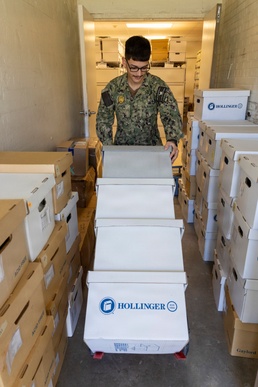
PENSACOLA, Fla.– In an effort to preserve regional history and cultural heritage, volunteers from Naval Air Station (NAS) Pensacola and the University of Georgia (UGA) teamed up to transfer more than 900 boxes of archaeological artifacts and records from the installation to the university, Aug. 12.
The initiative, spearheaded by the NAS Pensacola Public Works Department, is designed to enhance the curation, analysis, and long-term protection of the Navy's historical collections.
Carrie Williams-Hannah, NAS Pensacola’s Cultural Resources Manager, secured funding to correct deficiencies in the installation's previous curation program. The resulting contract, awarded to UGA, covers comprehensive artifact processing, analysis, collection rehabilitation, and database entry.
“Maintaining the artifact collection is about preserving institutional history, protecting cultural and scientific heritage, supporting research and scholarship, maintaining provenience and context, educating the public, supporting the Navy’s mission, preserving information for future generations, demonstrating responsible stewardship and protecting against loss of knowledge,” Williams-Hannah said. “Beyond compliance with the laws and regulations, it is about preserving evidence, knowledge, history, and public heritage that the federal government has been entrusted to protect.”
The UGA team previously conducted a site visit in April to inspect the extensive collection and prepare for its safe transport.
The transferred materials include excavated remains gathered during various archaeological surveys and studies of prehistoric and historic resources on the installation, along with their associated records. Additionally, extra copies of investigation reports and documentation will be scanned for modern electronic access.
The permanent transfer to UGA brings NAS Pensacola into full compliance with the federal regulation governing the curation of federally owned or administered archaeological collections, offering multiple strategic benefits to the Navy.
“This contract will also provide the Navy with a database of all artifacts recovered from NAS Pensacola which will advise the Navy of all items in the collection, provide information on artifacts requiring stabilization and/or conservation, and render the data more accessible for management and research,” Williams-Hannah explained.
She also noted the strategic geographic benefit of the move. “Further, the relocation of the artifacts farther inland will keep the material out of harm's way in the event of adverse weather occurrences,” she said.
While the collection is permanently moving to the university, ties to the local community will remain intact. “Yes, it is permanent, but we will still loan artifacts to our local partners in preservation and history via UGA,” Williams-Hannah added.
The sheer scale of moving over 900 boxes required significant manpower, leading to a massive joint volunteer effort. Navy personnel, civilian staff, and university representatives worked side-by-side to accomplish the heavy lifting.
“A huge thank you to the volunteers,” Williams-Hannah said following the load-out. “If not for them, we would still be loading artifacts!”
Founded in 1826, Naval Air Station Pensacola, known as the “Cradle of Naval Aviation,” supports operational and training missions for several tenant commands, Naval Air Technical Training Center, Naval Aviation Schools Command and Center for Technical Training. The installation also hosts Marine Aviation Training Support Group 21 and Marine Aviation Training Support Group 23 and serves as the headquarters for Naval Education and Training Command. In addition to an active airfield, NAS Pensacola maintains a deepwater port supporting operations for the U.S. Coast Guard.