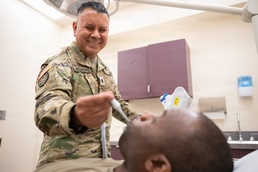
FORT BELVOIR, Va. — U.S. Army Reserve medical personnel worked alongside active-duty service members at military treatment facilities in the National Capital Region during the Medical Readiness Skills Sustainment Program, using their annual training period to maintain occupational skills and operate within joint-service medical environments.
The training placed personnel from the Pinellas Park, Fla. based Army Reserve Medical Command and its supported formations at the Alexander T. Augusta Military Medical Center at Fort Belvoir and DiLorenzo Pentagon Health Clinic in Arlington, Va. The program integrates Reserve medical personnel into operational Defense Health Agency facilities where they perform duties associated with their military occupational specialties and areas of concentration alongside active-duty personnel.
“The Medical Readiness Skills Sustainment Program is a strategic partnership between the Army Reserve Medical Command and local Defense Health Agency facilities in the National Capital Region,” said Master Sgt. Raheem Scott, MRSSP-MIL (military) noncommissioned officer in charge and brigade mobilization officer for the Northeast Medical Area Readiness Support Group, headquartered in Staten Island, New York.
Scott said NE-MARSG has conducted the training in the NCR for more than 10 years, and Reserve medical personnel receive hands-on training in active medical facilities.
Scott said. “For the Reserve Soldiers, they're provided real-world, hands-on MOS (military occupational specialty), AOC (area of concentration) enhancement training alongside their active-duty counterparts.”
At ATAMMC, Master Sgt. Daniel Saurwrein, the hospital's senior clinical noncommissioned officer, serves as a liaison between the facility, AR-MEDCOM and the medical area readiness support groups sending Soldiers to the National Capital Region for training.
“My overall role in the MRSSP is to interface with the liaisons and AR-MEDCOM and the Northeast [MARSG], as well as the subsequent agencies like Southeast [MARSG], Central [MMARSG], to bring their Soldiers here to our facility and, of course, to our outlying clinics, DiLorenzo Pentagon Health, and help the process go a little bit more smoothly,” Saurwrein said.
The NCR iteration of MRSSP-MIL uses multiple rotations. Scott said the program averages between 20 and 40 Soldiers per rotation.
The current training also places additional emphasis on matching individual Soldier requirements with capabilities available at the participating medical facilities.
“Key differences from previous iterations of this program has been the integration of the Logan Dental Clinic, and also truly getting after individual critical task lists based on the capabilities of the facilities that the Soldiers will be falling in on,” Scott said.
For some Army Reserve Soldiers, civilian employment does not align with their military occupational specialty, limiting how frequently they perform those skills outside of military service. MRSSP-MIL provides an environment where those personnel can return to clinical duties and practice tasks associated with their military assignments.
Saurwrein said the rotations increase the focus on training for Soldiers who may not regularly have access to the same clinical opportunities at their home units. He also said the teaching-hospital environment requires permanent-party personnel to maintain their own skills as they train incoming Reserve personnel.
“Some of the key benefits to having the Army Reserve Soldiers here during these rotations have been the increased focus on training,” Saurwrein said.
Staff Sgt. Eric Roman, a 68Q pharmacy specialist assigned to the 7409th Troop Medical Clinic in Charlotte, North Carolina, works in private security in his civilian career. His annual training assignment placed him in the pharmacy at the Pentagon.
“A lot of the Soldiers don't actually practice the MOS outside,” Roman said. “So they give the Soldiers a really good opportunity to get some hands-on experience and some training to learn their job.”
Roman said battle assemblies do not always provide an environment where pharmacy specialists can routinely perform occupation-specific tasks. Working in a functioning pharmacy allowed him to return to systems and procedures he had previously used.
“A lot of this is a refresher and it's great to start remembering how to do things again and get some hands-on training,” Roman said.
That sustainment training extended across multiple medical specialties.
At ATAMMC, Staff Sgt. Alexandria Rodriguez, a 68W combat medic with AR-MEDCOM, spent her annual training working with emergency department personnel. Rodriguez previously served nine years on active duty and worked as a flight paramedic before transitioning to the Army Reserve. She is also completing nursing school.
The assignment allowed Rodriguez to apply both sets of skills while participating in patient interventions and hospital rapid responses and observing nursing procedures.
Rodriguez said clinical staff provided supervision when she encountered unfamiliar equipment or procedures while also allowing her to perform skills independently as she became comfortable with them.
“It's the perfect amount of autonomy, but also support for the things that you're here to relearn, the things that you're not doing every single day,” Rodriguez said.
Saurwrein said integrating Reserve personnel for short rotations also requires permanent-party staff to account for patient care while simultaneously training personnel who are new to the facility's procedures.
“We not only have to worry about the patients and their safety and their medical care,” Saurwrein said.
“But we also want to take advantage of this time that we get to pour back into the Reserve component.”
While clinical repetition supports individual medical readiness, MRSSP-MIL also places Army Reserve personnel in facilities staffed by members of multiple military services, requiring participants to work within organizations whose systems and procedures may differ from those used by their home units.
At the Pentagon, Sgt. Freddy Aguilar, a 68A biomedical equipment specialist assigned to the 354th Medical Company in Seagoville, Texas, worked alongside Navy biomedical equipment personnel while gaining experience with equipment he does not routinely encounter in his civilian position.
Aguilar said his civilian biomedical work primarily involves equipment used in operating rooms and other clinical settings, while the Pentagon assignment exposed him to dental equipment and military-specific processes.
Working alongside Hospital Corpsman 2nd Class Paul Aguipo, assigned to Navy Medicine Readiness and Training Command, Fort Belvoir, also demonstrated how personnel from different services could exchange technical knowledge despite differences in their administrative and maintenance systems.
During preventive maintenance on a vaccine refrigerator supporting an immunization clinic, Aguipo said Aguilar helped troubleshoot the equipment, identify a faulty display battery and locate the information needed to order a replacement.
“Sgt. Aguilar just displayed so much information and adaptability when it comes to actually PMing (preventative maintenance) and troubleshooting the equipment,” Aguipo said.
The exchange worked in both directions. Aguilar observed similarities between Army and Navy biomedical maintenance while also encountering differences in how the services document their work.
Army Reserve dental personnel experienced similar integration with Air Force staff at the Pentagon.
Spc. Jovanie Vargas, a 68E dental specialist assigned to the 7222nd Medical Support Unit in Tampa, Florida, works as a correctional officer in his civilian career. During MRSSP-MIL, he returned to a clinical environment and worked alongside Air Force dental personnel.
Tech. Sgt. Holly Layuyu, an Air Force dental assistant assigned to the Bolling Medical Squadron, of Joint Base Anacostia-Bolling, D.C., said Reserve personnel brought experience from their military and civilian backgrounds while also providing additional staffing within the clinic.
“You learn both sides,” Layuyu said. “I've had a lot of questions in terms of how does their military side tie into their civilian side and what they've taken away from it, as well as also pick their brains coming from the Reserve side.”
Layuyu said working together also provided opportunities for personnel from different services and components to exchange perspectives and knowledge.
“I really do enjoy just the different perspective and how branches can give each other, give and take,” she said.
The program also included medical administrative personnel whose work supports patient records and continuity of care.
Sgt. Cordyvia Mozelle, a 68G patient administration specialist assigned to the 7235th Medical Support Unit at Fort Benning, Ga., worked with medical records at the Pentagon. Her duties included communicating with different clinical sections and distributing, retrieving and transferring medical records between facilities and installations.
For medical personnel with broader clinical backgrounds, the assignment provided exposure to multiple sections within the same facility.
Lt. Col. John Huaylinos, a 66H Medical-surgical nurse who recently became a 66R Psychiatric Nurse Practitioner, worked in the laboratory, occupational health and acute care sections during his annual training at the Pentagon. Huaylinos said the assignment required Reserve personnel to learn the clinic's procedures while sharing their own professional experiences with other staff members.
“We each learn from each other,” Huaylinos said. “We support each other.”
Huaylinos, who has served since 2001, described personnel arriving from different organizations, learning an unfamiliar workflow and becoming more cohesive as part of the immersive training.
“It doesn't matter where we're coming from, how we can learn what the flow is, or how we can improve the flow and help each other,” Huaylinos said.
Across the participating facilities, MRSSP-MIL places Army Reserve medical personnel into active clinical operations, allowing them to practice their assigned specialties while learning the procedures, systems and workflows used by active-duty medical organizations.
The joint environment adds another component to that training. Army Reserve Soldiers work alongside Army, Navy and Air Force personnel and civilian employees, requiring participants to adapt to different organizations and procedures while performing medical functions shared across the military health system.
For Saurwrein, that integration reflects how military medical personnel could be required to operate during future missions.
“We are not going to be in combat as just [Alexander T. Augusta Military Medical Center],” Saurwrein said. “We're going to be in combat with the Army Reserves, National Guard, with our civilian partners as well.”
Saurwrein said the interaction among Soldiers, Sailors, Airmen and civilian personnel during the rotations also supports the hospital's preparation for situations in which permanent-party personnel deploy and outside personnel are required to fill positions at the facility.
“If we're told to go out the door ... this is what it's going to look like in our facility,” Saurwrein said. “We're going to ask for you to come back. And so training our replacements, that's a key part of this program as well.”
Scott connected the hands-on component of the program to AR-MEDCOM's preparation for large-scale combat operations and the requirement to maintain medically ready formations.
“Nothing is better than real-world hands-on training, which builds and maintains combat-ready formations,” Scott said.
After more than a decade of participating in and overseeing the program, Scott said the training continues to provide Soldiers opportunities to perform their medical specialties in operational environments.
“This has been a great training platform, and I would love to see it expanded as it, again, provides Soldiers that real-world hands-on training, and it gets our Soldiers ready and capable to do their jobs,” Scott said.