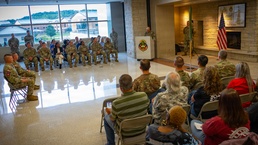
After nearly two decades of providing critical care and transition support to wounded, ill, and injured service members, the Fort Riley Soldier Recovery Unit cased its colors during an inactivation ceremony on Aug. 14, 2026.
Gathered at the Irwin Army Community Hospital, Army leaders, Soldiers, and former SRU staff reflected on the unit’s legacy. While the ceremony marked the end of the SRU's mission at Fort Riley, speakers emphasized that the unit’s impact will endure in the lives of the countless individuals it helped rebuild.
The SRU’s origins date back to June 15, 2007, when it was first activated as the Warrior Transition Unit with just 39 Soldiers and a small staff. Recognizing the growing need for specialized care, Fort Riley opened a permanent, state-of-the-art $54 million Warrior Transition Battalion complex in May 2010.
Rebranded as the Soldier Recovery Unit in October 2020, the formation provided comprehensive medical, administrative, and transitional support. Operating across a seven-state region, the SRU used a cadre of nurse case managers, social workers, physical therapists, and transition coordinators to guide Active Duty, Reserve, and National Guard personnel through their recovery journeys.
The Fort Riley SRU holds the distinction of being the first unit of its kind in the Army to deactivate, setting a benchmark for others to follow.
COL Jason Marquart, commander of Irwin Army Community Hospital, highlighted the meticulous planning required to safely draw down the unit without compromising patient care.
“Over a year ago... we started talking about the change to the SRU,” COL Marquart said. “Little did I know a year later, I was going to see an example of what excellence looks like. This organization... is the first one to deactivate. That means there was an organized transition of both people and equipment, taking care of the Soldiers that were assigned here that whole time period.”
COL Marquart noted the massive undertaking of the transition, successfully reducing the unit’s footprint from 120 assigned personnel down to 11 leading up to the ceremony, ensuring every Soldier was properly cared for before the official inactivation date of Oct. 1, 2026.
For the SRU’s cadre and leadership, the casing of the colors was a deeply emotional moment. LTC Benjamin Peffer, commander of the SRU, praised the integrated team of military and civilian professionals who worked tirelessly to ensure no Soldier was left behind during their darkest hours.
“For two decades, the Soldier Recovery Unit has stood as a beacon of hope, healing, and transition,” LTC Peffer said. “The success of this unit is measured not by battles won on distant fields, but by the lives rebuilt here at home. Your legacy lives on in the health, strength, and future of every person you serve.”
Peffer also honored the resiliency of the recovering Soldiers themselves, noting that they met adversity with the same courage they demonstrated in uniform, fighting the unique “Battle of Recovery.”
As the unit’s colors were passed for the final time and cased, the SRU Command Sergeant Major Ryan Johnson offered a reminder that the unit’s history is not confined to a display case.
“Casing unit colors is never easy, but it does not erase what we have achieved together here over these past few years,” CSM Johnson said, taking a moment to also thank the families for their quiet sacrifices, late nights, and endless support.
“While these cased colors today close a chapter, our story does not end here,” Johnson said. “It lives in the leadership, the friendships, and the fierce standard of professionalism that was instilled in every Soldier who has ever supported or served by this formation. As you all move on to your next units across our Army, you carry that DNA with you.”