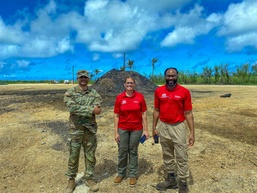
SAIPAN, Northern MarianasIslands—In April, one of the most powerful typhoons made landfall on the Commonwealth of the Northern Marianas Islands (CNMI)—Super Typhoon Sinlaku. With sustained winds at 170 mph, it was categorized as a “Super Typhoon” and a Category 5 storm.
The destruction Sinlaku caused on CNMI was no less than devasting. Across CNMI, there were reports of uprooted trees, overturned vehicles, toppled utility poles, loss of power, roofs ripped off homes, impassable roads, spoiled food due to loss of power, flooding and downed powerlines.
Then three months later, Super Typhoon Bavi hit. Though Bavi moved faster through the islands, it was stronger than Sinlaku. Winds were sustained at 185 mph. While Saipan and Tinian suffered damage, Rota—the southernmost island in CNMI—greatly suffered damage and loss power for almost two weeks.
Post-Sinlaku, the U.S. Army Corps of Engineers (USACE), The Federal Emergency Management Agency (FEMA), the American Red Cross, and other government and municipal agencies deployed to CNMI to assist in recovery efforts. Recovery was ongoing until Bavi halted operations, but USACE and their partners were able to respond quickly since they were already on the ground.
If you ask a USACE employee what an emergency mission is like, most will tell you that every mission is different. Each one is treated as a new experience with challenges and successes. From soldier to civilian, many have stated this was their first time deploying and shared their experience.
Being Spiritually Focused One would always know when Candice G. Núñez would walk into the Recovery Field Office. She would either wave at everyone, stop by each station to say hi, shake hands or even fist bump.
Candice Núñez served in the U.S. Army for 22 years as a medical service operations officer. Hence, she is familiar with being adaptable and working under pressure in highly intense environments. During a deployment, it is easy to become consumed by 12 to 15 hour workdays and lose sight of your own well-being.
Núñez stated the key to thriving during a deployment is self-care, “One of the most important lessons I've learned is to make time for yourself: physically, mentally, and spiritually.”
Núñez made it a priority to create opportunities for personal renewal and connections. It helped her be a better first responder and find joy in her job.
“I attended the local Seventh-day Adventist Church, which helped me feel connected to the community and strengthened me spiritually. I also enjoyed taking evening walks along the beach, where I could reflect, meditate on my purpose, and recharge,” she stated.
She even fed the local animals. These experiences helped her cultivate a deeper and powerful connection to the island in a “unique and special way.” She purposefully created a space for comfort during a time of emergency.
“Those moments of reflection, renewal, and community connection were just as important as the work itself and helped me maintain a healthy balance throughout the deployment,” she said.
Working Side-By-Side Currently, Núñez serves as the national emergency preparedness program manager and civil planner for USACE’s North Atlantic Division. She supports preparedness, response and recovery operations across six districts in 13 states. As part of the Sinlaku Recovery mission, she uses her current and military skills to act as the main liaison between USACE and FEMA as part of the Emergency Support Function #3 – Public Works and Engineering(ESF3) Cadre, one of 15 emergency support functions under FEMA’s emergency response framework.
Her role required a robust coordination effort, which involves effective communication, organization, problem-solving, adaptability and teamwork.
“My experience as a retired military service member has been invaluable, providing me with the ability to quickly adjust to changing environments, perform effectively under pressure, and collaborate with diverse teams while maintaining a strong focus on the mission,” she said.
That said, her most memorable moments have been working side-by-side with her colleagues across division, districts, federal, state and local agencies.
“One thing that has stood out to me is that USACE's greatest asset is its people. The professionalism, teamwork, and willingness to support one another have made this deployment both rewarding and professionally enriching,” she said.
Find the Joy in the Job For those wanting to volunteer for an emergency mission, Núñez stated one needs to be open-minded, flexible and not hesitate to ask questions. Many people are only here for 30 to 60 days, hence, time is of the essence. In emergency operations, there is not one typical day. Many USACE employees have stated every deployment is unique with experiences, successes, people, timelines, issues and environments.
“Take the opportunity to learn from experienced and new team members, build relationships, and embrace new challenges,” she said.
But ultimately, Núñez found the joy in the job.
“Maintaining a positive attitude will help you get the most out of the experience,” she said.