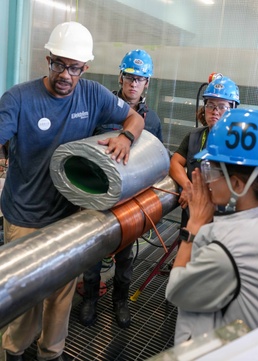
YOKOSUKA, Japan- U.S. Naval Ship Repair Facility and Japan Regional Maintenance Center (SRF-JRMC) has taken another step forward in increasing its organic ship repair capability. From July 27 to 29, the Yokosuka Pipefitter Shop conducted specialized freeze seal training on board Fleet Activities Yokosuka. This training event marks the latest step in the command's effort to obtain freeze seal capability for routine surface ship repair. Currently, the technique is primarily reserved for stateside nuclear vessel maintenance, making its introduction to Japan a frontline advancement poised to improve efficiency in conventional ship fleet repairs.
The highly technical freeze seal process tackles a notorious maintenance headache by circulating a supercooled medium, such as liquid nitrogen, through a copper line that is wrapped in an insulated jacket directly around a pipe. This creates a solid, temporary ice plug that completely halts liquid flow and precisely isolates problem areas. Normally, a faulty valve forces crews to shut down and drain large sections of a ship's piping, delaying repairs and requiring extensive manpower.
Adopting this sub-zero technology shifts SRF-JRMC's maintenance posture from reactive to proactive. Without a freeze-seal option, conventional vessels such as guided-missile destroyers and cruisers often had to defer maintenance until a system-wide drain-down could be scheduled. With this advancement, SRF-JRMC maintenance teams will be able to resolve issues during shorter availability periods by drastically reducing the lead time needed for these types of repairs.
This training builds directly on an earlier collaboration in which an SRF-JRMC delegation traveled over 7,000 miles to Norfolk Naval Shipyard (NNSY) in Virginia to learn about the freeze seal technique. During that visit, the combined U.S.-Japan team successfully executed a first-of-its-kind freeze seal on an eight-inch copper-nickel pipe filled with flowing, pressurized saltwater.
With the knowledge gained in Norfolk, SRF-JRMC built a local mock-up of the pipe in their shop, using the same dimensions, for further hands-on training. Using equipment provided by the NNSY team, who conducted the training, the command was able to replicate the training for every member of the section.
“Working with the Norfolk team helped us master this complex freezing technology,” said Takahito Arai, the X56 shop head. “With this new skill, our pipefitters can now do targeted repairs that we couldn't easily do here before.”
Overcoming these traditional piping isolation challenges permanently thaws weeks of potential downtime for future ship maintenance availability. The next step to bringing this capability to SRF-JRMC is to execute a freeze seal shipboard during an availability on a U.S. Navy destroyer this Spring. Ultimately, this innovative tool directly aligns with Navy readiness goals, ensuring the ships of the U.S. 7th Fleet remain mission-ready for deployment in the Indo-Pacific region.
For over 75 years, SRF-JRMC has been the linchpin of U.S. Naval operations in the region by providing intermediate and depot level repair for the ships of the U.S. Navy and the U.S. 7th Fleet.