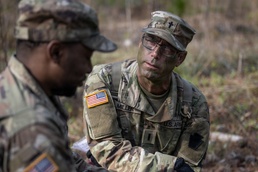
FORT INDIANTOWN GAP, Pa. — Long before Capt. Daron Miller learned to sit quietly with soldiers carrying invisible burdens, he believed strength was something that had to be proven.
Chaplain (Capt.) Daron Miller, assigned to Headquarters and Headquarters Battalion, 28th Infantry Division, Pennsylvania Army National Guard, now measures strength differently.
At 19, Miller was searching for something difficult enough to make him feel accomplished. Something that might answer a lingering sense that he needed to achieve more to become someone, that would fill a persistent emptiness he felt within him.
His journey began in an unlikeliest of places - a bookstore.
Miller, fresh out of high school and looking for a challenge, spotted a book about Navy SEALs. A quick perusal of the back cover was all Miller needed to make up his mind.
“I decided to join the Navy and become a SEAL before I even paid for the book,” Miller said.
Miller, eager to discover exactly what he needed to do to become a SEAL, devoured the information quickly, learning that in the final phase of BUD/S (Basic Underwater Demolition/SEAL) training, candidates are required to run 14 miles. He was struck with inspiration.
“I thought the greater the obstacle, the greater the sense of accomplishment I would feel,” Miller said.
A personal test was in order.
“I literally grabbed a Marlboro stopwatch that came out of a carton of my mom’s cigarettes, and all I knew was that it was seven miles down to the gas station and back,” Miller said. “So I just put on my tennis shoes, didn't bring water, I had the stopwatch to time myself, and I just ran 14 miles.”
Miller’s voice takes on a quizzical tone as he recounts the story, as if he’s amused when he recalls this reckless younger version of himself.
“I'm not saying that's safe,” said Miller, “But I did it.”
Almost as an afterthought, Miller added “And my feet hurt the next day.”
On Oct. 15, 1993, he stepped off a bus at Navy boot camp. Fifteen months later, he reported to SEAL Team 3 after completing Basic Underwater Demolition/SEAL training.
“In dive phase”, Miller said, “I got an award called ‘First Time, Every Time’. That means in every graded evolution that we did, all the drown-proofing and diving, I passed my very first time.”
It was an unlikely accomplishment for a young man raised in the Midwest who had never seen the ocean before arriving at SEAL training.
Despite his accomplishments, Miller still felt empty and restless. Looking back, he said he came to understand that God was guiding him toward a purpose far greater than the one he had envisioned for himself.
Miller recalled asking himself, “How is it I’ve done all this, but inside I feel just as unfulfilled as I did before I ever joined the Navy?”
It dawned on him that the fulfillment he craved had to be something that existed purely outside of himself, said Miller, and none of his accomplishments could bring him the peace he craved.
That realization began a transformation that would eventually take Miller from the SEAL teams to seminary and, years later, into the Pennsylvania Army National Guard chaplaincy.
Miller had entered the Navy looking for an identity; The SEAL teams gave him one.
But like a wetsuit that never quite fit, that identity began to chafe.
He remembers the confidence, and sometimes arrogance, that came with being young, strong, and succeeding in an environment built around exceptional performance.
“You go through training, you’re 19, 20 years old,” Miller said. “Every day I’m in this grinder ... and it says you’re someone special. Your sense of entitlement is fertilized like you wouldn’t believe.”
Miller had never attended church growing up. Raised by a single mother in Kansas, faith had not been a significant part of his life.
But even with every significant achievement, Miller still felt he was missing something. He began to see that some of the SEALs he once viewed as models of strength were, in his eyes, outwardly strong but inwardly lacking. It forced him to reconsider what strength actually meant.
During a six-hour drive back from training in California, Miller found himself riding with another SEAL he had never met. Five minutes into the trip, the other man began talking about his Christian faith. This SEAL, a former missionary to Russia before joining the Navy, quoted scriptures from memory perfectly. Miller was intrigued.
“He quoted Scripture in response to every question I asked,” Miller said.
That unlikely conversation became the catalyst Miller had been searching for, deepening a faith that would eventually reshape not only what he believed, but how he understood the experiences he’d accumulated along the way.
Miller remained in the Navy until 2006. After leaving active service, he attended Lancaster Bible College and Capital Seminary, initially believing his special operations background might prepare him to minister to veterans in a hospital setting.
Instead, another door opened.
A fellow seminary student serving as a chaplain candidate connected Miller with the Pennsylvania Army National Guard. Miller eventually commissioned as an Army chaplain and was assigned to Headquarters and Headquarters Battalion, 28th Infantry Division.
He entered the chaplaincy carrying a resume that could easily have become his identity.
Instead, those experiences became a connection point to other service members.
“When a soldier’s in front of me and they see, ‘Oh wow, he’s got a combat diver badge and all of that stuff,’” Miller said, “‘This isn’t just a pastor who stepped in off the street and put on camis. Here’s someone that shared some of the things that I’ve done.’”
Those experiences can establish credibility before a conversation ever begins, establishing rapport and trust between soldiers and chaplain.
“It absolutely opens up doors for soldiers and helps them to speak,” said Miller.
Maj. David Boyles, a Pennsylvania Army National Guard chaplain who has worked alongside Miller for several years, said Miller’s demeanor runs counter to assumptions people may make about someone with his background.
Boyles had heard Miller was a former SEAL before meeting him and expected a personality shaped by the stereotype that sometimes accompanies elite military service. Those assumptions disappeared almost immediately.
Instead, Boyles encountered someone quiet and reserved.
“He doesn’t try to put on airs to appeal to people,” Boyles said. “He always approaches people, conversation and decisions with humility and authentic intentions.”
That humility may be one of the clearest indications of how Miller’s understanding of strength has changed.
Miller knows what conventional military toughness looks like.
During Hell Week, Miller said he spent days cold, exhausted and continuously moving. He remembers reaching the point where completing the week no longer seemed like a simple calculation; it became a raw decision to continue, one moment and one inch at a time.
But decades later, when Miller talks about resilience, he rarely begins with Hell Week.
He talks about the soldier who chooses to show up, no matter what mental or physical battle they may be fighting.
“Resilience doesn’t have to be these huge, big things,” Miller said. “It can be something simple like getting up in the morning, putting on the uniform and standing in formation because it took that much effort to do that morning.”
Some of the strongest people Miller has encountered, he said, will never have their perseverance marked by a badge, qualification or award.
“There’s soldiers I’ve met that have done things that take more perseverance and resilience than anything I’ve accomplished in my Navy career,” Miller said. “But nobody knows about it, because they’re private stories.”
In the Chaplain Corps, the ability to listen as others share their most personal stories and deepest struggles is invaluable.
Although the confidential nature of counseling means he rarely witnesses Miller’s private conversations with soldiers, Boyles said Miller’s everyday interactions reveal care and intention in listening to those who seek him out.
“Most people listen to respond,” Boyles said. “Chaplain Miller listens to understand.”
That approach carries into a part of the chaplain’s job most soldiers may never see.
Army chaplains advise commanders on matters involving religion, morals, ethics and morale. Boyles said Miller works hard to remain aware of the health and well-being of the individual soldiers within the organization, and he uses that understanding to advise commanders.
“Not many see this part of what the chaplain does,” Boyles said, “but it is often the most influential part of our work within the unit.”
For Miller, caring for others has also required learning that strength does not mean endlessly giving without acknowledging his own limits.
In ministry, he compares it to pouring from a cup.
“You’re always pouring into someone else’s cup - somebody that needs encouragement, that’s going through a bad situation - and your cup isn’t infinite,” Miller said. “You’re eventually going to run out.”
Earlier in his life, Miller might have considered taking time for himself a weakness. Today, he calls it wisdom.
When Miller isn’t ministering to soldiers, he serves as a civilian chaplain at a senior living community, ministering to people confronting aging, illness, cognitive decline and the end of life.
For Boyles, that career choice says as much about Miller as his military resume does.
“His willingness to step into an environment where growth and change in the people you care for are not likely ... is a testament to his servant’s heart and a desire to care for people regardless of any noticeable outcome,” Boyles said.
Boyles sees the same philosophy in Miller’s work with soldiers, where the impact of a conversation may not become apparent for months or years, if it becomes apparent at all.
For a man who once measured himself through achievement, it is a markedly different measure of success.
Miller also credits his family with making that service possible.
He met his wife when they were young and remained with her through Navy service, marriage, raising two daughters, his transition from special operations and his eventual call to ministry.
“She has sacrificed more than I ever have,” Miller said.
The stability she provided at home, he said, allowed him to be fully present wherever his service took him.
Once, Miller wanted people to look at what he had accomplished and see someone exceptional. He had pursued one of the hardest things he could find because he believed overcoming a sufficiently difficult obstacle might finally make him feel complete.
Now, when he looks back at those experiences, he does not see a former life he wishes he could reclaim.
“There was no looking back,” Miller said. “I don’t miss it.”
Instead, he sees a rucksack.
“All of that equipped me for the ministry with a rucksack that was full of everything that I needed,” Miller said. “It wasn’t about me. All of that was for every soldier here.”
Experience became a way to understand someone else’s struggle. Accomplishment became a way to establish trust. Hardship became perspective. The identity Miller once sought through elite service became less important than what those years equipped him to give others.
Boyles sees the difference in the way Miller carries himself.
The former SEAL he once expected to be loud, difficult or consumed by his own accomplishments instead became a chaplain known for listening and humility.
A man once determined to prove how much he could endure now devotes himself to recognizing what others carry, understanding that resilience comes in many forms.
Sometimes, it looks like the soldier who gets out of bed each morning despite carrying the weight of loss and trauma.
Sometimes, it means admitting their cup is empty, and they need help filling it.
Sometimes, it means carrying decades of experience without allowing those experiences to become the entirety of who you are.
“We are so much more than what we do,” Miller said.
For Miller, strength is no longer something that has to be proven. It is something that can be used in service to someone else.