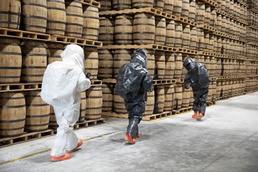
BOSTON, Ky. — Moving between rows of aging bourbon barrels, Kentucky National Guard Soldiers and Airmen in fully encapsulated protective suits searched for a threat they could not see.
The suspected hazard was fictional, but the response capabilities and interstate relationships being tested were real.
Members of the KYNG’s 41st Weapons of Mass Destruction Civil Support Team trained alongside North Carolina National Guard’s 42nd CST at the Jim Beam Booker Noe Plant in Boston, Aug. 11, 2026.
The joint exercise tested how the teams integrate during a complex chemical, biological, radiological, nuclear or explosive (CBRNE) incident.
For the scenario, the 41st CST responded after two employees became ill after discovering a deceased individual and an unidentified substance inside a barrel warehouse. As the simulated incident expanded across multiple buildings, the 41st requested support from North Carolina’s 42nd CST.
The teams conducted survey operations in separate buildings while coordinating communications and sharing information across the incident site.
“So, what’s cool about this is all the different CSTs have the same sort of capabilities,” said U.S. Army Maj. Ryan Hubbs, deputy commander of the 41st CST. “It’s giving us the opportunity to test out our communication systems with two different CSTs—how we communicate when we’re downrange and how we share information and intelligence during the operation.”
During the exercise, the two teams worked to share information from separate survey operations and combine their findings into a common incident picture for the incident commander.
“Working with one another makes that mission much easier, because we know the faces, we know how to do things now that we didn’t know before,” said U.S. Army Lt. Col. Patrick Mohan, commander of North Carolina’s 42nd CST.
Mohan said another CST may be needed based on an incident’s size, duration, conditions or specialized personnel requirements. Training together beforehand makes it easier for the teams to integrate during a real response.
“Us being able to work with the 41st, integrate our communications and share information was invaluable,” Mohan said. “Just the practice of doing that provides real-world training value.”
Survey personnel enter potentially contaminated areas using an all-hazards approach.
“The first entry that usually happens is reconnaissance,” said U.S. Air Force Capt. Blake Culver, science officer for the 41st CST. “We are looking for radiation. We’re looking for chemicals. We’re also keeping an eye out for anything else that could be present across the CBRNE spectrum.”
During the exercise, survey team members entered the warehouse in Level A protective suits with self-contained breathing apparatuses.
Survey personnel used multiple detection systems and a Mobile Field Kit, or MFK, to photograph what they encountered, transmitting the images to the team operating in the cold zone.
“If they have a question about what they’re finding or if there’s something that we need immediate action on, we can share information in real time,” Culver said.
That information helps responders make decisions while the survey continues.
“We support the state in so many ways,” Culver said. “We are a resource for the local FBI and for local police agencies when they need our help in making an identification or getting an assessment.”
Culver said the team also provides technical assessments and recommendations to fire departments and local hazardous-materials teams.
The team put those capabilities to use following the fatal UPS plane crash in Louisville in November 2025. Twenty members of the 41st CST mobilized to assess air quality around the crash site, testing for toxic compounds and providing analysis to officials managing public safety measures.
For U.S. Army Staff Sgt. Kory Waller, who joined the 41st CST in May, the exercise was his first full-scale training event with the team.
“It was a big learning curve for me, having no experience in the chemical world,” Waller said. “To get out here and actually go through a likely scenario that could happen in real life—it was very eye-opening and, overall, a good learning experience.”
“Scenarios like this can happen any day and night,” he said.
That readiness extends beyond Kentucky. Joint exercises allow CSTs to test relationships, communications and procedures before they are needed during an actual emergency.
For Hubbs, the specialized equipment and technical expertise ultimately support a straightforward purpose.
“We’re supporting Kentucky with public safety,” he said. “When you see us out, know that we’re making sure that the whole area is safe. We’re monitoring for any bad stuff out there, and we’re keeping you guys safe so that you can enjoy any event that you go to.”
# # #