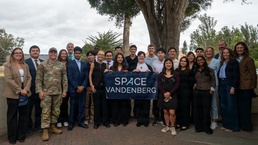
VANDENBERG SPACE FORCE BASE, Calif. – This is no ordinary summer camp – this is Space Vandenberg – an eight-week internship program that concluded Aug. 14 with a capstone showcase event at the Space and Missile Technology Center campus at Vandenberg Space Force Base, California.
Eighteen students representing Allan Hancock College, Cal Poly San Luis Obispo, Cuesta College, Santa Barbara City College, and University of California Santa Barbara, rolled up their sleeves and dedicated their summer to gaining hands-on experience working in a mission-critical environment to contribute to building the spaceport of the future.
The program was designed to create a pipeline of talent and innovation by equipping students from various educational backgrounds to solve real-world, interdisciplinary problems, advancing Vandenberg Space Force Base and the region as a national leader in space launch and technology industries.
Selection for the program required students to demonstrate professionalism, team communication skills, academic rigor, and motivation.
Students were divided into six teams to complete mission-focused projects supporting organizations across Vandenberg Space Force Base. Organizations included the 2nd Range Operations Squadron, 30th Civil Engineer Squadron, 30th Operations Support Squadron, and the Digital Transformation Office.
U.S. Space Force Lt. Col. Christopher Menino, 2nd Range Operations Squadron deputy squadron commander, attended the capstone event where he outlined the importance of bringing interns into the picture to solve various initiatives.
“We’re using modern technology, like agentic artificial intelligence, to solve problems rapidly with very little cost,” said Menino. “The folks who are doing that are these young people from the local communities and colleges around the area who are bringing their expertise in these new technologies and driving us into the future. We need more of this and we’re looking forward to continuing engaging with the community.”
The program provides students with hands-on experience in the space industry while strengthening partnerships between academia and the U.S. Space Force to help develop the next generation of the national security space workforce.
Students who participated in the program were awarded U.S. interim security clearances, which opens further doors to federal and Department of War career paths and an $8,000 stipend.
Anthony Ma, a University of California Santa Barbara computer engineering student, said this program would likely benefit his future career.
“Now I’m really interested in going into the aerospace industry and I’m excited to learn more about engineering skills,” said Ma. “Thank you to Space Launch Delta 30, Vandenberg Space Force Base, 2nd Range Operations Squadron and everyone on base for making this such an amazing experience.”
The program concluded with a final project showcase, allowing the students to pitch their ideas in front of their peers, mentors, coordinators and base leadership.
U.S. Space Force Col. James T. Horne III, Space Launch Delta 30 commander, addressed the students during his closing remarks at the showcase event.
“You have proven that you have the talent and the drive to excel in this high-stakes environment,” said Horne. “You didn’t just spend a summer at Vandenberg. You helped us think differently about what Vandenberg can become. The Spaceport of the Future is being built right now. And after seeing what you accomplished this summer, I’m excited to see what you build next.”