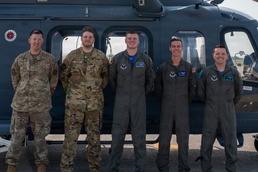
MALMSTROM AIR FORCE BASE, Mont. — It was early evening when the call came on July 30. There was a hiker with a medical emergency in the Beartooth Mountains. The hiker and her group were nine miles deep in the backcountry, over rough terrain, and it would take all night for search and rescue teams to reach her by ground and provide critical medical care. Her campsite was in a narrow valley at 9,500 feet, beyond the reach of the civilian aircraft available that night.
At 7:30 p.m., the Air Force Rescue Coordination Center tasked the 40th Helicopter Squadron to support the Carbon County Sheriff's Office search and rescue operation. A crew was already at the squadron preparing for a scheduled training flight, allowing the entire squadron to quickly shift from training to a real-world rescue mission.
“We had people who weren't even on the crew helping with this, getting the aircraft ready. While I was working forms and getting the legal side done, as well as stepping to the aircraft, other people were out there getting my rescue gear ready and everything I needed,” said Senior Airman Dakota Doss, a special missions aviator with the 40th.
A short time later, an MH-139A Grey Wolf, four flight crew members and one medical technician, lifted off from Malmstrom at 8 p.m. under the call sign Air Force Rescue 11.
The 200-mile flight south took an hour and 15 minutes. Wildfire smoke had settled over central Montana in pockets that came and went with the wind, cutting visibility to as little as two miles.
"When I say we had to use our night vision goggles — we were like, 'oh man, this is gross,'" said Capt. Jacques Soto, the aircraft commander and the 40th’s MH-139A chief of standards and evaluations. "Then it clears up for a bit, but if the wind shifts, you're back in it again."
The moon that night was nearly full, but it made almost no difference. The campsite sat in a stair-stepped glacial basin walled in by peaks rising above 12,000 feet, and the terrain threw the whole bowl into shadow.
The hikers were almost exactly where they said they would be, only 100 yards from the coordinates the sheriff's office had relayed to Rescue 11. The Rescue 11 crew credited this to regular updates they received from the sheriff’s office via satellite communications.
Capt. Aaron Sanders, mission copilot and standards and evaluation officer for the 550th Helicopter Squadron, brought the aircraft into a hover while Tech. Sgt. Homer Miller, the medical technician on the helicopter and the section chief of flight medicine at the Malmstrom Operational Medical Readiness Squadron, rode the rescue hoist to ground level. The water in the creek was high, and the only dry ground near the patient was a patch of grass roughly 10 feet square, sitting no more than six inches above the creek. He worked there for about 10 minutes in the downwash of a helicopter hovering at just 50 feet above the ground.
"I was down on one knee and still getting pushed into the ground," Miller said. "When I took a knee, it sank into water."
Above him, Staff Sgt. Owen Anderson, weapons and tactics noncommissioned officer in charge at the 40th Helicopter Squadron, ran the hoist through the open door with one hand locked on the cable, fighting a rescue basket that spun and rocked on the way down while watching the rotor clearance.
"When I'm on the hoist, I can't take my hand off of it," Anderson said. "I've got other things I'm worried about. Make sure the hoist doesn’t hit anything. Make sure the survivor stays in the basket and gets into the aircraft safely." Hovering within 25 feet of a stand of towering pines, Soto and Sanders held the helicopter in position for two full cycles of the hoist, bringing up the hiker first followed by Miller.
"It went off without a hitch," Anderson said.
From the rescue location in the backcountry, Rescue 11 flew the hiker to the rooftop helipad at St. Vincent Healthcare in Billings, then fought scattered thunderstorms most of the way home. From start to finish, they spent more than four hours flying at night, in difficult conditions, well above their typical training altitude, and for the first time successfully conducted a rescue operation using the MH-139A’s hoist mechanism.
The whole Rescue 11 team credited communication among the hikers, state and federal agencies for the mission’s success.
"We’ve developed a relationship with a lot of the local agencies east of the Rockies, and it works really great," Soto said. "This mission went so well, and I’d say a lot of it was the capabilities of the helicopter and the professionalism of Carbon County."