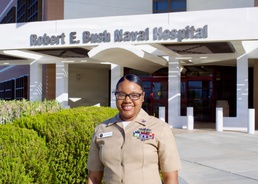
TWENTYNINE PALMS, Calif. — Behind nearly every diagnosis, treatment decision and assessment of a service member’s medical readiness is laboratory work that patients rarely see.
For Hospital Corpsman 1st Class Meosha P. Williams of Navy Medicine Readiness and Training Command (NMRTC) Twentynine Palms, that work is both a science and a responsibility — one that has earned the High Springs, Florida, native national recognition for her contributions to clinical laboratory medicine.
Williams, a medical laboratory technician and laboratory department lead petty officer at Naval Hospital Twentynine Palms, was recognized on May 29 with the Omicron Sigma award, a national President’s Honor Roll award presented by the American Society for Clinical Laboratory Science. The recognition honors clinical laboratory professionals for service, volunteerism and dedication to advancing the profession.
For Williams, the award carries particular significance because much of a laboratory professional’s contribution to patient care happens outside public view.
“Receiving this honor is incredibly humbling on a personal level,” Williams said. “In laboratory science, we do a lot of our heavy lifting behind closed doors, away from the patient’s bedside, so it can sometimes feel like our work goes unseen.”
Williams said the recognition validates the long hours laboratory professionals spend ensuring specimens are processed accurately and physicians receive reliable information to guide patient care.
“It’s a powerful reminder that what we do truly matters,” Williams said. “It fires me up to keep advocating for our junior technicians, so they know their hard work is seen and valued.”
At Naval Hospital Twentynine Palms, Williams’ responsibilities extend beyond the laboratory bench. In addition to serving as the department lead petty officer, she supervises laboratory operations at Branch Health Clinic Bridgeport and Branch Health Clinic China Lake.
Her responsibilities include overseeing clinical laboratory operations, maintaining quality control and regulatory compliance, and mentoring Hospital Corpsmen and medical laboratory technicians responsible for providing diagnostic services to patients across the command.
The work requires precision because laboratory results can influence decisions ranging from routine treatment to whether a service member is medically ready for an operational mission.
“Laboratory medicine is the foundation of patient care,” Williams said. “I enjoy the high stakes, the precision required and knowing that our background analysis directly saves lives by helping to guide physicians’ treatment plans.”
Her interest in the field began long before she entered Navy Medicine.
While attending high school, Williams participated in a criminal justice program and developed an interest in forensic science. She was drawn to the investigative nature of laboratory work and the process of using scientific evidence to answer questions that could not necessarily be resolved through observation alone.
“I have always been fascinated by the ‘detective work’ of healthcare,” Williams explained.
That interest eventually became a Navy career combining science, medicine and military service.
Williams grew up in a family with a history of military service. Her grandfather served in the Army, and her father served in the Navy. Her father’s service initially influenced her decision to enlist, but Williams said her reasons for remaining in the Navy evolved as her career progressed.
“I joined the Navy originally because of my father, but it developed into a reason to serve a purpose greater than myself, seek personal and professional growth, and see the world,” Williams said.
Navy Medicine offered an opportunity to combine that sense of service with her interest in science and healthcare.
“I chose Navy Medicine because it allowed me to combine my passion for science and healthcare with direct service to our country’s warfighters and their families,” Williams said. “Knowing that the diagnostics we run in the background keep the fleet healthy, ready and lethal is incredibly rewarding.”
That connection between laboratory medicine and operational readiness is particularly important at NMRTC Twentynine Palms, where Navy Medicine personnel support Marines and other service members training at Marine Corps Air-Ground Combat Center Twentynine Palms.
Williams said laboratory medicine contributes directly to force health protection by providing the information medical providers and commanders need to assess health risks and maintain a medically ready force.
“From screening service members before deployment — HIV testing, blood typing and immunization verification — to monitoring occupational health hazards and diagnosing infectious diseases in the field, we ensure our forces are medically fit to deploy,” Williams said. “We provide the rapid, actionable data commanders need to keep the fighting force healthy and ready to fight tonight.”
Williams’ Omicron Sigma recognition follows another national honor she received for her contributions to the profession.
She was selected as the 2025 Society of American Federal Medical Laboratory Scientists (SAFMLS) Outstanding Enlisted Service Member of the Year, an award recognizing leadership, technical expertise and contributions among federal and military laboratory professionals.
Williams was nominated by her directorate leadership for her work optimizing laboratory readiness, training junior Sailors and serving as a Navy member-at-large on the SAFMLS Board of Directors.
The recognition was especially meaningful because Williams had viewed SAFMLS as an organization representing some of the profession’s most accomplished leaders throughout much of her career.
“For my entire career, SAFMLS was this prestigious organization that I always heard about in passing,” Williams said. “It always felt like this elite, higher-ranking circle where all the major decisions and wonderful medical advancements were happening.”
Becoming involved with the organization — and ultimately being recognized by it — changed that perspective. “To not only be a part of it but to be recognized nationally by them feels absolutely surreal and deeply rewarding,” Williams said. “It shows junior Sailors that those doors are open to them, too, if they put in the work.”
Williams said representing Navy Medicine on a national, joint-service stage was a career milestone made possible in part by the laboratory directors, senior enlisted leaders, civilian laboratory managers and colleagues who have mentored and supported her throughout her career. She said those mentors pushed her beyond her comfort zone and challenged her to become a stronger leader, an example she now aims to provide for the junior Sailors and laboratory technicians she leads.
For Williams, developing those junior technicians is as important as her individual accomplishments.
Her advice to hospital corpsmen interested in laboratory medicine begins with mastering the technical requirements of the profession without allowing technology and routine processes to obscure the reason the work exists.
“Master your craft and never lose sight of the patient behind the tube,” Williams said. “It is easy to get caught up in the automation and numbers, but every specimen belongs to a Sailor, Marine or family member depending on you for accurate answers.”
She also encourages junior laboratory professionals to pursue professional certifications and become involved in organizations outside their immediate commands, including SAFMLS, the American Medical Technologists and the American Society for Clinical Laboratory Science.
Williams reported to NMRTC Twentynine Palms in January of 2024. Her next assignment will allow her to put her emphasis on mentorship and professional development into practice on an even larger scale.
She is scheduled to transfer in February 2027 to become an instructor at Fort Sam Houston, Texas, where she will help train the next generation of Navy Medicine medical laboratory technicians.
Williams said she hopes to use the assignment not only to teach the technical aspects of laboratory medicine but also to help shape how new technicians view the profession.
“The daily bench work can sometimes feel monotonous, and I want to introduce fresh ideas, new perspectives and incentives to the training program to keep our technicians engaged and ultimately improve retention,” Williams said.
Her long-term plans remain centered on laboratory science and education. Williams intends to complete her master’s degree and hopes to attend the Clinical Laboratory Management and Science program later in her Navy career.
After retiring from the Navy, she plans to continue teaching by becoming a university professor in a clinical laboratory science program.
The progression from laboratory technician to lead petty officer, national award recipient and future instructor reflects a career increasingly focused not only on producing accurate laboratory results, but also on developing the people who will produce them in the future.
For Williams, that investment in the next generation is inseparable from the laboratory’s contribution to Navy Medicine’s operational mission. Whether testing a specimen at Twentynine Palms, supervising laboratory operations at a branch health clinic or eventually standing in front of a classroom of new technicians, the objective remains the same: ensure Navy Medicine has skilled laboratory professionals capable of delivering accurate information when patients, providers and warfighters need it most.
Navy Medicine's 44,000+ talented and ready forces optimize health readiness, deliver quality healthcare, and provide global expeditionary medical support to warfighters.