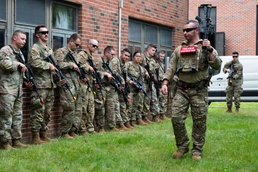
U.S. Air National Guard civil engineers from four New England states practiced procedures for moving on foot in hostile territory at Fort Devens Army Reserve Training Area, Aug. 10–15, 2026.
The dismounted operations training was part of the Prime Base Engineer Emergency Force Region 1 Patriot Forge II field training exercise, a week-long engagement focused on building cross-functional combat skills in a simulated contested environment. Approximately 200 Airmen from the Connecticut, Maine, Massachusetts, and New Hampshire Air National Guards participated.
The Prime BEEF Airmen navigated the complex terrain of Fort Devens’ South Post training area while carrying approximately 50 pounds of individual combat equipment. They traded their traditional engineering capabilities for tactical gear, weapons, water and meals ready-to-eat, and learned how to move and communicate as a cohesive fighting force.
“This training makes better Airmen by ensuring that they’re all able to work as a team, understanding that their role may not be what their specific job is,” said Master Sgt. Randy Smith, operations superintendent with the 157th Civil Engineering Squadron. “Sometimes, we deploy with other branches of service, so the hard work they put in now makes it easier for them to integrate with members of other branches later on.”
Engineers practiced tactical movement techniques and learned how to establish defensive fighting positions. Teams relied on radio transmissions and hand-and-arm signals to coordinate maneuvers and maintain 360-degree security in off-road terrain.
The intensity of the module peaked when patrols encountered simulated opposing forces. Under enemy fire, the Airmen were forced to rapidly transition from patrol movement to combat response. Teams executed critical care-under-fire protocols, applying tourniquets and performing manual and litter carries to extract casualties without compromising their defensive perimeter.
“The biggest challenge about this training is the unknown,” said Smith. “The newer Airmen have practiced some of these exercises during basic training, but exercises like these also help with training every Airman to the same standards.”
Prime BEEF Airmen provide expeditionary engineering capabilities wherever airpower is needed. That can require Airmen to move personnel and equipment between operating locations, navigate difficult terrain, and continue performing their engineering mission while responding to changing conditions around them.
The training also reinforced skills that overlap with other portions of Patriot Forge II. Tactical communications, individual movement, casualty response and force protection can all become factors during a convoy scenario. Rather than treating each skill as an isolated task, the module required Airmen to combine them while operating as part of a vehicle crew.
Patriot Forge II used a rotational training model, allowing participating Airmen to move through multiple training areas during the exercise rather than remain focused on a single mission set. Other competencies practiced during the week-long field training exercise included base defense, mounted operations, and land navigation.
In addition to building multi-capable Airmen needed for the future fight, Patriot Forge II established a standardized baseline for expeditionary readiness across Region 1 Prime BEEF civil engineering squadrons.