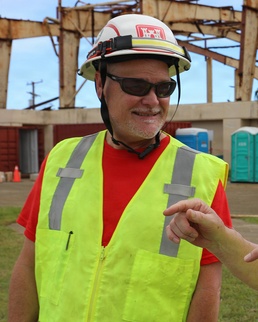
HUNTSVILLE, Ala. – For Joseph “Joe” Fentress, a safety manager with the U.S. Army Engineering and Support Center, Huntsville, a 45-day deployment to Saipan offered something that can sometimes be difficult to find from an office in Alabama: the opportunity to see firsthand how his work affects people in need.
Fentress deployed to Saipan in the Commonwealth of the Northern Mariana Islands as part of a U.S. Army Corps of Engineers disaster response mission following significant damage unleashed by typhoon Sinlaku as it tore its way across the Pacific.
He initially expected to spend 30 days supporting the response. Instead, he extended his deployment to 45 days as recovery operations continued.
“When you go out there and you get to see the lights turn on in a neighborhood that hasn’t had power in a long time, you can actually see the work that you’ve done, how it helps the locals there,” Fentress said. “And it’s a fantastic feeling.”
That feeling is one reason he continues to volunteer for deployments.
For Fentress, the Saipan mission began almost immediately after he arrived.
There was little time to adjust to the tropical heat, humidity, or significant time difference from Alabama. Team members arriving at a disaster site join a mission already moving at full speed, the safety manager stated. For the U.S. Army Corps of Engineers, disaster relief deployments are ready, set, go.
“When you get out there, you’re working 12 or13-hour days right away,” Fentress said. “You don’t have a whole lot of time to sit back and acclimate. You hit the road running.”
Fentress initially served as the debris safety officer, working with contractors and the team responsible for clearing debris and establishing temporary debris reduction sites.
The larger Corps response also included temporary power and temporary roofing operations. The roofing mission included the famous blue-roof program used to provide temporary protection to storm-damaged homes.
About two weeks into his deployment, Fentress moved into a broader safety management role for the response and remained in that position for about a month.
The mission changed again when Super Typhoon Bavi, a category 5 storm, struck during his deployment, causing additional damage to the nearby island of Rota. Temporary roofing and power personnel who were still in the area were called back into action, allowing the Corps to use people and equipment already positioned in the Northern Mariana Islands to support the additional response.
For Fentress, the experience illustrated how the Corps can bring together people with different specialties from across the organization and quickly place them where they are needed.
Huntsville Center employees may typically work on programs and projects far removed from a disaster site, but they are also part of the larger Corps of Engineers enterprise. People with the appropriate training, medical clearances and availability can be called upon to support emergency response missions well beyond their home organizations, if they so choose.
Fentress indicated that he learned about deployment opportunities through communication with the Corps’ emergency response safety cadre and through conversations with his supervisor. Safety personnel selected for those missions receive specialized emergency response training before deploying, ensuring there are no knowledge gaps to fill when the rubber meets the road.
The safety manager said the support he received from mission leadership made the Saipan deployment particularly memorable. He described the camaraderie and safety culture as among the best he has experienced during a deployment.
On the ground, leadership did more than talk about the importance of safety, he explained. Leaders went into the field with safety personnel and made safety part of the daily mission.
“Everybody kept safety at the primary focus of getting this work done for the people of the Mariana Islands,” Fentress said.
The deployment also brought lessons back to Huntsville.
Working in an environment where decisions have to be made quickly gave Fentress a different perspective on how safety professionals can work with contractors, identify problems and find solutions without losing sight of the mission.
But the most important lesson he brought home may be one he hopes other Huntsville Center employees will consider for themselves.
For team members who spend much of their careers supporting projects from Huntsville, deploying can provide an opportunity to experience another side of the Corps mission. One measured not only through schedules, contracts and completed work, but through communities beginning to recover.
“Don’t be scared. Get out of your comfort zone,” Fentress advised. “If people just deploy once, I guarantee you they’re going to deploy over and over, because it’s a lot of work, but it’s just such great work.”