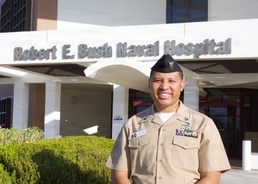
TWENTYNINE PALMS, Calif. — Deep in the Mojave Desert, where Marines train for some of the military’s most demanding operational environments, Hospital Corpsman 1st Class Raphael R. Claxton is helping prepare Navy Medicine personnel for a mission of their own: protecting the health of the force wherever it deploys.
Through hands-on training, preventive medicine and force health protection, Claxton has made readiness the focus of his leadership at Navy Medicine Readiness and Training Command (NMRTC) Twentynine Palms, where his efforts to prepare Sailors for the operational mission earned him selection as Expeditionary Medical Facility (EMF) Bravo’s Senior Sailor of the Quarter in June 2026.
Claxton, a Dallas native, serves as senior enlisted leader for the Directorate for Public Health at Naval Hospital Twentynine Palms and senior preventive medicine technician (PMT) for the EMF Bravo detachment at Twentynine Palms. In those roles, he helps connect the command's day-to-day public health mission with its responsibility to generate trained, qualified and deployable medical forces for the Navy and Marine Corps.
NMRTC Twentynine Palms serves as a force generation platform responsible for military readiness through the delivery of high-quality inpatient, outpatient, and preventive healthcare services to authorized beneficiaries. Claxton said that the relationship between the readiness and training commands and expeditionary medicine is central to understanding the role of EMF Bravo.
“NMRTC Twentynine Palms is a readiness and training command which focuses on supporting warfighters and their families, through this support we can certify, train, and equip medical professionals with the skillset needed to best serve the fleet” Claxton said. “EMF Bravo mobilizes personnel to carry out expeditionary missions in austere environments.”
Since arriving at Twentynine Palms in December 2025, Claxton has applied that readiness-focused approach across a broad public health portfolio. As senior enlisted leader for the Directorate for Public Health, he provides enlisted leadership for personnel supporting the immunization clinic, preventive medicine, occupational health, industrial hygiene, audiology and health promotion.
Each of those areas contributes to force health protection and the ability of operational units to maintain medically ready personnel. From ensuring service members receive required immunizations to identifying occupational and environmental health hazards, public health teams work to prevent illnesses and injuries that could remove personnel from the fight.
For Claxton, preventive medicine is inseparable from operational readiness. It is one of the tools Navy Medicine uses to preserve the force before medical treatment becomes necessary.
“PMTs are the champions of medical readiness and force health protection,” Claxton said. “It is our responsibility to preserve the public health of service members and their families.”
That responsibility extends beyond the walls of Naval Hospital Twentynine Palms.
Serving as a liaison to operational forces, Claxton coordinates with units aboard Marine Corps Air Ground Combat Center Twentynine Palms, Naval Air Weapons Station China Lake and Marine Corps Mountain Warfare Training Center Bridgeport to manage, maintain and advise on immunization requirements affecting approximately 28,000 service members and beneficiaries.
The coordination helps ensure personnel remain medically prepared for training, operational requirements and potential deployment while giving supported units access to preventive medicine expertise necessary to identify and address force health protection concerns.
The geographic and operational diversity of the command's supported population also provides opportunities for Navy Medicine personnel to develop skills applicable beyond the military treatment facility.
Twentynine Palms is home to one of the Marine Corps' premier live-fire training installations, where Marines prepare for operations in demanding environments. China Lake supports Navy weapons research, development, testing and evaluation, while the Marine Corps Mountain Warfare Training Center prepares forces to operate in complex mountainous and cold-weather environments.
Supporting those communities requires public health personnel capable of adapting their expertise to different missions, populations and environmental conditions.
Claxton's leadership was particularly evident during the command's recent Safety and Occupational Health Management Evaluation, or SOHME, when he led a junior preventive medicine team through the evaluation of 18 environmental health programs.
The team earned a “commendable” score, the highest possible rating.
Beyond the evaluation itself, the effort provided an opportunity to develop junior preventive medicine technicians through hands-on application of their technical skills. Claxton places an emphasis on ensuring corpsmen do more than complete required training, focusing instead on developing the technical competence and confidence necessary to perform independently when called upon in an operational environment.
That approach supports NMRTC Twentynine Palms' role as a force generation platform. The knowledge, skills and abilities Sailors develop while supporting the command's beneficiaries and operational partners become capabilities they carry with them to future assignments, operational units and expeditionary medical platforms.
For PMTs, those capabilities can become especially important during deployments where environmental hazards, communicable diseases, food and water safety concerns and other public health threats can directly affect a unit's ability to accomplish its mission.
“EMF Bravo’s mission is to preserve the fighting strength of the Fleet and Fleet Marine Force in diverse operational environments,” Claxton said. “To execute this mission, we must ensure our PMTs are knowledgeable of global health crises and trained to expeditiously manage these threats.”
PMTs can be called upon to assess environmental and occupational health risks, conduct disease surveillance, evaluate sanitation conditions, inspect food and water sources and advise commanders on measures necessary to protect personnel. In expeditionary environments, where established infrastructure and resources may be limited, those skills become an important component of sustaining the force.
Claxton's emphasis on technical mastery is rooted in deployability.
He takes a hands-on role in qualifying hospital corpsmen and sustaining their clinical and preventive medicine competencies, helping ensure Sailors are prepared to perform their duties beyond their current work centers. His training efforts also extend outside the Hospital Corps. Claxton works with culinary specialists to ensure they meet qualification standards for food handling and safety, another preventive measure that can directly affect the health and readiness of a unit.
Foodborne illness, communicable disease and environmental hazards have the potential to degrade a unit's effectiveness without an adversary ever firing a shot. Developing personnel capable of recognizing and mitigating those threats supports Navy Medicine's responsibility to preserve the fighting strength of the Fleet and Fleet Marine Force.
For Claxton, that means preparing Sailors to operate where those skills are needed most.
When asked what advice he would give junior Sailors interested in expeditionary medicine, Claxton pointed to a quote attributed to Rear Adm. Grace Hopper: “A ship in port is safe, but that's not what ships are built for.”
“Hospital corpsmen belong in the Fleet and Fleet Marine Force; that is where we are most needed,” Claxton said. “Expeditionary medicine gives us the opportunity to support the warfighter where we are most needed.”
Claxton’s approach reflects the broader readiness mission of NMRTC Twentynine Palms and EMF Bravo. While personnel assigned to the command deliver health care each day, they are simultaneously building the knowledge, skills and abilities needed to transition from the military treatment facility to an operational environment when called upon.
For EMF Bravo, that preparation is essential to maintaining a force capable of mobilizing and delivering expeditionary medical capabilities in support of combatant commander requirements. At Twentynine Palms, that mission begins long before deployment by ensuring the Sailors Claxton leads are trained, qualified and ready when the call comes.
Navy Medicine's 44,000+ talented and ready forces optimize health readiness, deliver quality healthcare, and provide global expeditionary medical support to warfighters.