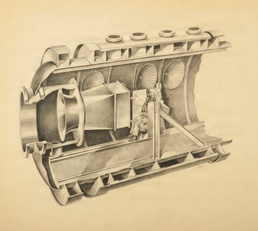
ARNOLD AIR FORCE BASE, Tenn. – From its inception, Arnold Engineering Development Complex ground testing has not focused exclusively on engines and aircraft. In June 1957, when the Complex was known as Arnold Engineering Development Center and Arnold Air Force Base served as its sole location, tests were conducted to determine the maximum dynamic pressure at which a pilot’s clothing and equipment would remain intact following an aircraft ejection. Wind blast testing was conducted in the T-2 test cell of the Engine Test Facility at Arnold on U.S. Navy and Glenn L. Martin Company pilot ejection equipment. Thirty-three test runs were completed during the period from June 11-19, 1957. To accomplish the tunnel testing at Arnold, an ejection seat mounted on a support structure was attached to the test cell floor. This placed the seat approximately 4 feet from the blast nozzle, and the seat was fixed in multiple positions during testing to assess any effects the position of the test article – a man-sized dummy – had on ejection equipment failure. The dummy, designed to simulate human movements of the arms, legs and head, was made from steel bars and sponge rubber. Its movement was restrained by tightening its joints. “The dummy was clothed and equipped with flight gear and mounted in an ejection seat,” states a technical report authored by Delbert Taylor and S.R. Harris III in August 1957. “The seat was equipped with an inertia locking reel on which a band of web material was wound. This reel allowed normal movement but prevented sudden surge-type movements which might otherwise take place during ejection. The band was fastened to the parachute harness at the point at which the straps crossed between the shoulder blades.” A drogue chute equipped with a 22-foot riser used to stabilize the seat was mounted to the back of its headrest. For tests involving the drogue chute, the chute was deployed by a projectile fired by a powder charge which was triggered by a relay signal. “The dummy was held in the ejection seat by the parachute harness which attached to the seat at the inertia locking reel and at the right and left corners where the back rest and seat joined,” the 1957 report states. “A screen to catch debris was installed downstream of the test article.” Five configurations of Navy flight gear, which included summer flight coveralls, an exposure suit, a full pressure suit and a winter flying suit worn over a G-suit, adorned by pilots to help negate the effects of aircraft acceleration, with a mask-mounted oxygen regulator, and one configuration of Glenn L. Martin Company gear – a one-piece nylon flight suit – were evaluated over the course of the nine-day testing period. Prior to this effort at Arnold, simulated pilot ejection testing had been conducted elsewhere in which a dummy was ejected from a rocket-powered sled. Data obtained from the sled test contained the combined effects of aerodynamic forces such as lift, wind blast and resulting violent movement of the dummy’s limbs. “It was therefore decided to isolate wind blast effects by testing in a wind tunnel,” the 1957 report states. Photographic coverage of the sled test also proved difficult due to the necessity of installing cameras along the track, the use of ambient lighting and the requirement to follow a fast-moving object. This further supported wind tunnel testing, as photography of a more stationary test article in a tunnel would be more viable. Instrumentation was installed, and failures or malfunctions of the flight gear as a function of the maximum dynamic pressure, time required to reach the maximum dynamic pressure, total time of the wind blast, seat position and equipment configurations were assessed. Testing was conducted at simulated sea-level flight Mach numbers from 0.33 to 1.0. The results showed little damage to the gear from wind blasts at Mach numbers less than 0.75. Damage to the helmet visor, parachute harness and coveralls, and movement of dummy itself, typically resulted from tests at simulated Mach numbers of greater than 0.75. The technical report written by Taylor and Harris states that due to test limitations, such as a limited amount of flight equipment for each configuration to be tested, and the collection of only a small amount of data, attributed to issues with some instrumentation provided by the Martin Company, only comparisons and trends were established during testing. “There were few failures and/or malfunctions resulting from wind blasts having peak dynamic pressures of [1,000 pounds per square foot] or less,” the report states. “The visors, flight coveralls, parachutes and/or harnesses, and zipper-type fasteners usually failed in wind blasts with maximum dynamic pressures in excess of 1,000 lb/sq ft. Neither the number nor the extent of these failures seem to correlate with either seat position or dynamic pressure. This lack of correlation is thought to be the result of equipment reuse, the small amount of data and the inconsistency in the equipment material.” Taylor and Harris observed the majority of failures of the flight coveralls occurred on the downstream side of the dummy where clothing vibrated or “flapped” violently. The flapping frequency increased as dynamic pressure increased, indicating failure due to gear fatigue rather than dynamic pressure. During several test runs, parachute arming and partial or full deployment, along with loosening of the harness, occurred at dynamic pressures exceeding 1,000 pounds per square foot. During many runs at these same pressures, harness, retention and lap belts loosened and snap- or zipper-type fasteners on the gear opened. “The zippers opened both in the normal manner and by pulling apparat,” they wrote. The dummy also moved violently at the dynamic pressures. “The torso moved back against the seat, the arms moved up and backward, and the upper part of the torso moved to one side, allowing the head to move off the head rest and backward, bending the neck across the edge of the back rest at the -27º and 18º seat positions,” the report states. “The legs moved up adjacent to the torso, and the arms moved backward at the 63º seat position.” Because the ejection seat and supporting structure partially blocked the air stream near the nozzle exit, impact of dynamic pressures on the drogue chute could not be accurately determined, and these tests were discontinued. This is the 21st in a series of articles highlighting the history of Arnold Engineering Development Complex during its first 75 years. Additional articles will be published throughout 2026 to commemorate the anniversary of AEDC.