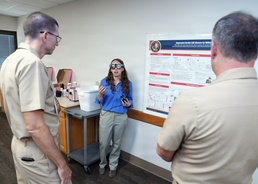
SAN ANTONIO-FORT SAM HOUSTON (Aug. 13, 2026) Alissa Klein, of Agoura Hills, Calif., a graduate student at Georgia Institute of Technology, is participating in the Office of Naval Research’s Naval Research Enterprise Internship Program (NREIP) at Naval Medical Research Unit (NAMRU) San Antonio.
NREIP gives academically talented college students, graduating seniors, and graduate students pursuing STEM careers the opportunity to learn about Naval research and technology while receiving first-class mentoring by top scientists and engineers.
During her summer internship, Klein was assigned to the Biomedical Systems Engineering and Evaluation Department where she conducted research on augmented reality (AR) glasses for use by military medics.
To present her findings, Klein participated in a poster session and oral presentation held at the Battlefield Health and Trauma Research Institute, Aug. 11 and 13.
The end goal of Klein’s research is to have an AR system in Role 1 medic’s helmets with live positioning and health data to help them quickly and effectively triage causalities in the field.
According to Klein’s mentor, Andres Martinez Murillo, a biomedical engineer, assigned to Combat Casualty Care and Operational Medicine directorate, her internship was extremely effective in prototyping and further developing the AR glasses for military medics.
“The idea of researching a system to find casualties in the battlefield came from last year’s Military Health System Research Symposium when we were listening to a talk about Ukraine and how medics were having difficulty getting to casualties in the field due to drones spotting them,” said Martinez Murillo. “It seemed to us that by having a system that allows medics to spot their casualties in the chaotic battlefield, it may be quicker for medics to reach the casualty, for both their safety and the casualties.”
Klein was instrumental in developing the GPS guided system to locate the casualties and coded the entire system to work with an AR system previously developed by the engineers, Martinez Murillo explained.
“Her consistency and determination allowed her to complete the prototype system in time for future testing, and we applaud her for her efforts and achievements. We couldn’t be prouder of the internship candidates we received this year.”
Navy Medicine Research & Development (NMR&D) makes use of multiple channels to recruit and retain critical U.S. Navy medical support personnel. The research commands reach out to the next generation of scientists through conferences, STEM events, internships and career days, and support recruiting efforts early in undergraduate and graduate programs.
NAMRU San Antonio, part of NMR&D, conducts gap-driven combat casualty care, craniofacial, and directed energy research in support of Navy, Marine Corps and joint U.S. warfighter health readiness and lethality while engaged in routine and expeditionary operations.
Navy Medicine’s 44,000+ talented and ready forces optimize health readiness, deliver quality healthcare, and provide global expeditionary medical support to warfighters.