In any given year, if you drive through the front gates of Camp Grayling, Michigan, during the first two weeks of August, you won’t make it very far before you hear an acronym being tossed around without restraint: WINS.
“When is the next WINS brief?”
“Who’s got the next WINS?”
“No, she can’t make 0900 work; she’s got WINS. How about 1030?”
“Bring that DV through the WINS at Building 353, that should be a good primer.”
Like any good staff officer and directorate lead, I largely ignored this acronym. I pretended to know what it meant for several days, hoping it would be casually disclosed in passing before I could put it in GenAI and learn a new concept. I nodded. I wrote things down to develop context and look competent. I rearranged schedules. I quietly waited for the truth to reveal itself.
I was familiar with the concept of winning, and the notion of accumulating multiple victories for a cumulative, categorical achievement commonly referred to as wins. Wins were good, a cause for celebration and recognition, and based on the generally constant use of the WINS acronym, I made the inference that they could be related.
Perhaps a brief on how well things are going? In a world of red charts on PowerPoint slides and the daily consumption of four different FRAGORDs, this was a reassuring notion.
However, on August 3rd, my curiosity and complacency finally diverted flight paths.
“Sir, what is the WINS brief?” I asked Colonel Todd Fitzpatrick as we were leaving the office after an interview with a local network of radio stations. Col. Fitzpatrick looked at me, smiled slightly, and imparted the knowledge.
“Ah, for the uninitiated. What Is Northern Strike? WINS. The WINS brief.”
Exercise Northern Strike
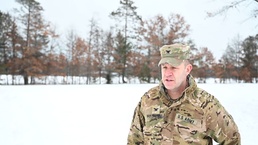
Fitzpatrick is the Exercise Director for Northern Strike—having held the billet since July of 2023. Most writers, myself included, would find it difficult to separate his story over the last three years from that of the exercise itself. He has borne this burden of leadership for more than 1,100 days. In 48 hours, his odyssey of leading Northern Strike will come to an end.
Exercise Northern Strike is Michigan’s annual invitation for the joint force to mobilize north, get uncomfortable, and do difficult things at scale.
Since 2012, Northern Strike has grown from a regional training event into a joint, multi‑national exercise series that fills Michigan’s National All‑Domain Warfighting Center (NADWC) with hundreds of rotational units each year. Under Fitzpatrick’s tenure as exercise director, that growth has been defined not just by numbers, but by the character of training.
In his first summer in the chair, Northern Strike 23‑2 pulled more than 7,000 participants from 25 states, one territory and several international partners into Camp Grayling, Alpena, Selfridge and Oscoda‑Wurtsmith for expeditionary skills, command and control, sustainment and joint integrated fires training. The exercise even pushed into intra‑theater medical care, evacuating simulated patients to Fort McCoy, Wisconsin for follow‑on treatment—tying Michigan’s training environment directly into the broader readiness system.
Northern Strike 24‑2 sharpened the focus on the emerging character of war. More than 6,300 participants from 32 states and territories and five international partners trained on homeland security scenarios, defense against unmanned aerial systems, maritime protection of high‑value assets, and combat search and rescue systems. The Joint Personnel Recovery Agency integrated with training units to test newly developed recovery systems, while units worked problems across Lake Huron, Rogers City Quarry, Battle Creek, Oscoda‑Wurtsmith, and K.I. Sawyer.
By 2025, Northern Strike 25‑2 had fully embraced Combined Joint All‑Domain Command and Control, Combined Arms Live‑Fire Exercises, cyberspace and electromagnetic activities, defensive cyberspace operations and contested sustainment and logistics. More than 7,500 participants from 36 states and territories and nine international partners trained with counter‑UAS scenarios, more than 30 fixed‑wing aircraft, En‑Route Patient Staging System medical chains, unmanned undersea vehicles, and maritime freedom of navigation operations.
In 2026, Northern Strike 26‑2 crossed another threshold. More than 9,000 military personnel from 36 states and territories and five international participants are now training across Michigan’s NADWC on large‑scale combat operations, contested logistics, integrated counter‑UAS, maritime operations on both Lake Michigan and Lake Huron, and Expeditionary Port Mortuary capabilities. The exercise is explicitly described as a proving ground for how the joint force will fight in the future, integrating multi-component Army, Air Force, Navy, Marine Corps, Space Force, National Guard, Reserve, interagency, and international partners in a single, accredited Joint National Training Capability environment.
If it sounds complex, that’s because it is. However, the complexity can be boiled down to core tenets.
Northern Strike has always been tailorable, scalable, and a cost‑effective return on investment for a nation to train its joint force. Under Colonel Fitzpatrick, those cornerstones of the exercise carry weight and produce results that keep units coming back year after year.
They are reflected in the way scenarios are written, the way commanders of rotational units can make decisions that affect other aspects of the exercise, and the way teams forged in the forests of Michigan must earn the proficiency of their mission‑essential tasks.
“Northern Strike has become the exercise where the joint force comes to get ready for the most difficult missions that can be imagined. Michigan’s National All‑Domain Warfighting Center gives units room to fail in training, room to learn, and immediate opportunities to go back to the field and innovate toward success,” said Brig. Gen. Scott Meyers, Director of Joint Staff for the Michigan National Guard. “Col. Fitzpatrick is critical to this effort.”
The Director
Fitzpatrick is calm, collected, introspective, and direct. A native of Grand Ledge, Michigan, he has led the Northern Strike Exercise Planning and Control team since July 1, 2023, all while maintaining his qualifications as a CH-47 (Chinook) pilot. An aviator’s aviator, his experience in the Michigan Army National Guard totals more than 30 years. A former commander of Michigan’s 3rd Battalion, 238th Aviation Regiment (General Support Aviation Battalion) formations and the NATO Kosovo (KFOR) Air Task Force, Fitzpatrick additionally serves as the Michigan National Guard’s State Army Aviation Officer (SAAO).
By serving as the Exercise Director of Northern Strike and the SAAO, not only is he responsible for the successes and failures of planning one of the largest international, joint, and multi‑component readiness exercises each year, he is also charged with validating all the flight requirements and reviewing the risk management plans for every National Guard aviation mission in the State of Michigan.
He is the person the state’s senior leaders call when a problem is persistent, complicated, and evades simple solutions. When a situation needs someone with tactical patience, a tempered demeanor, and an unwavering command presence, Michigan calls on Colonel Fitz.
During his tenure as exercise director, Colonel Fitzpatrick and his staff have incorporated a steady expansion in scale and ambition. Participation numbers have climbed into the 9,000 range for the summer iteration. International participation has grown. Scenarios now routinely include Combined Joint All‑Domain Command and Control (CJADC2), Cyberspace and Electromagnetic Activities (CEMA), Defensive Cyberspace Operations (DCO), integrated counter‑UAS operations, maritime missions on two Great Lakes and complex medical and mortuary chains in support of large‑scale combat operations.
What matters most to him, though, is not the number of patches on a slide or flags on a map. It is whether commanders are getting meaningful training for their teams—whether units are challenged, and whether the exercise is honest about the threats they will face.
“Fitz’s strength is that he doesn’t just know Northern Strike—he knows every mile of the National All‑Domain Warfighting Center and how to turn it into meaningful training for the joint force,” said Brig. Gen. Daniel Kramer. “He can sit down with an Army battalion commander, a Navy medical group, an Air Force squadron or an international partner and lay out, in plain language, what this exercise can do for them. That depth of understanding, and his ability to articulate it, is a big reason units keep coming back to Michigan to train.”
Building Ready Teams
When units come to Northern Strike, they expect to build readiness in their collective proficiencies and confidence in their ability to execute mission essential tasks. Under Fitzpatrick, that expectation has become the standard.
“Northern Strike ties all of Michigan’s training environments—the challenges of winter in Grayling, the heat of summer that penetrates the forest canopy, the waters of Lake Huron, the multi-use airspace that extends up and out—the NADWC is where serious units come to train in Multi-Domain Operations,” said Brig. Gen. Ravindra Wagh, commander of the Michigan Army National Guard. “Colonel Fitzpatrick leads the team that sets the conditions for commanders to achieve their training objectives, building teams at echelon that contribute to the ready force.”
He is not content with check‑the‑box training. When a battalion or squadron arrives at Camp Grayling or Alpena, the default assumption is that they are here to work hard problems. That might mean fighting through single‑digit temperatures and frozen equipment in January or integrating counter‑UAS systems and maritime operations on Lake Huron in August. Either way, there is a deliberate effort to connect training objectives with the realities of modern conflict.
The winter iterations, Northern Strike 25‑1 and 26‑1, tell that story clearly. Those exercises have put reserve component and active duty forces into wind, snow, and temperatures that have historically dropped lower than parts of Alaska, forcing units to adapt and overcome conditions they could face against a near‑peer threat. Units move people and equipment into the NADWC via rail and roadway, then execute cold‑weather, joint all‑domain operations, shaping operations with joint fires and drawing from a cold‑weather equipment pool that includes skis, snowmobiles and snowshoes.
Summer iterations have matched that intensity in different ways. Units train on air defense scenarios born from recent drone attacks in the Middle East, practice defensive cyberspace operations, and run contested sustainment lanes that force logisticians to think in terms of denied routes and disrupted communications. Medical units exercise supply chains and aeromedical evacuation—in a contested and complex environment. Maritime teams protect high‑value assets, work freedom of navigation operations, and integrate unmanned systems above and below the waterline. The vision Fitzpatrick put forward to his team is that we must nest conditions of what is currently possible with what will be possible; build the scenario to the requirements of the next year, the next rotation, the next conflict.
Colonel Fitzpatrick’s approach to building ready teams is straightforward. First, define what “ready” means for the unit. Second, design the problems so they can’t be solved by repetition alone. Third, give commanders room to command.
He spends a surprising amount of time listening—to planners, to liaison officers, to range control, to commanders who have just come off a live‑fire lane. He asks what worked. He asks what felt “canned”. He asks where the friction was artificial and where it felt real. Then, he has his team adjust.
On the staff side, Northern Strike has become an annual proving ground for planners, battle captains, and control cell personnel from across the Michigan National Guard and visiting units. Under his leadership, the exercise planning and control team has mentored a cohort of officers and NCOs each year, building the foundational block that grows staff proficiencies in the Michigan force.
Those staff members learn how to move thousands of people and pieces of equipment across multiple locations safely, how to synchronize fires and airspace, how to balance environmental constraints with operational needs, and how to respond when the plan meets real weather, real maintenance, and real human factors.
A Legacy of Innovation and Developing Subordinates
Northern Strike under Colonel Fitzpatrick has been defined by innovation in both exercise design and leader development.
On the design side, the exercise has steadily integrated new domains, threats, and technologies. Counter‑UAS scenarios and air defense lanes derived from real‑world drone attacks. Command and control architectures that force units to think in terms of dispersed, contested networks instead of static, linear communications. Complex cyber and electromagnetic spectrum attacks on units that require commanders to fight through degraded systems—Northern Strike lacks a pause button to halt training and “fix comms”. Maritime operations on Lake Huron and Lake Michigan that blend unmanned platforms and complex targeting problems. Expeditionary mortuary capabilities tied directly into large‑scale combat operations. None of that came out of a vacuum. It came from a director who is willing to let the exercise evolve, and who sees innovation not as a buzzword, but as a requirement.
Equally important has been Fitzpatrick’s focus on developing leaders.
In my short time knowing him, I have seen him consult his subordinates for their experience, analyze the knowledge his staff generates, thoughtfully internalize risks and requirements, assess the viability of possible solutions, and direct action based on what decisions will best support commanders in the field. The Northern Strike plans and operations cells, under his leadership, have been engineered to develop solutions for units and prepare service members for the warfight of tomorrow.
Junior officers and NCOs in the exercise planning and control team are not treated as note‑takers. They are treated as future operations officers, future battalion S3s, and future brigade planners. Fitzpatrick puts them in positions where their analysis matters. He allows them to brief senior leaders. He expects them to understand not just their lane, but how their lane affects integrated collaboration between the adjacent cells. How will this aviation issue affect logistics? How will the logistics constraints degrade fires? What is our crossover between public affairs and localized civil‑military relationships? Fitzpatrick is building the future leaders of the Michigan National Guard using the microcosm of Northern Strike to build staff proficiencies that will carry Michigan for the next twenty years.
They learn that innovation, in this context, is not an abstract concept. It is the act of taking a commander’s intent, understanding the threat, recognizing the constraints, and then building an exercise event that stretches units without breaking them. See yourself, see the enemy, see the terrain. For a young staff officer, this point of inward reflection on exterior, operational variables must be internalized. The consistent nature of warfare, versus the ever-changing character of warfare, lives on in every marker strike on the whiteboard, every argument turned professional development conversation, every drone intercepted around a command post, with every tick on the Battle Major’s watch. Fitzpatrick has caught the lightning in a bottle.
Over three years, that pattern has produced a cadre of officers and NCOs who can plan, control and adjust large‑scale training events. It has also built a shared understanding among Michigan’s up-and-coming staff talent that Northern Strike is not just an exercise; it is a schoolhouse for planners and operators.
“Colonel Fitzpatrick is the type of leader you pray you get the opportunity to work for during your career. His work ethic is second to none; he will never say that we can’t complete an assigned task. He’s one of the most intelligent and versatile officers I’ve ever served with,” said Lieutenant Colonel Nick Anderson. “I’ve had the pleasure to work for him over the last three years; during that time I’ve seen Northern Strike grow to something it would take other organizations ten years to replicate.”
The Future
The future of Exercise Northern Strike will be one without Todd Fitzpatrick at the helm. They say the future holds no guarantees, and each year the mission grows more complicated and competes with new priorities. With that, it can be difficult to prognosticate with certainty what the exercise will look like two or three iterations from now.
What can be said, with some confidence, is that the foundation he leaves behind is solid. It is capable. It is ready.
Northern Strike today occupies a specific place in the national training ecosystem. It is the National Guard’s largest joint readiness exercise, a joint‑accredited program that brings together thousands of service members across multiple services, components, and countries. It supports the national strategies and strategic priorities focused on the Arctic, large‑scale combat operations, contested domains, and homeland defense. It generates an average of tens of millions of dollars in economic activity in northern Michigan each year, tying the readiness of the joint force directly to the health of local communities.
It also has a reputation as an exercise where commanders expect reality. They expect scenarios that reflect real threats, not sanitized ones. They expect an area for their staff teams to learn how to handle complexity. They expect to walk away with readiness, not just in their metrics, but in their ability to execute their assigned mission with confidence.
Fitzpatrick’s departure will test that system. New leaders bring new ideas to shape the exercise. Global events will continue to shift the character of war. Technologies will change. Policy guidance will update. The exercise will need to keep pace and snowball with complexity.
The advantage Northern Strike carries into that future is the culture he helped build—a culture that treats training as serious work, that expects innovation, that respects the profession of arms and that understands the responsibility attached to bringing thousands of service members into Michigan’s training areas.
It is also backed by a generation of staff officers and NCOs who have learned under his watch how to plan, execute, and adjust. They know what “good” looks like. They know when an exercise event is shallow and when it is dynamic. They know how to have difficult discussions with commanders about risk, requirements, and training tradeoffs.
The WINS brief—“What Is Northern Strike”—will continue. The new director, Lieutenant Colonel Richie Sands, will stand up in front of distinguished visitors and explain why units keep coming back to northern Michigan in the dead of winter and the longest days of summer. He will talk about NADWC, next-generation command and control, the availability of the electromagnetic spectrum, unmanned surface vessels, and large-scale combat operations (LSCO). He will fixate distinguished visitors on maps and schedules and slides and demonstrations of combat power. He will carry Fitzpatrick’s legacy and build the exercise bigger and better. LTC Sands will direct his team to innovate, to pull in new resources to meet the requirements of commanders in the field, all while maintaining the concept of keeping the warfighter at the exercise center.
The guarantee of Northern Strike led by Fitzpatrick was one of warfighters operating a little closer to the edge of the reality of modern warfare. Fitzpatrick’s team created a training environment that plucked service members out of their comfort zone, made leaders of rotational training units a little more honest about the threats they will face, and built ready teams prepared to plan and execute the missions of our nation.
The future of Exercise Northern Strike will be written by the units that keep making the drive up to Northern Michigan, the commanders who keep demanding more, and the planners who keep finding ways to deliver it.
If I were a betting man, I would be putting my money on a future full of wins.