SACRAMENTO, Calif. -- U.S. Army Corps of Engineers Sacramento District leaders consistently look for ways to improve project delivery methods. One of the most effective ways to achieve this goal is through industry partnerships.
Industry partners have significant experience implementing progressive and collaborative delivery methods such as progressive design-build, design-build to budget, integrated design and construction, and early contractor involvement. Now, USACE is exploring opportunities to incorporate these tools into its contracting processes and is seeking direct feedback from industry partners to shape future acquisition strategies.
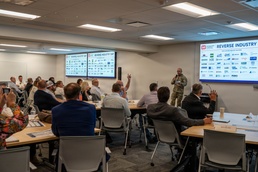
The Sacramento District hosted over 50 contractors who are familiar with methods such as progressive design-build for a Reverse Industry Day.
Unlike traditional industry days where government representatives present upcoming workload and projects to contractors, Reverse Industry Day flips the script. The event centered on roundtable discussions where USACE and industry partners sat together to share lessons learned, highlight best practices, and identify concrete opportunities to improve project delivery outcomes.
The driving force behind this shift is a recognition that the traditional "design-bid-build" model no longer meets modern needs.
The three sequential phases in this model--design, bid, and build--are contracted with separate entities, which limits collaboration during early design phases. Often, USACE would elect to design projects but shifting priorities led to designs being shelved for years. By the time funding is acquired, engineering standards may have changed resulting in redesigns and ultimately extending the timeline of a project.
To deliver projects faster, the military is optimizing innovative acquisition strategies like progressive design-build and other transaction authorities.
In progressive design-build, USACE can collaborate with contractors during early design phases before negotiating a final project price. A major shift from previous methods where collaboration couldn’t begin until the design phase was complete.
In December 2025, that requirement changed when Congress passed the National Defense Authorization Act for Fiscal 2026, marking the first time progressive design-build is specifically authorized for military construction. A prime example of progressive design-build is modeled by the Little Mountain Test Facility, a state-of-the-art radiation research facility near Hill Air Force Base in Utah.
Little Mountain Test Facility was USACE’s first Progressive Design-Build Other Transaction solicitation. Under this $111.5 million program, a new 50,000 square-foot facility will expand the nation’s radiation testing capabilities in support of the Sentinel program and future Nuclear Hardness mission requirements.
“We will use these innovative acquisition strategies to more efficiently deliver quality projects on time and within budget,”saidCol. Robert McTighe, USACE Sacramento District commander.