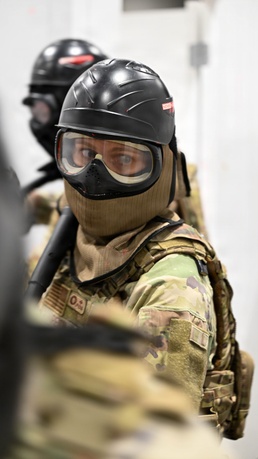
JOINT BASE ELMENDORF-RICHARDSON, Alaska – Twenty-two Air Guard security forces Airmen from the 107th Attack Wing conducted land navigation and active shooter training in Alaska from July 13 to 19.
The training exposed the airmen to an environment different from their home station at Niagara Falls Air Reserve Station. The terrain around Joint Base Elmendorf-Richardson, just outside Anchorage, includes dense brush, taller trees than those in western New York, hills that limited visibility and consistently changing weather conditions.
“With the land navigation and active-shooter training, it sharpens our mind where we can’t just rely on memory because everything looks different,” said Senior Airman Kaitlyn Reich.
Master Sgt. Earl Barber, the senior enlisted member for the exercises, said training in Alaska gave the airmen experience operating in conditions they could encounter during assignments in other parts of the world.
“TDYs to Alaska are very important as it’s a different environment, which helps us train for cold weather or constant rain for days, just like it was when we were there,” Barber said.
The terrain also presented challenges during land navigation training. Barber explained the dense brush and hills could limit visibility to 10 to 20 feet, requiring airmen to adjust how they moved and navigated.
“There is also the elevation change itself that is different,” Barber said. “When we go overseas in different climates and terrains that are like Alaska, this helps us to be able to adapt to that environment.”
The training environment also included an unexpected wildlife encounter when a group conducting land navigation encountered a black bear which went without incident.
JBER isn’t a fenced-in base meaning local wildlife can wander on base at will. To ensure the safety of the individuals present on base, the base’s Facebook page gives constant warnings of watch out for wildlife.
Barber said the thick brush and limited visibility meant airmen had to remain aware of hazards that might not be immediately visible.
The room clearing training exercise presented a different challenge: an unfamiliar facility layout. The scenarios included armed and unarmed role players and civilians, requiring the airmen to apply the appropriate rules for each situation.
Riech said the experience also provided lessons she can bring back to her civilian law-enforcement career and use when training other members of the squadron.
“The field experience gives me an advantage in my career,” said Reich, who is also a West Seneca police officer. “I’m able to apply techniques I learned in Alaska to help improve training at home.”
Those lessons included navigating without relying solely on GPS and applying techniques from the active shooter training, Reich added.
The Alaska training gave the 107th Security Forces airmen experience operating outside their familiar environment while reinforcing the need to adapt their tactics and decision-making to changing terrain and conditions, the Airmen said.