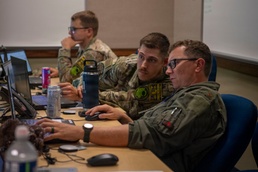
The 110th Wing conducted an air component forward experiment during exercise Northern Strike 26-2 at the Alpena Combat Readiness Training Center, Aug 3 -14.
Traveling more than 250 miles, the 110th Wing rapidly deployed a team from Battle Creek to evaluate agile command and control capabilities.
“Command and control of airpower in a distributed, contested environment is no small task,” said U.S. Air Force Lt. Col. Ignacio Perez, 217th Air Component Operations Squadron director of operations. “It requires subject matter experts to work together in conditions they are not accustomed to.”
“Our team met this challenge head on,” added Perez. “They established the necessary communication, security, and staff infrastructure to be able to publish and disseminate air tasking orders for the exercise from an alternate location.”
The experiment marked the second iteration of the concept, building on lessons learned from last year’s Northern Strike exercise. As in the previous iteration, the team transported equipment and personnel to Alpena.
“Building on last year’s success, we were able to leverage new tech on commercially available networks and sustain air operations under simulated contested conditions," said Perez. “We were able to bring units from across the base, state, and nation together to further prove we can conduct distributed operations. This is critical to any theater the Air Force may find itself in.”
The joint experiment encompassed units from across the 110th Wing, the Michigan National Guard’s 51st Weapons of Mass Destruction-Civil Support Team (WMD-CST), and a Navy Air Naval and Amphibious Liaison Element (NALE).
“Operating in a joint environment is exactly what we need to prepare for near-peer conflicts,” said U.S. Navy Cmdr. William Fortune, U.S. Naval Forces Europe-Africa NALE reserve unit. “By combining our unique capabilities with the 110th Wing’s airpower focus, we proved that we can continue the joint fight by still seamlessly communicating, sharing data, and sustaining a unified front even when operating from an austere location and communications are degraded.”
This year’s experiment tested staff planning and operational functions required to rapidly deploy equipment and personnel.
“It is a great opportunity to test the logistics behind moving an Air Operations Center and other staff functions,” said Master Sgt. Brandon de Jong, 217th Air Component Operations Squadron air transportation specialist. “We are demonstrating how we can downsize our tech and personnel footprint while still getting the job done. This is how we test and build resilient capabilities.”
Another new aspect of this year’s training was modifying existing air tasking orders from remote locations in the field and on the water.
“Demonstrating distributed command and control from the middle of Lake Huron marks a significant step in how we operate in contested environments," said U.S. Air Force Maj. Megan Serrano, 110th Operations Support Squadron assistant director of operations. “This experiment proved we can replicate key aspects of an air operations center in a non-traditional environment.”
The team also demonstrated numerous ways to connect to required networks and applications, including using 5G provided by the 110th Communications Squadron, the local network, and assistance from the 51st WMD-CST.
“We’re here today to support the air component forward with a distinctive capability we bring to the fight: Starshield,” said U.S. Air Force Maj. Jeffrey Overhulse, 51st WMD-CST deputy commander. “It provides resilient command and control from an austere location, delivered by a team postured 24/7/365.”
By mastering these lightweight logistical footprints, the 110th Wing directly enhanced the broader exercise by providing rapid command and control information for air assets supporting thousands of participating ground troops.
“The second iteration of the experiment shows how the wing and our partners are leaning forward,” said U.S. Air Force Col. James Rossi, 110th Wing commander. “We are constantly looking to innovate and improve our capabilities. The things we learned here have tremendous benefit for the Air National Guard and the Air Force as a whole.”