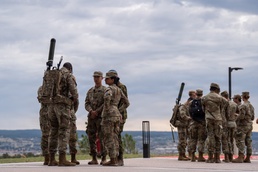
U.S. AIR FORCE ACADEMY, Colo. —Approximately 300 cadets participated in the Space Force’s Azimuth program throughout the summer, gaining exposure to its missions, organizations and Guardian culture.
Azimuth serves cadets already selected to commission into the Space Force and those considering Space Force career opportunities. It also introduces future officers from other services and Canada to the role of space capabilities in joint and coalition operations.
Detachment 1, Space Delta 1, hosted three sessions of the three-week pre-commissioning program at the U.S. Air Force Academy, with most of the cadets hailing from either the academy or an Air Force ROTC detachment.
“Through classroom instruction, operational visits, hands-on experiences and capstone exercises, cadets gain the knowledge and perspective to arrive at their first assignment better prepared to contribute,” said Maj. Sarah Dawdy, the detachment’s chief of staff. “More importantly, we want them to understand where they fit into the bigger picture and arrive at their first assignment ready to learn, contribute and lead.”
The Azimuth program directly supports STARCOM’s mission to prepare combat-ready forces to fight and win in a contested, degraded and operationally limited space environment. By prioritizing the deliberate development and education of these cadets early in their careers, STARCOM is actively shaping the next generation of space warfighters.
The curriculum progressed from foundational instruction to operational exposure before concluding with an exercise requiring cadets to apply what they learned.
During the first week, cadets learned about the Space Force’s organization, missions, threat environment, space weather, international partnerships and access to space.
They reinforced those lessons through hands-on electives involving cyber operations, imagery analysis and satellite operations. Other activities included neutral buoyancy training and high-powered rocketry.
The second week moved cadets from the classroom to operational units at Schriever, Peterson and Buckley Space Force Bases and other mission locations.
“The operational visits are always a highlight because cadets get to see the mission firsthand and interact directly with Guardians doing the job every day,” Dawdy said. “Apollo Dagger, the Space Policy Game and the hands-on electives also give them the opportunity to apply what they’ve learned and see how it all comes together.”
Cadet Austin Smith, Michigan State University Air Force ROTC, East Lansing, Michigan, said Azimuth provided additional exposure to the space mission.
“For me, Azimuth has been absolutely wonderful,” Smith said. “It’s been the ability to actually see Space Force competencies, Space Force career fields and Space Force life in a way that I never would have been able to if I didn’t have this opportunity.”
During the final week, cadets participated in Apollo Dagger, a capstone exercise conducted alongside the Special Warfare Orientation Course.
Participants served as a space planning cell supporting special operations forces during scenarios focused on electromagnetic warfare, orbital warfare and missile warning. They developed mission products and space domain awareness information in support of operational planning.
This year’s program placed greater emphasis on operational missions, mission planning and the Space Force’s role within the joint force and the international community. It also covered the military, political and economic implications of decisions involving space operations.
While addressing cadets, Col. Krista St. Romain, Delta 1 commander, challenged them to embrace the responsibility of serving in the space domain.
“There are new opportunities for each one of you, should you choose to become a Guardian,” St. Romain said.
She went on to explain that space comes with its own unique set of challenges, requiring solution-oriented recruits with an eye for problem solving.
“Don't just identify a problem,” said St. Romain. “Who's going to solve it? We're moving fast and those are the individuals we're looking for in the Space Force.”
Industry representatives also discussed how the commercial space sector contributes to national security and future capabilities.
“Azimuth wouldn’t be possible without the tremendous support from across the Space Force and our partners,” Dawdy said. “Operational units and organizations, academia and industry partners volunteer their time to mentor and educate.”
The program concluded with a post-course assessment, end-of-course survey and closing ceremony for each group.
“Whether they commission into the Space Force or another service, we want them to understand how space capabilities support and enable the joint force,” Dawdy said. “For those becoming Guardians, we want them to have a solid foundation they can build on.”