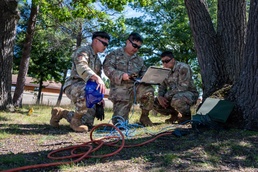
ALPENA, Mich. -- Combat communications squadrons from multiple states and territories gathered in northern Michigan Aug. 1-15 to support Exercise Northern Strike 26-2 at Alpena Combat Readiness Training Center.
The 239th Combat Communications Squadron, Missouri Air National Guard, trained and worked alongside the 264th CBCS, Illinois Air National Guard, and the 293rd CBCS, Guam Air National Guard, combining their experience to establish and maintain communication capabilities for exercise participants. Based out of Jefferson Barracks Air National Guard Station, Missouri, the 239th CBCS provides communications support wherever it is needed, including in deployed locations, as part of the 131st Bomb Wing.
Northern Strike is a biannual National Guard Bureau-sponsored exercise that brings together thousands of joint and allied service members to train in a simulated combat environment to replicate the complex challenges warfighters may face during military operations.
“Being so far away from home creates the opportunity for people to work close together [and] outside of their comfort zone,” said Maj. Eric Karas, 264th CBCS commander. “We get to share experiences and skills that we don’t normally get to and come up with new problem-solving methodologies, especially with sister combat communications units.”
Together, the squadrons built a variety of communications systems to provide secure voice, data, and internet for over 900 joint and allied exercise participants at Alpena Combat Readiness Training Center. Airmen addressed communications needs identified before the exercise as well as new requests that emerged during training.
“It’s very much a real-world scenario,” said Staff Sgt. G. Raye Anderson, 239th CBCS cyber transport systems specialist. “For more austere locations you have to rely on tactical satellites and radio frequency kits.”
Northern Strike’s realistic training situations and mission requirements challenged the squadrons to adapt, collaborate, and develop solutions required for agile combat employment where traditional communications infrastructure may not be available.
“The great thing about the Air [National] Guard is the diversification of our Airmen’s skills, and anytime we can share that we become better warfighters,” said Maj. David Hood, 239th CBCS commander.
Hood said deployments often present challenges that go beyond the squadron’s standard capabilities, requiring Airmen to adapt and find creative solutions to meet the mission.
"Experiences like this give us the chance and creative freedom to practice doing so,” Hood said.