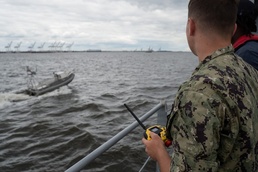
U.S. Naval Academy midshipmen participating in summer training aboard Yard Patrol (YP) craft have completed the inaugural “YP NEXT” training block, deploying robotics and autonomous systems (RAS) directly from YPs for the first time in history, marking an important milestone in preparing future naval leaders for an increasingly autonomous maritime battlespace.
“Using our iconic Yard Patrol craft as “motherships” for autonomous systems, our remarkable group of midshipmen were the first to execute this innovative concept, integrating autonomous capabilities in the air, on the sea, and under the sea,” said Lt. Gen. Michael Borgschulte, Superintendent of the U.S. Naval Academy. “The future fleet will be crewed, uncrewed, and seamlessly integrated, and the future leaders of that fleet are already underway and making way in this critical field.”
Held during the third block of summer training in July and August, YP NEXT introduced midshipmen to the tactical employment of unmanned and autonomous technologies while reinforcing core competencies in seamanship, navigation, damage control, and bridge resource management.
The first RAS portion of the training block opened with an industry-led “Field Day,” exposing midshipmen to advanced uncrewed architectures. Industry partners provided hands-on instruction on platforms including Havoc AI’s Rampage and BlackSea Technologies’ Global Autonomous Reconnaissance Craft (GARC) unmanned surface vessels alongside Jaia Robotics’ Jaiabot aquatic data-collection drones.
Midshipmen applied those concepts during a simulated “Game Day” evolution developed with the Johns Hopkins University Applied Physics Laboratory. Using custom-coded search patterns, midshipmen executed tactical mission profiles to map hydrographic environments, track and identify targets, and simulate the neutralization of maritime threats.
“This training block was not just an introduction to technology, but an immersion into the RAS ecosystem, including education, hands-on experience, and experiential learning from success and setbacks while employing advanced systems,” said Cmdr. Donny Peltier, the Adaptive Rapid Engagement Squadron (ARES) Director and a professor within the Weapons, Robotics and Control Engineering Department. “Our future warfighters have received a unique immersion into RAS through this inaugural training event at the Naval Academy, and we can confidently say no other university offers a program that seamlessly integrates academia, military operations, cutting-edge technology, hands-on experience, and industry partnerships like we do.”
Under their Drone Dominance Program, the Department of War recently directed 80 Neros Archer first-person view, quadcopter drones for use in a training environment at the U.S. Naval Academy so that midshipmen can establish a baseline familiarity with low-cost, consumable strike and reconnaissance platforms. Connectium Technologies led classroom instruction on unmanned aerial vehicle attack drone history, capabilities, and flight instruction and provided hands-on training on the field using the Neros Archer and Skydio air vehicles. Instructors from the Marine Corps Warfighting Laboratory and the Naval Academy’s Adaptive Rapid Engagement Squadron (ARES) team also taught the midshipmen how first-person view drones can enhance small-unit lethality and provide organic capabilities in combat.
“This is the future of naval warfare in action,” said Borgschulte. “Our midshipmen are taking the cutting-edge research developed in our world-class classrooms & laboratories and applying it where it matters most: at sea. They are learning not only how to operate autonomous systems, but how to integrate and employ these technologies in tomorrow’s fight.”
Following initial ashore and localized evolutions, the midshipmen took to sea for a Chesapeake Bay and Atlantic Ocean transit that combined rigorous shiphanding with real-world exposure to the defense industrial base, academia, and operational forces:
Rather than displacing fundamental mariner skills, the U.S. Naval Academy is committed to ensuring midshipman understand how autonomous capabilities are designed to augment them. This summer training block and YP NEXT marks the opening phase of a comprehensive institutional effort to integrate RAS concepts across all four years of the midshipman experience. Insights from the initial training block will directly inform future curriculum updates, laboratory research, and Brigade-wide professional training, aligning U.S. Naval Academy instruction with Navy and Marine Corps priorities to accelerate adoption of unmanned technology alongside expert human decision-making.
Founded in 1845, the U.S. Naval Academy today is a prestigious four-year service academy that prepares midshipmen morally, mentally, and physically to become professional officers in the naval service. More than 4,400 men and women representing every state in the U.S. and several foreign countries make up the student body known as the Brigade of Midshipmen. U.S. News and World Reports has recognized the Naval Academy as the #1 top public school, #3 national liberal arts college, and #5 best undergraduate engineering programs. From a pool of more than 16,000 applicants, approximately 1,200 earn appointments to the U.S. Naval Academy each year. Midshipmen learn from military and civilian instructors and participate in intercollegiate varsity sports and extracurricular activities. They also study subjects like small arms, drill, seamanship and navigation, tactics, naval engineering and weapons, leadership, ethics, and military law. Upon graduation, midshipmen earn a Bachelor of Science degree in a choice of 26 different subject majors and go on to serve at least five years of exciting and rewarding service as commissioned officers in the U.S. Navy and U.S. Marine Corps. For more information about the Naval Academy, visit www.usna.edu and our social media via linktr.ee/usnavalacademy.