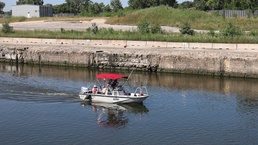
The U.S. Army Corps of Engineers (USACE) Chicago District recently completed a series of comprehensive tests on the Electric Dispersal Barrier System to better understand the system's operating limits and evaluate the effects of increased stray electrical currents should higher voltage levels ever be required to control the transfer of invasive carp species into the Great Lakes.
Located on the Chicago Sanitary and Ship Canal (CSSC) in Romeoville, Ill., the Electric Dispersal Barrier System serves as the critical line of defense against the movement of invasive fish species between the Mississippi River Basin and the Great Lakes. The CSSC creates a man-made aquatic connection between the Chicago River and the Des Plaines River, making the barriers an essential component in protecting the Great Lakes ecosystem. The barriers generate an underwater electric field that deters invasive fish from advancing through the canal.
Testing was conducted in two phases, with the first occurring in February and the second in July. Each phase lasted approximately two weeks, allowing engineers to collect data under both cold and warm weather conditions. Seasonal differences can affect variables such as water conductivity and fish activity, making it important to evaluate the system under a variety of environmental conditions.
Each testing period consisted of two distinct phases. During the first week, engineers collected baseline measurements without vessel traffic. The second week introduced barge traffic to evaluate how large commercial vessels influence the electric field and surrounding stray currents under a variety of operating conditions.
To simulate the largest vessel configuration typically seen in this section of the canal, crews used one tugboat pushing five barges. The barges can effectively act as an extension of the electrical field, potentially allowing stray current to travel farther than it would under normal operating conditions. While previous testing has confirmed that current signage and safety measures are appropriate during normal operations, these tests were designed to determine how far stray currents could extend if the system were required to operate at significantly higher voltage levels. At the highest test settings, electrical measurements may extend beyond the existing safety signage, providing valuable data for future planning.
The presence of large barges also places additional demand on the barrier system. As vessels move through the electric field, operators must continuously adjust the voltage to maintain the desired electric field strength throughout the barrier.
During testing, engineers evaluated the system at three operating levels: the normal operating level of 2.3 volts per inch, followed by elevated levels of 3.7 and 4.6 volts per inch.
"A lot of this effort is about capturing data at operating levels that we don't normally use," said Josh Nickel, Barrier Project Manager for the USACE Chicago District. "Under normal operations, the barrier runs at 2.3 volts per inch. It creates an underwater electric field that deters invasive fish from advancing and directs them back downstream."
Nickel explained that testing at these elevated levels is uncommon and is conducted specifically to prepare for the possibility of an invasive species threat that would require immediate operational changes.
"We want to ensure safety is always our top priority," Nickel said.
Should the district receive notification of an imminent invasive fish threat, operators may need to quickly increase the barrier's operating levels.
"We need to understand exactly what happens from a safety standpoint for our personnel, stakeholders and anyone working in or around the project site," Nickel said. "If we ever have to ramp up operations, we'll already know what to expect."
Approximately 30 personnel from across the Chicago District supported the testing effort, representing Operations, Construction, Engineering and Design, Vertical Construction, Geospatial, as well as personnel from the Rock Island District.
Throughout the testing, crews collected both static and dynamic electrical measurements. Static measurements were taken at predetermined locations upstream of the barrier before and after barge movements to verify that electrical currents remained within expected limits. Additional crews positioned around the site collected dynamic measurements at potential critical locations, documenting the highest levels of stray current observed during testing.
The team also took advantage of the opportunity to improve future operations by developing a detailed field map to support dive operations conducted during normal barrier conditions. The mapping effort will help establish safer procedures for future maintenance activities.
"We recognized an opportunity to make a strategic advancement," Nickel said. "Once a future contract is awarded, we'll already have the information needed to develop a safe dive plan, protect our employees and execute the work efficiently."
Weather presented additional challenges throughout the testing period. Storms temporarily halted field operations and disrupted portions of the barrier's electrical power supply, requiring crews to continually adapt their testing schedule.
"We were able to pivot and adjust as conditions changed," Nickel said. "By adapting our plan, we completed work that was expected to take an additional week and finished ahead of schedule."
The testing provided critical data that will help USACE better understand the Electric Dispersal Barrier System's performance under elevated operating conditions, ensuring the district is prepared to respond quickly, and safely, if future invasive species threats require higher barrier settings.