SAIPAN, Northern Mariana Islands—In April, one of the most powerful typhoons made landfall on the Commonwealth of the Northern Marianas Islands (CNMI)—Super Typhoon Sinlaku. With sustained winds at 170 mph, it was categorized as a “Super Typhoon” and a Category 5 storm.
The destruction Sinlaku caused on CNMI was no less than devasting. Across CNMI, there were reports of uprooted trees, overturned vehicles, toppled utility poles, loss of power, roofs ripped off homes, impassable roads, spoiled food due to loss of power, flooding and downed powerlines.
Then three months later, Super Typhoon Bavi hit. Though Bavi moved faster through the islands, it was stronger than Sinlaku. Winds were sustained at 185 mph. While Saipan and Tinian suffered damage, Rota—the southernmost island in CNMI—greatly suffered damage and lost power for almost two weeks.
Post-Sinlaku, the U.S. Army Corps of Engineers (USACE), The Federal Emergency Management Agency (FEMA), the American Red Cross, and other government and municipal agencies deployed to CNMI to assist in recovery efforts. Recovery was ongoing until Bavi halted operations, but USACE and their partners were able to respond quickly since they were already on the ground.
If you ask a USACE employee what an emergency mission is like, most will tell you that every mission is different. Each one is treated as a new experience with challenges and successes. From soldier to civilian, many have stated this was their first time deploying and shared their experience.
The People Learner With only 23 days as a USACE employee, Cpt. Nathaniel Hashisaki deployed to Saipan as part of the Super Typhoon Sinlaku Recovery mission. Based on his experience deploying for the U.S. Army, Hashisaki was expecting the conditions in Saipan to be more austere.
Hashisaki was also surprised to see the variety of people working for emergency operations. He had more of an U.S. Army lens when it comes to disasters.
“What surprised me most is the variety of personnel that support the mission from across USACE,” he said. “The most memorable is meeting and learning about people from all different backgrounds, what each person brings to the mission, learning how their districts are different; different personalities, different backgrounds.”
Even though he is task and mission focused, he always prioritizes understanding people; learning about their backgrounds and roles. This helps him see things on a macro-level to determine how to help the team. He self-describes as a “people learner.”
“I've enjoyed this so far. I've learned a lot. And I continue to learn every day,” he said.
At the Recovery Field Office, Hashisaki’s job is to assist the commander by collecting information and ensuring the team has the correct timelines and schedules to be successful.
Prior to USACE, he oversaw the health, welfare and morale as the brigade company commander for the 3rd Brigade and 25th Infantry Division. When he returns to the Honolulu District, he will be a project engineer in their construction division.
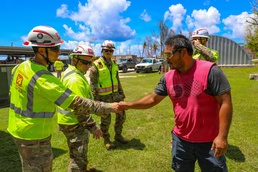
Visiting Rota Hashisaki’s job mainly requires him to be in the office working in operations; however, he was able to travel to Rota with USACE’s Grid Power team July 26. During the visit, he gained a deeper knowledge of the culture and the work USACE is doing in CNMI holistically, since he was not in CNMI at the beginning of the recovery mission.
“I was thinking about someone's roof being damaged and that they don't have power, so what are their options? Going there, you really get a perspective of a small island,” he recollected.
Hashisaki mentioned his admiration for the USACE Temp Power Team who had installed 22 generators on Rota from the day he arrived until the day he was interviewed for this story. As of Aug. 8, about 34 generators have been installed on Rota which includes: at two shelters housing about 100 people; the health center; a cell tower; water wells; police and fire departments; the judicial center; the Coral Garden (which is housing first responders), Light Heart, and Valentino hotels; a water bottle plant; an ice production facility; and a diesel service station; the Rota Youth Center; the Rota High School; and the Departments of Commerce and Labor.
“Seeing Rota’s progress over time, the level of impact that we can have across the visions that we have, is great to see the local communities being restored,” he said.
A New Perspective Being in Saipan with USACE provided Hashisaki a new perspective on the ebbs and flows of emergency operations during a disaster mission. Seeing the operations and devastation firsthand provided him the experience to understand the impact.
“Somebody could explain to me what emergency management is and how the operations are conducted. But, seeing it hands-on provides a better understanding,” he said. “You really get to appreciate the impact that USACE can have following these disasters.”
For instance, he explained at home when the traffic lights go out, he knows they will eventually be repaired in a timely manner. But for the CNMI islands, it could take weeks to turn the power back on. A generator installation is not simply power, it is a path to normalcy, which Hashisaki understands.
“It has been a long time for a lot of people,” he said. “That means a lot to these people, so taking that into consideration, and understanding this is a massive impact for them. It’s what all the planning response teams are doing and how they're helping the community,” he said.
Take the Opportunity Some advice he would give to USACE employees or military personnel desiring to volunteer for a disaster recovery would be to talk to people who have attended previous emergency missions.
“I've learned that from my understanding, from talking to people who have gone in previous ones,” he said.
From an Army perspective, he stated to always be ready for conditions that range from readily available resources to a more austere environment. Right now, he is in a hotel, but that could change at any minute.
“It's understanding that it could go either way; and to be prepared for really either option where amenities might be close by or [not] readily available,” he said. “So, it's a really rewarding experience. If you have the opportunity to volunteer, I would take it.”
It’s a Choice For Hashisaki, a soldier is told what to do without much choice. USACE civilian employees, have the choice to volunteer for an emergency. That resonated deeply with him.
“For the people of the Corps, it’s really impressive to me, and speaks volumes to the character of people in the Corps to say, ‘I will volunteer to go in his mission,’” he said.