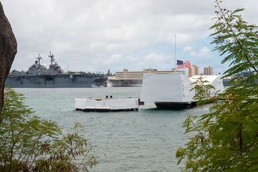
Wasp-class amphibious assault ship USS Essex (LHD 2) and Assault Craft Unit (ACU) 5 completed landing craft, air cushion (LCAC) ship-to-shore operations between Kilo Pier and Ford Island at Joint Base Pearl Harbor-Hickam (JBPHH), Aug. 2, 2026.
This marked the first in-port LCAC operation at Pearl Harbor since 2018 and the first time Essex performed this capability while docked. These operations moved critical U.S. Navy and Marine Corps equipment directly to Ford Island following the conclusion of Rim of the Pacific 2026, helping maintain mission readiness.
“Conducting these operations in-port is a tremendous logistical accomplishment, which the Essex-15th Marine Expeditionary Unit (MEU) team coordinated with local harbor authorities, while maintaining peak operational readiness,” said Essex Commanding Officer Capt. Russell Everitt. “The successful execution of these operations in a historically high traffic environment proved that with proper planning, we can exercise this capability almost anywhere we want.”
Planning and coordination for this operation involved careful risk assessments with the JBPHH Port Operations Center. Operators followed strict speed limits and used planned transit lanes to keep personnel, local boaters, and nearby historic sites safe. The USS Arizona Memorial and Battleship Missouri Memorial stayed open to visitors throughout the operations.
For the operators, steering an air-cushioned vehicle through Pearl Harbor’s narrow channels was a unique and valuable experience.
“Navigating an LCAC in the restricted waters of Pearl Harbor requires absolute precision and constant communication with the ship’s combat information center, well deck control, and port operations,” said Senior Chief Operations Specialist Tyler Dunbar, an LCAC craft master assigned to ACU 5. “The success or failure of any mission is a direct reflection of the planning. Although this appeared to be a simple ship-to-shore onload, our team dedicated days of detailed planning to ensure we would not only succeed but do so as safely, professionally, and as environmentally conscious as possible.”
During the operations, boatswain’s mates in the well deck handled the launch and recovery of LCAC 81 and LCAC 90. Since this was the first time Essex did well deck operations while docked, it was a unique challenge that required steady communication between Beach Master Unit (BMU) 1, combat information center, well deck operators and LCAC operators.
“Well deck operations are typically fast-paced, but operating pier side meant slowing down our normal rhythm to walk before we could run,” said Master Chief Boatswain's Mate Davon James. “After the first wave, things picked up speed and became business as usual. Most importantly, though, this was a great opportunity for our junior boatswain’s mates to safely perform well deck procedures and complete one of our most vital capabilities.”
All operations were finished safely and professionally, with no disruption to harbor traffic or Ford Island residents. This achievement is a major milestone for Essex and shows that amphibious forces can quickly handle logistics and sustainment whenever needed to support fleet readiness.
Essex is part of Expeditionary Strike Group (ESG) 3, a globally responsive and scalable naval command element that generates, deploys, and employs naval forces and formations for crisis response, contingency operations, forward presence, major combat operations, amphibious operations, humanitarian assistance and disaster response, and expeditionary logistics.