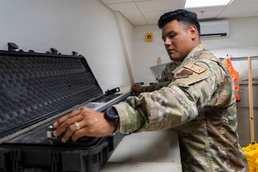
LAJES FIELD, PORTUGAL —The 142nd Civil Engineer Squadron recently completed a Deployment for Training (DFT) at Lajes Field, Portugal, to boost upgrade training and team readiness.
A DFT is a critical readiness strategy designed to provide Airmen with immersive, hands-on experience that mirrors real-world operational conditions. Whether conducted within the continental United States (CONUS) or overseas, these exercises validate mobilization procedures, strengthen team cohesion, and sharpen the squadron’s ability to adapt under resource constraints, ensuring personnel remain mission-ready for global taskings.
While this mission was originally designed as a multi-shop building demolition project, shifting priorities and budget constraints required the unit to adapt its scope on the ground. Nevertheless, the initial planning phase proved invaluable. Navigating the logistics of movement, documentation, and clearances gave the team vital operational familiarity with deployment protocols. Even as they pivoted to integrate with Lajes Field’s existing operations, reverse-engineering solutions with limited assets underscored the strength and flexibility of their initial planning foundation.
Beyond execution of trade skills, the broader strategic benefit of the mission was validating the operational processes that precede troops hitting the ground.
"The deployment for training enabled our unit to go through the motions of doing deployment activities and deployment planning," said Capt. Steven Tjoelker, a civil engineering officer with the squadron. "That was a huge factor setting us up for success in the future, being able to mobilize our Airmen, get them ready, and make sure we have all of the required training, certifications, and clearances."
A major focus of the trip was blending the squadron’s different operations shops. Instead of working in isolation, Airmen from structures, electrical, power production, and engineering assistant (EA) shops teamed up. Traditional trades gained hands-on experience training on heavy equipment, while the Water and Fuel Systems Maintenance (WFSM) shop worked with EAs to learn how to map utility lines and build infrastructure plans; essential data sets for engineering software that support airfield planning, asset allocation, and emergency management layouts.
"Together we are accomplishing the mission as one unit," said Master Sgt. Jacob Cravino, operations superintendent for the squadron. "We have younger Airmen that are going through upgrade training to get experience on other tools and use tools in a different way to solve these problems."
Beyond the technical skills, the remote setting forced the Guardsmen to build deep team bonds.
"The deployment for training is a very unique opportunity that a civil engineering squadron gets to experience, specifically in the National Guard," Tjoelker said. "It has enabled our unit to come together closer and also be able to work on difficult projects and difficult tasks with potentially limited resources and limited time."
Operating outside of their home station environment forced the Airmen to bridge the gap between their professional roles and personal dynamics. Working, eating, and living together, the team gained a deeper understanding of each member's unique strengths, allowing them to rely on one another more effectively. Unit leaders noted that cultivating this level of trust and familiarity is essential, as it ensures that when the squadron eventually faces a real-world deployment, the communication and operational cohesion are already firmly in place.