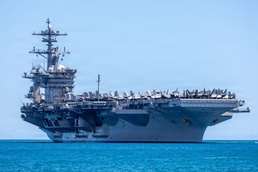
Naval Surface Warfare Center, Philadelphia Division (NSWCPD) supported exercise Rim of the Pacific (RIMPAC) 2026 through technical efforts focused on power sensing, operational energy, data collection, and navigation-system resilience.
RIMPAC is the world’s largest international maritime exercise, bringing allied and partner nations together in and around the Hawaiian Islands to strengthen interoperability, improve readiness, and build the cooperative relationships needed to support maritime security and the safety of sea lanes. The 2026 exercise marked the 30th iteration of the biennial event and provided a realistic training environment for multinational forces operating across the maritime domain.
“This exercise gave our engineers, scientists, and technical experts an opportunity to support the fleet in a realistic, multinational environment where readiness, interoperability, and resilience matter,” NSWCPD Commanding Officer Capt.Ashley “Ash” Wright said. “The work our teams did in support of this exercise reflects the direct connection between our technical expertise and the operational needs of Sailors and joint warfighters.”
As part of the RIMPAC Experimentation Program, NSWCPD’s Power Sensing Team partnered with the Naval Research Laboratory (NRL) to support the Azure Bison program. By installing and maintaining multiple sensing technologies afloat and ashore, NSWCPD provided Non-Intrusive Load Monitoring (NILM) and intrusive sensing installation support, calibration, and power-system subject-matter expertise.
These efforts produced data products that enabled cross-sensor correlation, data validation, and the identification of cross-domain electrical-system features.
The work built on NSWCPD’s broader effort to mature NILM technology as a safer, faster, and less disruptive approach to collecting electrical-system data. Traditional methods can require direct connections to energized equipment, which can be costly, time-consuming, and disruptive to operations.
The NILM effort directly supported the Generating Non-Intrusive Observations for Modeling Electrical Systems (GNOMES) project, an Operational Energy Capability Improvement Fund (OECIF) initiative.
“The value of this effort was not simply in collecting data, but in turning that data into a better understanding of how shipboard electrical systems behave under operationally relevant conditions,” NSWCPD Machinery Research Logistics and Ship Integrity Principal Technical Manager Allison DeRocco said. “By supporting sensor validation, power-system analysis, and cross-domain technical evaluation during RIMPAC, our workforce helped advance tools that can improve fleet energy awareness, resilience, and decision-making.”
Beyond hardware and data research, NSWCPD also supported cybersecurity and casualty-response training for RIMPAC 2026. NSWCPD’s Ship Navigation System, Navigation Critical Distribution System (NCDS) & Navy Electronic Chart Display and Information System (ECDIS) Controls Branch provided an Emergency Navigation Laptop to the Integrated Warfare Systems 6 cybersecurity program manager for underway use.
The Emergency Navigation Laptop is a stand-alone backup navigation capability designed to provide continuity if a ship’s primary ECDIS becomes unavailable. During RIMPAC operations, the laptop was used to simulate a cyber-related navigation casualty, enabling technicians and operators to demonstrate their ability to respond effectively and independently. The training also evaluated supervisors’ ability to coordinate and direct casualty-response actions.
Together, these efforts demonstrated NSWCPD’s role in strengthening fleet readiness by supporting operational experimentation, validating emerging sensing technologies, improving understanding of electrical-system behavior and operational energy use, and helping warfighters respond to navigation-system casualties in realistic exercise conditions.
NSWCPD employs about 2,700 civilian engineers, scientists, technicians, and support staff. The team focuses on research and development, testing and evaluation, acquisition support, and in-service and logistics engineering for non-nuclear machinery, ship machinery systems, and related equipment and materials for Navy surface ships and submarines. NSWCPD also serves as the main organization responsible for providing cybersecurity for all ship systems.