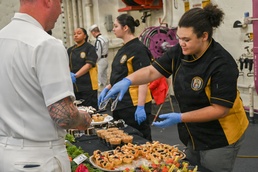
NEW YORK--Culinary Specialist 3rd Class Madison Heard is an inspirational Sailor assigned to San Antonio-class amphibious transport dock ship USS Arlington (LPD 24). Her story is one of overcoming adversity, the importance of having a plan and the payouts of hard work.
Heard was born on the west side of Chicago in an area she described as “not so great.” But, she recalls, from an age even as young as six years old, she wanted to start her own restaurant.
Her family eventually moved to Ohio, where the local high school gave her the option to exchange her junior and senior years for the same at a local trade school—the Springfield-Clark Career Technology Center (SCCTC). There, she studied culinary arts.
“There are typically two pathways people take when trying to move up in the world of professional cooking,” Heard said. “One is to start in a restaurant, and the other is to go to school. You typically have to grind a lot harder if you start in a restaurant, and you don’t get paid much to start. So my plan all along was to go to school and get trained.”
The next piece of her plan? Heard knew after graduating high school she wanted to join the Navy. “The Navy could provide me with culinary training—'A’ School—as well as lots of structured experience under more experienced cooks.” Her Naval service would earn her the tuition benefits to attend a proper culinary school.
But why the Navy over the other branches? “I was drawn to the Navy because Culinary Specialists prepare a lot of food from scratch,” Heard said. “Pastries, breads, stews, grilled steaks—you get to work with fresh ingredients and a wide variety of menus. That really fit the type of culinary experience I wanted.”
In high school, Heard was already talking to Navy recruiters. She shipped to basic training on July 20, 2020, just a single digit number of weeks after graduating high school. “I knew I wanted to be a Culinary Specialist (CS),” she said. “If they could not guarantee that to me, I was not going to enlist.”
When Heard got to "A" school, she immediately distinguished herself among her classmates. "I had prior experience from my high school culinary program," she said. "That gave me a strong foundation coming in. Cooking had already become a passion of mine, so I was excited to learn everything the Navy had to teach."
Because she graduated at the top of her “A” School class, Heard was interviewed about joining the staff at Camp David. “They liked that I had prior experience and that I was good at both cooking and baking,” she said.
The Camp David team ended up selecting her. It was an honor but also a sacrifice: the billet, which lasted for two years, required her to extend her contract by one year. That is why, when Heard gets out of the Navy this coming September, she will have served six years instead of five.
At Camp David, Heard started out in the galley, preparing food for Camp David staff and visitors.
“It was mostly making breakfast, lunch and dinner for visitors and employees, not for the VIPs,” said Heard.
While in that billet, she began training with Culinary Specialist Senior Chief Mike Edwards. Edwards had attended the Culinary Institute of America in Hyde Park, New York, and was assigned to a billet as a personal chef for a vice admiral at the Pentagon.
“After my shifts at Camp David, I would drive to Washington to train with Senior Chief,” said Heard.
Edwards was helping her train for the 2022 Joint Culinary Training Exercise (JCTE), a competition held annually at Fort Gregg-Adams, Virginia. Inviting over 200 military chefs from all U.S. branches and some international teams, too, it is the largest culinary competition in North America that is sanctioned by the American Culinary Federation.
The judges, some of whom were Michelin chefs, awarded Heard 2nd place in the Student Pastry Chef Competition event, 2nd in the Student Team Lead event and 3rd in the Student Chef event.
Because of her intensive training and outstanding performance, Heard worked her way up from Camp David’s galley eventually to a position where she prepared food for President Joe Biden.
Though an exciting billet like Camp David creates many fond memories, one in particular stuck out to Heard. The first, recalled Heard was when President Biden came to Camp David around Easter 2022.
Heard’s fondest memory there occurred when a secret service agent came by to ask if she could prepare a birthday cake as a last-minute surprise for another secret service agent.
“We had the ingredients and we had the time,” said Heard. “So I said yes! At the beginning of the day, making a stranger feel special and appreciated was not on my to-do list. So it was a bonus!”
After leaving Camp David, Heard was next assigned to USS Leyte Gulf (CG55), a Ticonderoga-class guided-missile cruiser. Now a CSSN (Culinary Specialist Seaman, an E-3), Heard was made a watch captain’s assistant right away because of her extensive experience at Camp David. In the CS world, galley watch captains are the CSs who direct the operations of the CS shift, delegating tasks to junior CSs and making sure everything runs smoothly.
“There was a CS1 aboard Leyte who was a baker,” said Heard. “She trained me and taught me cake decorating. It took me only two or three months before they made me one of the leading galley watch captains.”
While the transition from technical practitioner to manager often happens around the rank of first- or second-class petty officer for many Naval rates, in the case of CSs, it can start to happen as early as early as third-class. This is because CS shares, with a select few other rates like Logistics Specialist (LS) and Musician (MU), the particular quality that their job requires the coordination of multiple people in real time. Whoever conducts this real-time coordination is performing a sophisticated management function, sometimes even more sophisticated than the kinds of asynchronous management functions performed by senior enlisted managers and officers.
And in Heard’s case, it happened while she was still just a seaman.
“For a watch captain, the ability to delegate tasks to others is more important than being a good cook,” she said.
If galley leadership is not properly exercised, however, there can develop a vicious cycle that affects both CS morale and the ability of the CS team to deliver the food upon which their shipmates depend. And if watch captains do not delegate kitchen tasks effectively, that can cause both near-term and far-term system failure. In the near-term, the cogs represented by the most junior CSs can jam if they (the junior CSs) do not clearly understand their role in that system, or fail to execute that role. And in the far-term, the junior CSs do not learn how all the cogs are supposed to work together in an optimally efficient kitchen.
Culinary Specialists selected for leadership roles also have the opportunity to attend the Galley Watch Captain "C" School, which focuses on developing the leadership and management skills needed to oversee daily galley operations. While attendance is not required for advancement, Heard believes the course provides valuable preparation for watch captains. Because the course lasts nearly four weeks, however, operational commitments can make attendance difficult for some commands.
As one of Leyte Gulf's leading galley watch captains, Heard quickly learned that effective leadership involved much more than preparing great meals.
"Being a watch captain taught me that delegating tasks and developing people are just as important as being a good cook," she said. "The hardest part wasn't the cooking—it was making sure everyone understood their role and worked together as a team."
The experience challenged Heard to balance the immediate demands of feeding the crew with the long-term responsibility of mentoring junior Culinary Specialists.
"Sometimes it felt easier to do the work myself than to stop and coach someone through it," she said. "Looking back, I learned that taking the time to develop people is just as important as getting the job done."
Her tour aboard Leyte Gulf, the ship's final before its decommissioning in 2024, proved to be one of the most formative assignments of her career.
Balancing the technical and leadership demands of serving as a watch captain eventually led to professional burnout. When Heard transferred to USS Arlington in September 2024, she chose to focus on her role as the ship's primary baker, allowing her to continue refining her craft while supporting the galley's mission.
"I've focused on doing my job well and preparing for my transition to civilian life," Heard said. "My contract ends this fall, so I've also started planning for the next chapter."
Although she stepped away from formal watch captain duties, Heard continues to mentor junior Culinary Specialists.
"I lead classes on cake decorating and making pastries," she said. "I also teach new CSs about the galley's rhythm and sequencing so everything comes together at the right time. It's rewarding to see them build confidence and improve."
When Heard leaves the Navy this fall, she will attend the Culinary Institute of America's San Antonio campus, where she has family. Although she has not yet decided what type of restaurant she hopes to open, she remains committed to the dream she first envisioned as a six-year-old. After six years of Navy service, advanced culinary training, national-level competition, and leadership experience, that goal is no longer just an aspiration—it is well within reach.
“Sailors like CS3 Heard are an asset to the Navy and the Culinary Specialist community,” said Chief Culinary Specialist Cody Sikes, Senior Enlisted Leader at NAVSUP Headquarters. “Her passion for the profession, commitment to excellence, and dedication to mentoring others strengthen her team and greatly improve crew morale. As a Leading Culinary Specialist, I would be honored to have Sailors like CS3 Heard on my team and would have complete confidence in their ability to operate, lead, and inspire those around them.”
NAVSUP and Navy Supply Corps oversee a diverse portfolio including supply chain management for material support to Navy, Marine Corps, joint and coalition partners, supply operations, conventional ordnance, contracting, resale, transportation, security assistance, Sailor & family care, including food service, postal services, retail facilities, and movement of household goods. In addition to its headquarters activity, the NAVSUP Enterprise consists of 11 commands located worldwide.