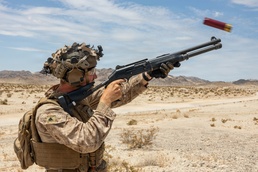
MARINE CORPS AIR GROUND COMBAT CENTER, TWENTYNINE PALMS, Calif. - The Marine Corps launched its first-ever counter-small unmanned aerial systems training lanes and integration during Service Level Training Exercise 4-26, July 15, 2026.
Participating units from 1st and 2nd Marine Divisions implemented C-sUAS in nearly every training event to ensure Marines can confidently deny, detect, and defeat the threat of enemy sUAS.
“Everywhere in the modern world, in all conflicts, the sUAS threat is becoming more prolific on the battlefield,” said U.S. Marine Corps Gunnery Sgt. Kevin Jares, an instructor with Tactical Training and Exercise Control Group. “We’re figuring out ways, with the squad’s organic weapons, to combat that threat and how to survive in today’s modern battlefield.”
This training would not be possible without the “Coyotes” from TTECG. Coyotes is the callsign of Marines attached to TTECG. The Coyotes facilitate risk-mitigated complex and dangerous live-fire training as well as simulate combat conditions that improve the decision-making cycle for Marines.
Marines began SLTE with a three-day training evolution on C-sUAS lanes, which involved classroom instruction, practical application, and culminated with live-fire lanes. Following this initial training, participants developed the basic skillset to apply the C-sUAS mindset to all subsequent SLTE training events. Throughout the evolution, TTECG integrated realistic enemy sUAS threats to drive the development of C-sUAS.
One of the most integral parts of the training was the operators. Without the Marines to fly the sUAS, training could not commence.
The sUAS operator training consisted of a three-week course of classes and practical application and included Marines from TTECG, 7th Marine Regiment, and 3rd Light Armored Reconnaissance Battalion. The operators were trained to fly first person view sUAS with an emphasis on tactical employment on all ranges during SLTE.
“The pilots that we had were really good,” said U.S. Marine Corps Capt. Faith Richardson, a platoon commander with TTECG. “Those Marines were a huge contributor. We tried giving the training audience a realistic look at the threat, and having proficient, well-trained pilots was really important.”
To combat enemy sUAS, Marines employed physical means of elimination, as well as non-physical means also known as electronic warfare. The kinetic weapons used by Marines were the M27 infantry automatic rifle firing 5.56 mm rounds, the M1014 combat shotgun firing 12-gauge shells, along with the M32A1 and M320 grenade launchers firing low velocity 40 mm anti-personnel rounds.
Through training, Marines engaged simulated enemy sUAS as close as 20 meters with sUAS flying at speeds of over 90 miles per hour.
“Small unmanned aerial systems have been around for a while, it’s just more prevalent in the battlespace today because it’s more cost-effective,” said Richardson.
The rise of sUAS comes at a time when drones can be cheaply produced and used for strikes and surveillance of forces, altering the dynamic of the battlefield.
“The intent of the C-sUAS lanes was to build the confidence of our Marines to target sUAS and complete the mission,” said Richardson.
The threat of sUAS poses new challenges for Marines, but it’s far from the only threat they may encounter. Marines throughout SLTE conducted training the same way with the added friction of enemy sUAS targets throughout their exercises. From urban house clearing to mounted patrols, Marines were tested and evaluated on their ability to deny, detect, and defeat sUAS.
“The whole event was successful and effective because of the Coyotes,” said Richardson. “We had a lot of help from multiple shops across TTECG to make the event happen, and those Marines made it a huge success.”
The growth and performance of the Marines combating sUAS over SLTE showed promising results. Marines continued to implement and perfect C-sUAS through tactics, techniques, and procedures established by TTECG, which will continue to be developed and refined through training and development.
Moving forward, training at the Combat Center will continue to include sUAS and C-sUAS in future SLTEs to ensure Marines have the basic skillset to operate in situations where sUAS may be present. The Marines taking part in C-sUAS training at MCAGCC will take what they have learned back to their home units to ensure the Marine Corps remains a highly lethal, adaptable force capable of dominating the future multi-domain fight.