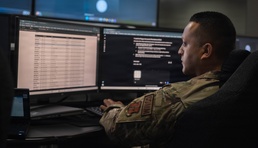
MARCH AIR RESERVE BASE, Calif.— Airmen from the 163d Communications Flight sharpened their cyber defense skills during Boreas, an exercise designed to strengthen network threat detection, defensive cyberspace operations and incident response to help safeguard Air Force information systems against evolving cyber threats Aug. 2, 2026.
While the 163d Communications Flight does not routinely perform defensive cyberspace operations as its primary mission, the exercise reinforced the importance of developing Mission Ready Airmen capable of recognizing and responding to cyber threats.
“It's not our primary mission set to do this, but our commander and leadership team believe heavily in the fact that cyberspace is constantly under attack, so we need to know what a cyber threat looks like. That way, if any issues arise, we have some experience with it,” said Senior Master Sgt. Lower, the cybersecurity, plans, programs and data operations superintendent. “We will provide any evidence of compromised network security to the dedicated cyber protection teams and elevate compromised systems quicker, keeping our network safe to a greater effect.”
During the four-hour exercise, Tech. Sgt. Carl Lugay, 163d CF, led six Airmen through a defensive cyber exercise. The team analyzed network activity, identified indicators of compromise, reported suspicious behavior and blocked malicious activity. Using cyber defense tools, the Airmen identified a compromised host distributing malicious code across the network. They traced the intrusion to a user who had opened an infected document, isolated the affected system and contained the threat.
“As cyber threats continue to evolve, exercises like Boreas prepare Airmen to recognize what real-world threats may look like and how to best prevent these threats from occurring in our daily operations,” Said Lugay. “Having Airmen aware of different functions in the domain of cyberspace helps create a solid foundation for tomorrow’s war.”
Boreas prepares Airmen for larger joint cyber exercises that simulate real-world operations. Annually, various military services host events such as Cyber Fortress, Amber Mist and Cyber Dawn, placing members in real-world scenarios with integrated joint teams actively defending a critical network against professional attackers. These exercises prepare the 163d Communications Flight to respond confidently when called upon.
“In the previous Cyber Dawn event we attended, our mission was defending a hospital network. The year before that was defending a power station network,” said Lower. “If a large-scale event happens and we need our actual dedicated cyber defense team to deploy somewhere else in the world, the National Guard Bureau knows which teams exist with the capabilities to fill in that role.”
In preparation for Boreas, Airmen engaged in individual training sessions using programs similar to the one used in Boreas, allowing them to practice network defense on a smaller scale. Individual training allowed the team to find their strengths and improve their weaknesses.
“We utilize different programs to provide training,” said Lower. “You can actually perform little exercises and go through all of the steps. We do that in our spare time to try to get better. It is all about improvement.”
Through exercises like Boreas, the 163d Communications Flight is better prepared to respond when a simulated attack becomes a real threat to the nation's critical infrastructure. By developing secondary cyber skills while maintaining proficiency in their primary specialties, the 163d Attack Wing continues to build Mission Ready Airmen capable of supporting operations across contested environments.