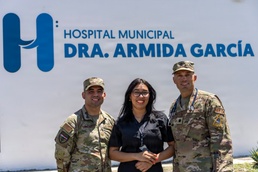
LA VEGA, Dominican Republic - Inside Hospital Dra. Armida García, a U.S. Air Force family physician, a Dominican physician and an Air Force medical technician serving as a Language Enabled Airman Program scholar quickly developed an unconventional rhythm. Medical terminology flowed between English and Spanish. Treatment options were debated across two healthcare systems. A translator became a clinical teammate. Every patient became an opportunity to learn.
The result wasn’t simply better communication but a rhythm in real time, turning language barriers into collaboration, allowing the team to compare approaches, adapt in real time and learn from each patient. It also reflects the broader purpose of Amistad 2026: bringing U.S. and Dominican medical professionals together in a real-world environment where collaboration, adaptability and shared expertise strengthen medical readiness.
For U.S. Air Force family physician Lt. Col. Alan Bordon, 45th Medical Group chief of medical staff, the value of the mission extends well beyond the patients seen each day.
“I’ve loved comparing how we work up common diseases, seeing what’s the same and what’s different,” Bordon said. “It’s been really fun to collaborate.”
Rather than practicing medicine independently, the physicians approached each patient as a collaborative discussion, comparing diagnostic reasoning, treatment options and available resources while learning how each country’s healthcare system approaches similar conditions.
Cases that would be routine in the United States often required different considerations in the Dominican Republic because of differences in available medications, disease prevalence and patient access to care.
“I’ve tried to think, ‘How can I learn and apply this to a contested or difficult environment?’” Bordon added. “That’s why we’re here, to build readiness.”
That mindset reflects one of the central objectives of Amistad: preparing medical professionals to operate effectively in unfamiliar or resource constrained environments while strengthening relationships with partner nations.
Those lessons extended well beyond physicians.
Serving as the team’s interpreter, Staff Sgt. Justo Ramirez-Carrillo, an Air Force medical technician assigned to Amistad under the Language Enabled Airman Program, became far more than a interpreter. He ensured complex medical conversations remained accurate, reinforced patient safety through closed-loop communication and enabled seamless collaboration between providers.
“Working alongside both physicians has allowed me to see different approaches to diagnosis and patient care,” Ramirez-Carrillo said. “Being able to interpret in my own language has been a great experience.”
When words alone weren’t enough, the team adapted.
Translation technology filled occasional gaps. Medical terminology became a shared language. Clinical procedures often required little explanation because each provider understood the workflow, regardless of nationality.
“We would have figured it out,” Bordon said. “Whether it was through technology or simply knowing what comes next in patient care, everyone found a way to contribute.”
That adaptability mirrors the operational environments Air Force medical personnel may encounter during future deployments, where communication, flexibility and teamwork are essential to mission success. For Dominican Dr. Arienny Cruz, assistant hospital director and family physician at Hospital Dra. Armida García, the partnership has strengthened both patient care and professional development.
“I’ve learned a great deal working alongside him,” Cruz said. “This has been a very positive experience, especially for our patients.”
She said the collaboration has introduced new clinical perspectives while reinforcing many practices already shared between both medical teams.
The mission has also increased community engagement. Because of extensive outreach conducted before the clinics opened, more residents sought care than would typically visit the hospital.
“Our community values having medical teams working alongside us,” Cruz said. “I hope this mission continues in other communities.”
While patients remain the immediate focus, the experience is equally valuable for the Airmen participating. Medical readiness depends on far more than clinical expertise. It requires Airmen capable of adapting to unfamiliar environments, working across cultures and solving problems alongside partner-nation providers.
“I know the buzzword is ‘multi-capable Airman,’” Bordon said, “but that’s really what you have to be. Everyone is playing a part.”
Whether drawing blood, coordinating logistics, interpreting conversations or assisting specialists outside their normal responsibilities, every member of the team contributed to the mission’s success.
“Sometimes they don’t need you to do the job you normally do,” Bordon said. “They just need you to do the work that’s in front of you. That’s how successful teams are built. And that is what we have here.”
By the end of each clinic day, diagnoses have been made, treatments planned and dozens of patients cared for. Equally important, trusted professional and personal relationships are built.
“I feel like there’s an instant connection because we have that common background,” Cruz said. “We both want to help the patient. After seeing patients together every day, it’s hard not to become friends.”
For Amistad participants, those relationships represent more than goodwill. They strengthen interoperability, enhance regional health security and ensure U.S. and partner nation medical teams are better prepared for tomorrow.