FORT DRUM, N.Y. (Aug. 7, 2026) -- Forensic science, hydroponics, engineering, and archaeology were just a few of the subjects students explored during the Fort Drum STARBASE Summer Camps in July and August.
Designed to spark lifelong curiosity, these immersive camps introduced children to a variety of STEM (Science, Technology, Engineering and Math) activities. The curriculum challenged them to brainstorm, work as teams, and use deductive reasoning to solve complex problems.
Dana Hanni, Fort Drum Starbase Academy director, said that the summer camps allow the staff to be creative with lesson plans, recognizing that sitting in a classroom is rarely a child’s first choice for summer vacation.
“We make the camp highly interactive and fun, so students stay engaged by choice,” she said. “And we try and get outside as much as possible with our lessons.”
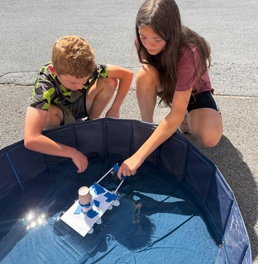
At the NextGen Innovators Camp, students became codebreakers during a Cipher Wheel Treasure Hunt, engineered Sphero-powered boats, and developed a watershed cleanup project, among the activities.
Tadeusz Jordan, age 10, said the cipher wheel challenge was his favorite because he liked working with secret codes. He also appreciated learning new things, like the Lake Ontario watershed management program.
“I never knew that before, but I just learned it,” he said. “It was educational, and the activities we did were fun.”
Beyond introducing a broad range of STEM careers, Hanni said that students are also shown how some of those skills can apply to their daily lives.
“Our hope is that they learn that STEM is around everything that we do,” she said. “I feel like a lot of times kids don’t realize that – we do math every day, and science every day, but you don’t always think about it.”
To bridge the gap between classroom themes and real-world applications, the camps introduce students to visiting subject-matter experts.
During the CSI: Future Detectives Camp, two detectives from the Jefferson County Sheriff’s Office spoke to students about their jobs and how they collect DNA, fingerprints and pertinent evidence. Afterward, they created a realistic crime scene for students to investigate.
Justin Terpstra, a software engineer at New York Air Brake, outlined the different branches of engineering such as civil, mechanical, chemical and electrical. He also highlighted how extracurricular activities offer cross-disciplinary learning opportunities.
For example, joining the school play teaches mechanical skills through set building, or electrical and computer skills from operating the lighting or sound boards. Similarly, a cooking club not only teaches culinary skills, but also math and chemistry concepts – from measuring ingredients to understanding how heat changes food.
Matthew Soulant, age 10, said his favorite activity was an engineering challenge that required teams to design and build a multi-story structure out of 20 plastic cups and a limited amount of tape. The students then tested its structural integrity by navigating through an obstacle course without causing damage.
Matthew devised his team’s structure and they won the challenge.
Hanni said that the summer camps have become a successful part of Fort Drum STARBASE since it was introduced in 2023. Some students return annually until they age out of the program.
Matthew completed both camps this summer, as well as last year’s sessions when he attended with his good friend Sebastian.
“It was a lot of fun,” he said. “We had a lot of fun, but Sebastian moved a few weeks ago, so he couldn’t be here this time. But I found some new friends.”
In addition to the fun activities, Matthew said he liked how STARBASE camp challenges students to explore new ideas.
“It’s like school, except a lot better,” he said. “And that’s something, because I actually like school. I’m one of those kids who likes school, and all my friends are there.”
Students will soon have even more learning adventures at the Fort Drum STARBASE Academy. One classroom is being reconfigured into a drone lab, where children will practice on simulators in a “No-Fly Zone” and then use those skills to pilot actual drones in the “Fly Zone.”
Hanni said they are planning an open house for teachers and administrators in February and then have a pilot program in the spring before adding it to the STARBASE curriculum for the 2027-2028 school year.