FORT DETRICK, Md.– U.S. Army Medical Logistics Command is bridging the gap between fielding new medical technology and sustaining it by delivering critical, hands-on training directly to military maintainers across the force.
Whether it is a portable life-support system on the East Coast or a specialized deployable X-ray shelter on the West Coast, AMLC is deploying its technical experts to ensure that when lives are on the line, the Army’s medical equipment is fully operational.
Recently, AMLC leveraged its enterprise footprint – including Medical Maintenance Operations Depots, or MMODs, and newly established Forward Repair Activity-Medical, or FRA-M, sites – to facilitate two training events at Fort Bragg, North Carolina, and Joint Base Lewis-McChord, Washington.
‘ICU in a box’
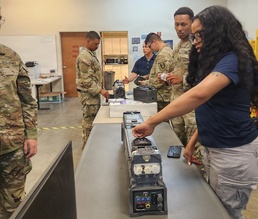
Operating under AMLC’s Medical Maintenance Management Directorate, or M3D, the FRA-M program provides direct medical maintenance support and training to tactical units. The Fort Bragg FRA-M site recently demonstrated this capability by facilitating a three-day manufacturer certification training for the newly fielded MOVES SLC system.
The MOVES SLC is a highly portable, micro-integrated life support system, combining an oxygen concentrator, ventilator, suction system and vital signs monitor into one single, rugged battery-operated unit.
Biomedical equipment specialists, or 68As, from the 51st Medical Logistics Company, 16th Hospital Center, trained alongside FRA-M contractors and civilian logistics assistance representatives, known as LARs, to master the maintenance and repair of the system.
Fielded in 2023, the MOVES SLC functions essentially like an intensive care unit in a box, providing immediate life-support functions right on the battlefield. Most notably, the units can generate oxygen from the surrounding air rather than relying on pressurized tanks, making them ideal for medics operating in remote environments where resupply can be difficult.
Recognizing the need for formalized training following the system's fielding, leadership from the 44th Medical Brigade coordinated with M3D’s Fort Bragg FRA-M site team to bring the specialized training directly to the installation's medical maintainers.
The FRA-M program provides a training platform to reinforce medical equipment maintenance skills, theory and field-level service knowledge for 68As. By providing medical equipment services and training, FRA-M site operations provide continuity for medical readiness and medical equipment training.
“Creating a more autonomous BMET culture regarding troubleshooting and skills sets has benefited the relationships and notoriety of the FRA-M operation,” said Anthony Cruz, site lead for the Fort Bragg FRA-M.
The certification course provided about a dozen trainees with a comprehensive understanding of the complex device, starting with a theory of operations course, progressing to an in-depth mechanical breakdown and concluding with extensive hands-on troubleshooting.
“This training ensures these maintainers can effectively service and sustain the equipment, which is critical for enabling Forward Resuscitative Surgical Detachments to provide medevac and prolonged field care in austere, deployable environments,” said Dominique Taylor, a LAR with the U.S. Army Communications-Electronics Command’s Integrated Logistics Support Center, Medical Systems Directorate.
Deploying diagnostics
While the Fort Bragg team focused on portable life support, AMLC personnel on the West Coast partnered with the 147th Field Hospital at JBLM to help Soldiers set up and operate the Army’s newest deployable computed tomography, or CT, X-ray system.
When battlefield injuries require immediate diagnostics, minutes matter. The training gave biomedical equipment specialists hands-on experience with the CT system, which is housed inside a specialized ISO shelter – a highly durable, relocatable facility built to the exact dimensions of a standard shipping container.
Experts from AMLC’s MMOD in Tracy, California, known as MMOD-CA, supported the event. Fernando Gonzalez, a biomedical equipment technician and member of MMOD-CA’s “flyaway team,” served as the primary instructor, backed by technical teams from Utah and Pennsylvania via the new FRA-M site currently being established at JBLM.
“This is a highly sophisticated piece of medical equipment, and it only works if the crew knows how to keep it up and running,” Gonzalez said. “Our goal was to make sure these Soldiers can troubleshoot and maintain this scanner themselves, so they have complete confidence in the system when lives are on the line.”
Soldiers learned how to safely transport, level and expand the shelter. This is a critical step because the CT scanner will not operate unless its internal sensors detect a perfectly level surface. The shelter’s lead-lined walls, required for radiation safety, add significant weight and complexity to the setup process.
Power support was maintained by Soldiers from the 147th Field Hospital, who operated generators to sustain the shelter and environmental controls during the training period. Ultimately, the CT system successfully passed its calibration verification certification, confirming it is ready for use.
“This fielding was a true team effort across the entire medical maintenance enterprise,” MMOD-CA Director Isaac Newman said. “While our flyaway team led the hands-on instruction, having the technical backing of our sister depots in Utah and Pennsylvania ensured the 147th Field Hospital received world-class support from start to finish.”
Sustaining the force
Whether establishing a deployable CT scanner or certifying maintainers on portable ventilators, AMLC’s involvement highlights the command’s role as the Army's premier sustainer for medical readiness, according to Alfred Zamora, deputy director of M3D's FRA-M program.
“Properly trained Soldiers in the field directly equate to high equipment readiness, ensuring that life-saving systems are fully operational and ready to support the warfighter at a moment's notice,” Zamora said.