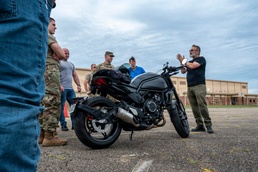
Steel Airmen gathered at the Pittsburgh International Airport Air Reserve Station, Pennsylvania, Aug. 1, 2026, for a motorcycle safety refresher course focused on improving low-speed control and reinforcing safe riding habits.
The course welcomed nearly 20 riders from several units, including Air National Guardsmen assigned to the 171st Air Refueling Wing. During the two-hour session, participants practiced clutch control, turns from a stop, slow-speed maneuvers and progressively tighter U-turns.
Joshua Hudson, 911th Airlift Wing director of psychological health and a certified motorcycle instructor, organized the course to help address a recurring challenge for motorcycle riders assigned to Reserve installations.
“The problem is that Reserve bases don’t have the manpower or the resources to provide a full-time or contracted person to conduct the training,” said Hudson. “That means there are a lot of Airmen who aren’t getting this taken care of.”
Hudson worked to create a locally available training opportunity using the Air Force’s motorcycle rider mentorship program. The course paired formal instruction with experience shared among the participating riders.
“Everybody there had years of experience riding,” said Hudson. “We wanted people to share their experiences, but we also wanted more people riding than sitting around watching.”
The course concentrated on clutch control, which Hudson described as one of a rider’s most important tools when operating a motorcycle below 30 mph. Participants began with basic left and right turns from a stop before advancing to slow-speed movements and U-turns within the width of a typical street.
The training concluded with an exercise known as the "Intersection Exercise" or "Crossroad Exercise" – a four-legged, low-speed cone pattern used in police motor schools and advanced training programs to master tight U-turns and friction-zone control.
“Everybody could probably do the first U-turn, but if your skills aren’t practiced, by the time you get to the third turn, you have accumulated every mistake from before,” said Hudson. “That is when you see where you need to improve.”
Some participants had been riding for 15 to 20 years, but the exercises still challenged them. Hudson said riding experience alone doesn't necessarily indicate skill level, especially when fundamental techniques aren't practiced regularly. Some participants had been riding for 15 to 20 years, but the exercises still challenged them. Hudson said riding experience alone doesn't necessarily indicate skill level, especially when fundamental techniques aren't practiced regularly — a pattern the Department of Defense picked up on in the mid-2000s.
As young warfighters returned from Iraq and Afghanistan, the DoW experienced a rapid uptick in motorcycle related deaths. In 2008 alone the military lost 124 servicemen to motorcycle crashes and the Army's rate rose by 34% that year. The Pentagon answered with a rule. DoD Instruction 6055.04, issued April 20, 2009, required every active-duty, Guard and Reserve member across all six branches to complete a Basic Rider Course before riding. Sport-bike owners had additional training and gear requirements were spelled out too — helmet, eye protection, boots, long sleeves and gloves. Refresher training was built in from there, required on a recurring cycle rather than treated as a one-time box to check.
"The length of time you ride isn't an indication of how good a rider you are," Hudson said. "Those skills are perishable if you don't practice constantly."
The session served as recurring refresher training for already-qualified riders and did not replace initial motorcycle safety requirements. Air Force riders must complete initial and intermediate training before entering the sustainment phase, which includes refresher training at least every five years.
Hudson said the benefits extend beyond simply meeting a requirement. Riding, he said, can sharpen fine motor control, build mindfulness and make riders more attentive behind the wheel of any vehicle — not just a motorcycle.
His hope is that the lessons don't stay in the parking lot. "What I hope is that they will use the class and then practice on their own," Hudson said.