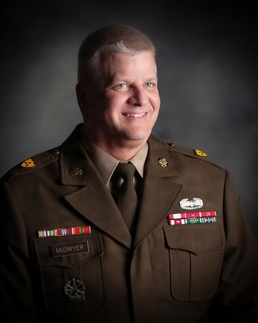
FORT HOOD, Texas — III Armored Corps and Fort Hood Command Sgt. Maj. John P. McDwyer had only been assigned to his first unit for a few days when he experienced his first alert.
It was 1988. The Berlin Wall was still standing, and Soldiers assigned to the 8th Infantry Division trained knowing they could be called at any moment. McDwyer grabbed his equipment, drew his weapon and the tank’s weapons, and headed to the motor pool with the rest of his unit. Tanks were loaded, crews prepared their vehicles and everyone waited for further instructions.
“You never knew what the Russians were going to do,” McDwyer said.
Nearly four decades later, McDwyer is preparing for a much different milestone.
After 38 years in uniform, the III Armored Corps and Fort Hood command sergeant major is retiring following a career that took him from a young tanker in Germany to the senior enlisted advisor of one of the Army’s premier armored formations.
Looking back, McDwyer said he never imagined his career would last this long.
“When I came in, my goal was, ‘If I like it, I’ll stay in,’” McDwyer said.
As a young Soldier, his ambitions were much smaller than the positions he would eventually hold.
“As a specialist and young sergeant, my goal was to be a first sergeant,” McDwyer said. “To me, that was the epitome of a leader in the Army.”
Instead, his career carried him through the end of the Cold War, multiple combat deployments, leadership assignments across the Army and eventually to III Armored Corps. Still, McDwyer said the positions he held are not what define his career.
“It’s not about what I did,” McDwyer said. “What I did is not going to mean a hill of beans in five years. It’s the influence that I’ve had, or the example I set for junior leaders to emulate.”
McDwyer’s interest in the military started long before he enlisted. Growing up, he watched war movies with his father, including “The Battle of the Bulge,” “The Bridge on the River Kwai” and other World War II films. The stories sparked an interest in military service that stayed with him into adulthood.
He briefly participated in Junior ROTC before focusing on sports and later joined the Texas Army National Guard while attending college. During drill weekends, he trained with an armor unit and met Soldiers who had recently returned from Germany.
“The stories they told about Germany really interested me,” McDwyer said.
College never felt like the right fit, he said.
“I had a lot of fun doing the drills,” McDwyer said. “In the end, college was not for me.”
He left the Guard, entered active duty in 1988 and had only two requests.
“I wanted to stay an armor crewman, and I wanted to go to Germany,” he said.
The Army granted both.
After arriving in Frankfurt, McDwyer was assigned to Delta Company, 2nd Battalion, 68th Armor Regiment, in Baumholder, Germany.
Life in Germany was different from anything he had experienced. The Cold War was still underway, and readiness drove everything the unit did. Crews worked until tanks were mission capable, even if that meant staying late on a Friday before the weekend.
“If your tank was broke that Friday, you didn’t get off until your tank was fixed,” McDwyer said.
The expectation was simple: Soldiers and equipment had to be ready. That mindset stayed with him throughout the rest of his career.
When the Berlin Wall fell in November 1989, McDwyer’s unit rolled out because no one knew how events would unfold. Once leaders understood what was happening, the unit returned to the motor pool.
McDwyer said those early experiences taught him that readiness could never wait until tomorrow.
His first tank commander, then-Sgt. Reginald Smith, reinforced those lessons every day.
“He was kind of that tough-love tank commander,” McDwyer said. “He worked us hard, but he made sure we were taken care of. Our needs were met.”
Smith expected his Soldiers to know their jobs, study their manuals and continue learning outside normal duty hours. If someone wanted to become a gunner, they were handed the manual and expected to learn it. McDwyer embraced that approach.
Years later, he realized many of the leadership principles he followed throughout his career started during those first years in Germany.
“Those leaders invested in us,” McDwyer said. “They expected us to know our jobs, and they expected us to keep getting better.”
That lesson would stay with him long after he left Germany.
McDwyer never wanted to do anything besides serve in the Armor Branch.
“There was just something about tanks,” McDwyer said. “Why carry my equipment when my equipment can carry me?”
His career eventually spanned nearly every stage of the Abrams tank’s evolution. As a master gunner, he helped field the M1A2 Abrams and develop new ranges, tactics, techniques and procedures for training tank crews at Fort Hood.
“I was fortunate to be on the very cutting edge of the M1A2 tank being fielded,” McDwyer said.
The work helped shape how crews trained not only across Fort Hood, but throughout the division, corps and Army. Even after moving into leadership positions, McDwyer never forgot what it was like to serve on a tank crew. His favorite tank was a second-generation M1A2 named Aneurysm, though the crew simply called her “Annie.”
“It was a special crew,” McDwyer said.
As a platoon sergeant with Alpha Company, 1st Battalion, 12th Cavalry Regiment, then-3rd Brigade Combat Team (now 3rd Armored Brigade Combat Team), 1st Cavalry Division, McDwyer and his crew stayed together through multiple gunnery rotations. Every qualification earned a distinguished rating, and none scored below a 950.
Their success was not an accident. McDwyer expected his Soldiers to know their jobs before they ever rolled onto a range.
One lesson has stayed with him for years. Before one gunnery, McDwyer climbed onto the tank and began checking the .50-caliber machine gun.
His gunner, who went by the name Marty, stopped him.
“He said, ‘I already did that,’” McDwyer recalled.
McDwyer smiled but checked it anyway.
“‘What? You don’t trust me?’ Marty asked.”
“‘No, I trust you,’” McDwyer replied. “‘But it’s my head that’s out here if it blows up.’”
The moment became another reminder that good crews don’t skip steps.
Everything mattered.
McDwyer pushed his platoon hard in training. His Soldiers often wondered why they spent so much time repeating tasks they already knew.
“They’d complain, ‘McDwyer’s always making us do something,’” he said with a laugh.
The answer came during rotations at the National Training Center at Fort Irwin, California. While other platoons struggled through events and received constant corrections from observer coach-trainers, McDwyer’s platoon had already rehearsed many of those situations.
The training paid off.
“All of our hard training had led up to being very, very proficient at what we did,” McDwyer said.
The experience reinforced something he had learned years earlier in Germany. Training was not about making life harder. It was about making Soldiers better before they ever faced combat.
Those lessons became even more important during McDwyer’s combat deployments.
As first sergeant of a cavalry troop with the 4th Infantry Division during Operation Iraqi Freedom, McDwyer inherited a unit already deployed overseas. Instead of meeting Soldiers in garrison, he learned their names and personalities while they conducted combat operations.
“You’ve got to get to know 150 Soldiers in combat,” McDwyer said.
The challenge became even greater during a later deployment.
The first two Soldiers McDwyer lost were his senior scouts and close friends.
“You couldn’t dwell on them being killed,” McDwyer said. “We had to put the troop back together.”
The mission continued. The Soldiers who remained still needed leaders.
McDwyer said watching Soldiers continue fighting despite the danger left a lasting impression on him.
“They kept doing the hard work every single day,” McDwyer said. “They kept putting themselves in harm’s way for each other.”
Those experiences changed the way he viewed training. Every range, every rehearsal and every repetition mattered because leaders never know which lesson may save someone’s life.
“You never want to be in combat wishing you had one more day to train,” McDwyer said.
He often tells leaders they should never wonder whether a casualty could have been prevented if they had spent more time teaching a task or correcting a mistake before deployment.
“The enemy always gets a vote,” he said. “All we can do is train to the best of our ability.”
McDwyer carried that same philosophy into Afghanistan while serving as command sergeant major of 2nd Battalion, 34th Armor Regiment, then-1st Brigade Combat Team (now 1st Armored Brigade Combat Team), 1st Infantry Division. The battalion experienced heavy fighting early in the deployment, reinforcing the importance of preparing Soldiers before they ever stepped onto the battlefield.
“If I don’t teach you to be the best tank gunner and demand that you be the best tank gunner,” McDwyer said, “I’m not giving you the best chance to survive.”
Combat also reinforced another lesson. Training and taking care of Soldiers go hand in hand.
McDwyer said leaders cannot expect Soldiers to focus on training if they are distracted by problems at home, financial issues or family concerns.
“You’ve got to know your Soldiers,” McDwyer said. "That means understanding who they are, what motivates them and what challenges they may be facing outside of work. If leaders take care of those problems early, Soldiers can focus on becoming better at their jobs."
As McDwyer moved into more senior leadership positions, his responsibilities changed, but his priorities did not. Instead of leading a platoon or company, he focused on giving subordinate leaders the resources they needed to train their formations.
He credits much of that perspective to retired Gen. Randy A. George, who served as his brigade commander years before becoming the Army chief of staff.
George challenged leaders to remove obstacles instead of creating them.
McDwyer carried that lesson with him throughout the rest of his career.
“My job is to worry about resources,” McDwyer said. “I need you to worry about training.”
Whether serving as a senior military instructor at Purdue University, commandant of the Noncommissioned Officer Academy in Hawaii or in later assignments across the Army, McDwyer said his focus remained the same. Develop good leaders. Train Soldiers. Give them the tools to succeed long after he is gone.
McDwyer thought his time in uniform was coming to an end while serving as the command sergeant major of First Army. He had already submitted his retirement paperwork when another opportunity came along.
III Armored Corps was looking for its next command sergeant major.
McDwyer decided to compete for the position.
The assignment brought him and his wife, Monique McDwyer, back to Texas, but it also gave him one final opportunity to help shape the Armor Branch.
“This has been the crown jewel,” McDwyer said. “This has probably been my favorite assignment.”
One of his first major events after arriving was the Sullivan Cup, the Army’s premier competition for tank and Bradley crews.
The results told him III Armored Corps had work to do.
Although the crews represented some of the best in the Army, McDwyer believed too many had lost sight of the fundamentals.
“There were lots of excuses,” McDwyer said. “At the end of the day, it’s still a tank range. You’ve got to go out and do your job.”
McDwyer and the corps leadership placed renewed emphasis on mounted lethality.
That meant improving gunnery, restoring proven training methods and making sure crews understood not just how to operate their vehicles, but why every step mattered.
“You’ve got UAS (unmanned aircraft systems), UAVs (unmanned aerial vehicle). You’re getting more information than ever before,” McDwyer said. “But if you can’t do the basics, all this technology is not going to help you do what you need to do, kill the enemy or survive the enemy.”
When the Sullivan Cup returned two years later, McDwyer said the difference was noticeable.
The crews shot better and the fundamentals had improved. The work, however, was not finished.
“We’ve got to continue to build,” McDwyer said.
The next challenge is improving maintenance and helping crews maneuver into positions where they can effectively employ their weapons, McDwyer said.
His focus has never been on preparing Soldiers for yesterday’s battlefield. It has always been preparing them for the next one.
“Tanks are not dead,” McDwyer said. “There are more threats to the tank now, but at the end of the day, the tank can kill just about any of that stuff.”
Technology will continue to evolve, McDwyer said, but one thing will not change.
“There’ll be something else out there,” McDwyer said. “We don’t know what it is, but there’ll be something else out there. Armor’s not going anywhere.”
When asked what legacy he hopes to leave behind, McDwyer did not mention his rank, awards or assignments. Instead, he talked about people.
He hopes the leaders he mentored continue teaching the next generation of Soldiers. Whether they become first sergeants, command sergeants major or general officers, McDwyer said their success will mean far more than anything he accomplished personally.
“That’s my legacy,” McDwyer said.
He believes leadership also means recognizing the talents Soldiers bring with them before they ever put on the uniform.
McDwyer recalled a specialist assigned to a supply position who also held a degree in data management from the Massachusetts Institute of Technology.
After leaders recognized her background, she helped develop applications used during a warfighter exercise. Some of those tools are still being used by multiple Army corps today.
“The U.S. Army is great because of our Soldiers,” McDwyer said.
His message to the force remains simple.
“This is a noble profession,” McDwyer said. “Take it seriously, but have fun while you’re doing it. Nothing’s about you. It’s always about your Soldiers. Take care of your families, and be ready for whenever the nation calls.”
McDwyer has participated in countless change-of-responsibility ceremonies throughout his career. Today will be his last one, followed by his own retirement ceremony.
Retirement, he said, feels different.
“This is the only retirement ceremony,” McDwyer said, walking into an office that is nearly empty. “I don’t think it’s fully hit me.”
After retirement, he and Monique plan to settle in the Houston area near family. He hopes to travel, play golf, volunteer and possibly do consulting work on a part-time basis. Mostly, he wants to enjoy the time they never had while moving from assignment to assignment.
McDwyer said he will miss the people more than anything else.
“I’m going to miss the interaction with the people, the great Soldiers and the training,” McDwyer said.
He will also miss the sounds that have become part of everyday Army life.
“Hearing the bugle calls,” he said. “That’s just part of being in the Army.”
After nearly 38 years, McDwyer was asked what he would tell the young private who arrived in Germany in 1988. Looking back now, his advice to that young Soldier is the same advice he hopes today’s Soldiers remember.
“Learn your job, take care of your Soldiers,” he said. “You’re in for a wild ride.”
Nearly four decades after reporting to his first unit in Germany, those words still define the career that followed. Not because of the rank he achieved. Not because of the positions he held.
But because, from his first days as a young tanker to his final days as the III Armored Corps and Fort Hood command sergeant major, McDwyer never lost sight of the people he believed mattered most.
The Soldiers.