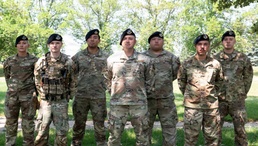
“We were moving through the forest, and it was really, really thick,” said U.S. Air Force Staff Sgt. Enrique Padilla from the 133rd Security Forces Squadron. “There was probably about a mile of brush between us and our objective. We didn’t have any depth perception with our night vision goggles, but we had to navigate through it. Everybody was tripping over logs, smacking their faces on branches... it was crazy."
This intense navigation challenge was just one moment in SAGE Eagle, a demanding, Green Beret-designed exercise pairing U.S. Army Special Forces with Air National Guard security forces. For nearly two weeks at Fort Walker, Virginia, Airmen were immersed in complex, real-world operations far beyond typical base defense. They conducted raids, cleared buildings, and rehearsed communication protocols under constant pressure.
The training aligns directly with the Air Force’s broader modernization goals, integrating new threats and technologies into every scenario.
“Drones are everywhere on the battlefield now,” Padilla explained. “On our second raid, drone operators flew ahead with IR floodlights lighting up the valley through our night vision. To the naked eye, it was completely dark. That drone guided us straight to the target. It was a force multiplier.”
U.S. Air Force Tech. Sgt. Andrey Shimko from the 133rd Security Forces Squadron, agreed, noting how the 133rd Security Forces Squadron’s own small drones were used to gather intel on enemy numbers, weapons, and terrain during the training. “I could see our unit’s drone program expanding, with more opportunities for deployment,” Shimko said.
This focus on advanced tactics reflects a fundamental shift in the mission. “When I first joined, it was about base security,” Padilla said. “Now we’re doing more outside-the-wire operations. We’re taking and defending airfields and deploying to austere environments. It’s a big change.”
For Shimko, his priority as a leader was ensuring his Airmen built confidence and combat awareness. “Accomplishing our objectives, being comfortable with our weapons, and understanding care under fire, that was key,” he said. “As a unit, we grew close. We cared about one another and we became masters of adapting to the ever-changing requirements of accomplishing our objectives.”
The six Airmen who participated brought back lessons that are already reshaping their squadron’s readiness at the 133rd Airlift Wing. “Room clearing is huge for us,” Padilla said. “It’s something we can teach others. Every time you clear a room, everyone knows exactly where they’re supposed to be. That’s what these guys taught us: how to make it second nature.” For National Guard units, opportunities like SAGE Eagle are rare but transformative, providing a glimpse into the future of joint-force operations.
“These kinds of operations inspire young Airmen,” Shimko said. “They see what’s possible, and some even want to cross-train into the Special Forces community. It’s about growth, as an individual and a force.”