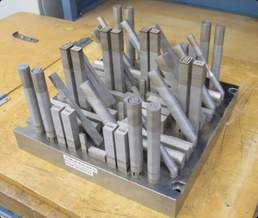
Naval Undersea Warfare Center Division, Keyport has become the first Warfare Center to receive official approval from Naval Sea Systems Command for a metal powder bed fusion additive manufacturing procedure.
This qualification validates the command's ability to reliably and consistently produce tactical- and shipboard-level parts using 17-4PH stainless steel, a material widely used throughout the Navy. Using the EOS M290—a metal additive manufacturing system in which a laser melts and builds solid parts layer by layer from fine metal powder—the team satisfied the rigorous safety and reliability standards set by NAVSEA’s guidelines for advanced manufacturing.
This achievement represents a critical shift away from traditional manufacturing and supply chain solutions toward on-demand capabilities delivered directly to warfighters and maintainers. By eliminating the need for repeated baseline and machine qualifications for future 17-4PH prints, it allows the command to produce these prints much more quickly than before.
“The Navy wants to be able to print these parts at the source of need, because the most efficient way to do things isn't to have Keyport print everything and then send it out to [the desired location],” said Andy Bloom, acting head of NUWC Division, Keyport's Rapid Prototyping and Fabrication Technology Division. “You can really print what you need when you need it, which is one of the primary benefits of an additive manufacturing capability where you don't have to have the finished part sitting on the shelf at all times.”
The initiative began seven years ago as a Naval Innovative Science and Engineering-funded project to combat supply chain constraints for legacy parts that traditional manufacturers can no longer efficiently produce. It later evolved into a formal qualification project with support from the Submarine Industrial Base.
According to Jonathan Heier, a mechanical engineer at NUWC Division, Keyport who was closely involved in the qualification process, the main challenge was providing undeniable proof that the new technology is reliable.
“With the powder bed fusion technology, you're creating material from nothing, essentially from this powder that gets melted to a liquid and then resolidifies,” said Heier. “There are so many unknowns with regard to process variables. The whole point of the qualification project is to say, ‘Okay, all variables aside, this machine will print a quality product.’ Based on experience, we believed that it would. However, we still had to generate the data to provide to NAVSEA to prove it.”
The testing also involved simulating the system's performance during an unexpected power outage. Because any pause in the printing process allows the metal to cool, there was a concern that the printed component might develop hidden metallurgical defects during such a pause. To address this issue, the team intentionally halted a build for 12 hours to simulate a power loss. Destructive testing on the resulting test piece definitively proved that the interruption hadn’t caused any material degradation.
Bryce Weber, platform readiness and endurance technology lead in the command’s Undersea Systems and Sustainment Engineering Department, praised the achievement.
“This milestone is a key enabler for the NAVSEA organic industrial base to begin upscaling metal AM technologies in a meaningful way,” said Weber. “Keyport’s processes to achieve this qualification can be transferred to other commands and duplicated. This provides an easier “instruction set” for OIB sites, unlocking the number of qualified machines allowed to print critical shipboard parts during maintenance availabilities.”
Weber added, “These qualification credentials allow Keyport to develop and validate part-specific manufacturing processes that can be digitally shared, creating outsized impact. The Keyport team is known for its agile manufacturing engineering, prototyping and production readiness capabilities to solve parts availability issues.”
NUWC Division, Keyport has already begun using this new capability. The command is also working on qualifying the printer for 316L stainless steel, an alloy with even broader applications for the maintenance and repair of Navy ships and submarines.
Additionally, the command is engaged in a multi-year effort to develop in-situ hardware that monitors the printing process to capture real-time quality assurance data.
-KPT-
Naval Undersea Warfare Center Division, Keyport is headquartered in the state of Washington on the Puget Sound, about 10 miles west of Seattle. To provide ready support to Fleet operational forces at all major Navy homeports in the Pacific, NUWC Division, Keyport maintains detachments in San Diego, California and Honolulu, Hawaii, and remote operating sites in Guam; Japan; Hawthorne, Nevada; and Portsmouth, Virginia. At NUWC Division, Keyport, our diverse and highly skilled team of engineers, scientists, technicians, administrative professionals and industrial craftsmen work tirelessly to develop, maintain and sustain undersea warfare superiority for the United States.