CAMP BONDSTEEL, Kosovo — On a clear spring night, the thunder of demolition rang across the camp with a deep, controlled concussion that shook the foundations of the wooden barracks and split the silence, stretching beyond Camp Bondsteel’s rolling hills.
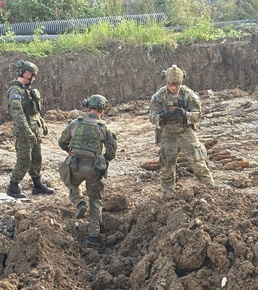
The blasts marked the end of an 11-hourKosovo Force (KFOR) Regional Command-East explosive ordnance disposal mission on June 10 that safely disposed of nearly 90 artillery projectiles uncovered earlier that day at a construction site.
Earlier that afternoon, Kosovo Police notified KFOR RC-E after a construction crew uncovered several unidentified ordnance items. The report was routed to RC-E’s EOD element, which promptly mobilized. Within hours, the response expanded into a multinational effort as EOD technicians from the United States, Finland, Germany and the Kosovo Security Force joined the operation.
“My team leader counterpart in the Finnish EOD joined us on the initial reconnaissance, and our German counterparts joined us immediately following one of their routine patrols that day,” said Sgt. Wiley Bullard, team leader with the 702nd Explosive Ordnance Company, working out of Camp Bondsteel. “It was a great experience seeing how the different countries work together and navigate the complex international, joint environment to accomplish this type of response.”
Upon arrival, teams established a cordon to keep civilians and non-essential personnel away from the hazards. They coordinated a safe approach route with local police; and the site leaders conducted a joint reconnaissance. What began as a report of only a handful of items quickly escalated. Bullard said the initial recon identified more than 20 artillery shells in the walls of the dirt trench.
As excavators continued their work that afternoon, the teams uncovered a total of 90 World War II era German artillery rounds embedded in the trench walls. Their condition was potentially unstable after decades of being buried.
An elementary school sits across the street from the site. Bullard said seeing the children pass by as his team arrived reinforced the mission’s stakes.
“As we drove by, it was a reminder of why we do what we do and why my mission is so important, to protect these communities,” he said.
EOD standard operating procedures emphasize safety at every step: cordon, reconnaissance, render-safe assessment, transport, and final disposal. The joint team cataloged and sorted the munitions on site, deeming them safe for transport. Within the operational limitations of KFOR, the ordnance was judged safe for transport but not for storage, so the mission required immediate disposal. However, with such a large mass of ordnance, logical challenges emerged.
This effort required rapid coordination. The 702nd EOD communicated with Finnish forces to secure heavy transport. A Finnish Armed Forces semi-truck was used to transport the load back to Camp Bondsteel’s demolition area. On arrival at the camp, controlled demolition operations would follow EOD procedures for safe emplacement of charges, evacuation of non-essential personnel, and remote initiation.
Bullard said the team coordinated with base security contractors from Continuity Global Solutions to escort the truck onto base and begin demolition operations at approximately 12:15 a.m.
Staff Sgt. Dylan Alfaro, the unit’s EOD noncommissioned officer in charge, emphasized the operational benefits of such responses.
“Responses like these help the team learn more about our area of operation,” Alfaro said. “Real-world responses sharpen local knowledge of terrain, hazards, and community dynamics that are invaluable for future responses."
EOD operations follow layered safety measures: route and site risk assessment, use of render-safe procedures where applicable, strict transport criteria, and controlled demolition in a designated range area. Teams operate with constant communication, detailed record-keeping and coordination with host-nation authorities and base security to minimize risk. Multinational interoperability, standardized procedures, shared terminology and tactics are essential to such success.
The total response time was about 11 hours, a timetable that reflects both the scale of the find and the deliberate care required.
“It makes for a long day, but safety dictates pace,” Bullard said.
Alfaro pointed out the learning aspect of the mission as well.
“It’s one thing to train, it’s another to apply that training in realistic conditions,” he said. “Working side-by-side with Finnish, German and KSF technicians reinforced interoperability and standardized procedures, improving joint response for future operations.”
As dawn broke over Camp Bondsteel, the quiet that followed the thunder reflected the disciplined work of multinational teams operating under established EOD procedures.
“Our goal is to return the area to a safe condition for the community,” Alfaro said.
EOD missions like the Vushtrri response are more than tactical successes; they are daily contributions to the mission’s strategic objective to maintain a safe and secure environment and freedom of movement for all people in Kosovo. Removing legacy ordnance from public works sites and transportation corridors directly reduces civilian risk and supports the local population’s sense of security.