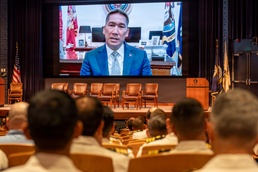
NEWPORT, R.I. – The Honorable Hung Cao, Acting Secretary of the Navy, delivered keynote remarks as the U.S. Naval War College (NWC) began its 2026-2027 academic year with two ceremonies, Aug. 3-4.
On Tuesday, Aug. 4, NWC held its annual Convocation ceremony, welcoming a total of 477 students to the academic year.
Cao, who addressed the Convocation audience virtually from Washington, D.C., called the war college “the leadership laboratory,” urging the enrolled military officers to embrace their roles as leaders, build relationships and stay loyal to their oath, their fellow service members and their allies.
“We're coming in at a very particular time, with threats looming around the world, but our Navy and Marine Corps are doing the job and securing the pathways,” said Cao. “The strength of our military is not the equipment we have; it’s our Sailors and Marines. As leaders, our one call is to lead those young sailors and Marines the right way. The Naval War College is the leadership laboratory we need, because the first time you meet one another should not be on the battlefield— it should be in places like this where we're able to share ideas and get to know each other."
The total of 477 included 292 new students from all six branches of the U.S. armed forces and U.S. federal government agencies, as well as 81 U.S. students continuing into the fall courses after previous November and March enrollments, and another 104 international students from partner and allied nations.
NWC students work to earn Joint Professional Military Education (JPME) credit and either a diploma or a master’s degree in National Security and Strategic Studies or Defense and Strategic Studies.
“Those who enroll in the U.S. Naval War College can expect a rigorous curriculum that will challenge them and, ultimately, forge them into strategists and warfighters who can be successful in any conflict, any time and any place,” said NWC President Rear Adm. Darryl Walker. “Many of the greatest military leaders our nation has seen in the last century and a half have been students or faculty here at the war college. We know there are many future commanders and flag officers among the students in the audience at convocation every year. It’s a proven fact.”
Each year, nearly 500 in-resident students graduate, with 60 percent being selected for command of ships, squadrons and other military units. In the U.S., the college has also produced three Chairmen of the Joint Chiefs of Staff, 15 Chiefs of Naval Operations and 13 other service branch heads.
Additionally, the college welcomes between 100 and 150 foreign officers to the U.S. from around the world each year to study strategy, warfare, decision making, and operational art. Since creating a program for international officers in 1956, the NWC has more than 5,500 international alumni from 145 countries worldwide. Approximately 10 percent of the alumni from the college’s international programs have gone on to become heads of their country’s respective navy.
The day before Convocation, NWC’s annual Cloister ceremony welcomed more than 300 faculty members from the college’s in-resident and distance education programs to celebrate faculty accomplishments and prepare for the academic year ahead.
During the event, the faculty was formally introduced to the war college’s new provost – the institution’s top academic officer – retired U.S. Navy Capt. Michael O’Hara, Ph.D. O’Hara previously served as the dean of the college’s Center for Naval Warfare Studies (CNWS).
“As a military and civilian faculty team, we teach in rigorous ways to prepare officers to be critical thinkers,” O’Hara told the assembled faculty during Cloister. “We challenge them through readings, case studies, and seminar discussions to take estimates of situations, to express intent, to consider alternate points of view and counterarguments. We immerse them in practical problems to plan and integrate joint all-domain operations from seabed to space. We wargame them and pit them against thinking opponents who sharpen their abilities to think at the operational-level of war and at the strategic-level, too.”
Also during Cloister, faculty members were recognized and presented awards for superior achievements in teaching and research related to their specific disciplines.
Among those recognized were Dr. Michael Poznansky, from CNWS’ Strategic and Operational Research Department (SORD) and Cyber and Innovation Policy Institute (CIPI), and U.S. Marine Corps Lt. Col. Marc Blankenbicker from CNWS’ War Gaming Department, who received the Civilian and Military Faculty Awards for Excellence in Research, respectively, for distinguishing themselves by formulating critical questions, investigating key data resources, and synthesizing and sharing innovative ideas.
Dr. Leigh Ann Perry of the College of Leadership and Ethics (CLE) and U.S. Navy Cmdr. Daniel Post of the Strategy & Policy Department received the Civilian and Military Faculty Awards for Excellence in Service, respectively, for providing excellent service to NWC and the greater community.
Prof. William Murray of SORD and the Halsey Bravo Research Group and U.S. Marine Corps Lt. Col. Matthew Rohlfing of the Maritime Advanced Warfighting School (MAWS) received the Civilian and Military Faculty Awards for Excellence in Teaching, respectively for providing a superb academic environment and educational experience for their students.
Retired U.S. Navy Capt. Thomas Mangold, Dr. Michael Martin, Dr. Robert Tomlinson, Dr. Mary Thompson-Jones and Dr. Donald Marrin were awarded status as emeritus professors, honorary titles that are carried into retirement and denote distinguished accomplishment during their careers as faculty.
Established in 1884, NWC informs today’s decision-makers and educates tomorrow’s leaders by providing educational experiences and learning opportunities that develop their ability to hedge aggressively, innovate continuously, fight distributively, delegate confidently, and command with clarity within complex battlespaces.