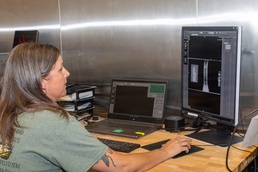
Have you ever been to the dentist’s office and received an X-ray of your mouth? They utilize plates and handy equipment to generate a quick digital image of your teeth to be evaluated in the blink of an eye. It seems like a rather standard tool for this age of digital transformation, yet it’s hard to believe such technologies are still in their infancy, growing more with each advancement to ensure we can improve and accomplish more in our time.
Now, what if I told you that a similar technology is now being utilized at Norfolk Naval Shipyard (NNSY), our team setting the standard of operations across the entire corporation?
NNSY is leading the charge with bringing computed radiography (CR) to the forefront of naval non-destructive testing (NDT). CR, a form of digital radiography (DR) testing, replaces traditional X-ray film imaging, where instead of using consumable film, it uses reusable photostimulable phosphor imaging plates or panels (IP) to capture images for evaluation and manipulation.
Previously at NNSY, the NDT Division (Code 135) and Welding Engineering and NDT Examiner Division (Code 138) would utilize traditional film to capture imagery of assets for analysis, using dark rooms beginning in the 1920s and then eventually utilizing film processors. Though this process got the job done, it took approximately 11 minutes to process one piece of film, and could not be shared to various individuals with need-to-know for that imagery. Not only that, but film was not reusable so once an image was set to the film, that film had served its purpose. As industry standards outside the Navy continued to expand into the digital age, NNSY saw an opportunity to innovate the way we do business.
““NNSY started working on this years ago with slow progress unfortunately,” said NNSY NDT Test Examiner Kelly Sawyer who joined in to begin developing the program in 2022. “In 2023, after 18 months of dedicated work from the ground up, we finally got approval to use CR. And now, we’re implementing it fully into NNSY, the first shipyard to utilize CR technology. Not only that, but in the next 12 months, we’re looking to be completely digital, utilizing Digital Detector Array in NDT, meeting the industry standards of today.”
“This has been a big push for the Navy overall to bring CR technology to our shipyards so it’s a fulfilling experience to see our team leading the charge in writing the procedures and working to build the program from the ground up so that everyone across our corporation can benefit from this technology,” said Code 138.3 Test Examiner Branch Head Daniel Hardison.
Compared to the traditional film process, CR can produce a digital image in 30 seconds. In addition, because the image is digital and can be stored on servers, there are no longer climate-controlled storage rooms and custom cabinets needed to properly store and maintain film within the NDT Division. That also means that images can be shared with any individual with a need-to-know, so that they can provide their input, even when not stationed directly at NNSY.
“It’s been a huge game-changer for us, especially when it comes to making multiple exposures and working with folks outside of NNSY,” said Hardison. “In addition, with the work we’re doing to build a NDT digital network, having CR means having more connections with our counterparts across the corporation – truly bringing more timely discussions and solutions to our work.”
As the program continues to evolve at NNSY, the team has been working with Pennsylvania State University to continue its work into DR technology. In addition, NNSY performed the first production CR inspection on July 22 of three piping weld joints. “This represents many years of working towards digital modalities for radiography to bring the Navy into the future,” said NNSY NDT Division Head Michael Vitas.
Sawyer said, “I’m super proud of the work that we’ve done here to bring this to our shipyard as well as the entire enterprise. I’m grateful that I was able to be in a position to work on this. It’s fantastic to see us grow and evolve in the way we do business, and seeing the images on a screen now, instead of film, and being able to instantly evaluate the welds using precise software tools is big. It’s a huge step in the right direction and I’m excited for us to keep moving forward into the digital world.”