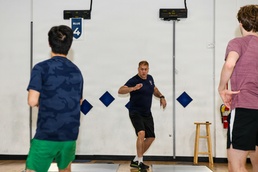
The high-pitched ringing of steel filled the room along with the rhythmic squeaking of rubber-soled shoes moving down the fencing strip, as the U.S. Olympic fencing team engaged in a linear tug-of-war of physical pressure and psychological baiting.
In the background, their coach, Lt. Col. Weston "Seth" Kelsey, United States Air Force Reservist and Inspector General for the 446th Airlift Wing at Joint Base Lewis-McChord, Washington, coaches his fencers to execute strategy and adapt to their opponents. The athletes rely on Kelsey to give them the advice they need to advance to the next big stage, the 2028 Summer Olympics in Los Angeles.
“The key to coaching an elite athlete is trust,” Kelsey said. ”If you want to compete at the highest level it takes time to build trust, vocabulary, experience, and to create a plan that meets each athlete’s needs.”
Kelsey has coached Olympic-level fencers since 2012, but prior to coaching, he was a legendary American épée fencer. Epée fencing is where two people fence with long, thin swords called épées. Kelsey, represented the United States in three consecutive Olympic Games - Athens 2004, Beijing 2008 and London 2012. Kelsey placed fourth in individual épée in London, making him the most elite men’s épée American men’s athlete in over 50 years. He also won a team gold medal at the 2012 World Fencing Championships.
According to Ariel “Ari” Simmons, a Team USA athlete and men's épée representative on the USA Fencing Athlete Council, Kelsey's experience gives him a unique ability to buy into a vision before results are visible.
“Because he has been in the arena, there is a deep, mutual respect,” said Simmons. “He treats his athletes as equals on a team and empowers them with agency.”
Kelsey’s athletic background has also gifted him with immense patience, continued Simmons. He has a 'third eye' for recognizing who is putting in the work for the long run, understanding that they are building today to win tomorrow. Ultimately, he respects everyone, believes in their capacity to make decisions, and inspires confidence in those choices.
For over 20 years, Kelsey has both mentored young fencers and served in the USAF Reserves. He joined the Reserves in 2007 after three years of active duty, serving in various capacities over his career.
Whether leading Airmen or coaching Olympians, Kelsey explained the first step to helping people succeed is understanding them beyond their performance. By taking the time to learn about their goals, challenges and motivations, he can better support their growth both personally and professionally.
"To be a good leader, you have to be genuinely curious about the people you're leading," Kelsey said. "You never know what a reservist has experienced before they show up for duty. They could be dealing with family responsibilities, stress at work or financial challenges.”
Elite athletes face similar challenges, whether they are navigating life transitions, recovering from injuries, or balancing the demands of school, work, and competition, he remarked. By leading with empathy, a coach can better understand these complexities and empower their athletes to reach their full potential.
As an inspector general, Kelsey evaluates unit readiness and leadership effectiveness under pressure. Military exercises introduce realistic, high-stress variables to identify weaknesses before real-world operations. Kelsey carries that exact framework onto the fencing strip.
"In fencing, just like in the military, you simulate high-pressure situations and train for them," Kelsey said. "When that moment inevitably comes in competition, you've already built the confidence and muscle memory to execute the right response."
That mindset was reinforced during a pivotal team competition when Kelsey served as the anchor and gave up a significant lead in points to his opponent.
"I felt like I had let my teammates down," he recalled. "I had two choices: move on and hope it never happened again or confront the mistake. I chose to analyze exactly what went wrong and deliberately train on that scenario with my teammates until I knew how to handle it."
Months later, Kelsey found himself in nearly the same situation, but this time the outcome was different.
“Because I had prepared for it, I stayed calm, trusted my training and helped my team secure the victory," Kelsey said.
Kelsey attributes his ability to adapt under pressure to a consistent framework of preparation, reflection, and deliberate practice. He applies these same principles to coaching athletes and leading Airmen, ensuring they are prepared to meet any challenge with confidence and resilience.
The road to the 2028 Summer Olympics is paved with relentless dedication. Kelsey and his fencing team are currently on a world-class training and competition tour, testing their skills against the globe's best competitors. Each stop provides an opportunity to refine tactics, sharpen reflexes, and build the mental toughness needed to compete on the Olympic stage in Los Angeles.
"I have a talented team, and each athlete brings something unique,” said Kelsey. “This season, I've seen glimpses of them becoming a true team rather than simply a collection of individuals. When we defeated the reigning Olympic champions, Hungary, in March, I saw firsthand what I've known all along: this group has the character and ability to become champions.”
While the team's progress has been encouraging, the next two seasons will demand relentless work. With 19 international stops in 24 months, success will require meticulous planning and careful balance to ensure every athlete reaches the strip in Los Angeles at their absolute peak.
“The beauty of combat sports is that, once the masks go down, all the noise disappears,” Kelsey said. “What remains is seeing which version of you and your opponent shows up to execute.”
Kelsey’s commitment to understanding the people he leads, whether an Olympic athlete or service member, ensures his teams are not only prepared, but truly empowered to succeed. This approach continues to drive success in both arenas.