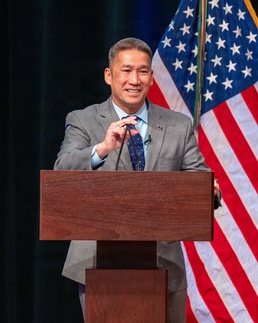
Looking back on his career as a U.S. Navy diver and explosive ordnance disposal officer, Acting Secretary of the Navy Hung Cao shared a personal perspective on the scientific and technological legacy of the Office of Naval Research (ONR).
“While many of ONR’s discoveries shaped the wider world, other less well-known breakthroughs transformed the daily lives of our Sailors and Marines on the front lines,” he said. “Having served in Iraq, Afghanistan and Somalia, my perspective is that what ONR does isn’t theoretical — it’s personal. It’s what saved our lives over there.
“For eight decades, ONR has stood at the vanguard of naval power,” Cao continued. “You’re the operational engine that transforms science fiction into tactical reality on the high seas.”
Cao gave his remarks during a special celebration honoring ONR’s 80th anniversary. Held on July 31 in the Pentagon Auditorium, the event highlighted eight decades of critical scientific and technological innovation for the U.S. Navy and Marine Corps.
In addition to commemorating historical achievements, the celebration discussed the future of integrated naval power and technological dominance — and featured more than 20 ONR technology displays on the second-floor Apex of the Pentagon’s 9th and 10th corridors.
Chief of Naval Research Dr. Rachel Riley talked about ONR’s newly released 2026 Science and Technology Strategy, which calls for a fundamental transformation of how the command prioritizes, develops and deploys technology to the Navy and Marine Corps.
Riley also introduced the CNR Fellows program. Launching this year, the fellowship brings newly tenured academic professors to ONR for a one-year term to learn about naval priorities, and provide technical oversight and state-of-the-art expertise.
“Every time I come to the Pentagon, I think about a poster here that has a George Washington quote from 1780,” said Riley. “It says, ‘There’s nothing so likely to produce peace as to be well prepared to meet an enemy.’ It speaks to the broader importance of ONR’s mission — to ensure that every U.S. Sailor and Marine, every platform within the Joint Force, is equipped with the latest and greatest technology.”
In addition to Cao, ONR’s anniversary celebration featured other prominent guest speakers:
“For 80 years, the Office of Naval Research has shaped the way we fight,” said Kilby. “Long before a ship is commissioned or a capability reaches the fleet, someone had to imagine that was possible. For 80 years, that has been ONR’s mission — to look beyond today’s requirements and prepare for tomorrow’s fight.”
Jewell recalled his time as a university professor and awardee of ONR’s Young Investigator Program — and expressed gratitude for the command’s sustained support of his academic research in hypersonics.
“The innovations taking place through ONR are truly mission-driven, and support the warfighters of today and tomorrow,” he said. “The mission of ONR is paramount to our nation’s economic and national security.”
During his presentation, Singer outlined five technological areas — what he called “lineages” — in which he believes ONR has been particularly effective since its establishment in 1946:
“In 1946, ONR started with six basic branches, including physics, fluid mechanics, aviation and physiology,” said Singer. “From that structure, ONR has [expanded] into areas that now extend from cyber to autonomy to directed energy. Entire departments are named after words that didn’t even exist in 1946. That shows an organization evolving and changing the very lexicon of human scientific and military capability.”
Warren Duffie Jr. is a contractor for ONR Corporate Strategic Communications.