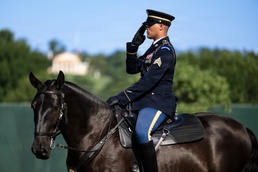
The warm summer temperature, green grass and blue sky at Arlington National Cemetery on July 14, 2026, were a stark contrast from North Korea’s snow-covered hills east of the Chosin Reservoir — where, in December 1950, U.S. Army Sgt. DeLoren D. Dage lost his life during one of the most brutal battles in history, remembered as the Battle of the Frozen Chosin. Dage had been holding the line against numerically superior Chinese communist forces that had surrounded his unit and were trying to destroy it. The Chinese were not taking prisoners. Dage was declared missing in action on Dec. 2. He was only 20 years old.
Dage served in Company A, 1st Battalion, 32nd Infantry Regiment, which was attached to the 31st Regiment, 7th Infantry Division — known as Task Force Faith, named after commander Lt. Col. Don Carlos Faith (Section 4). On Nov. 30, 1950, the soldiers of Task Force Faith broke out of their surrounded position east of the Chosin and headed south to the American lines; the 1st Marine Division, on the west side of the reservoir, also pushed south.
Faith’s men, including Dage, fought through Chinese roadblocks and ambushes in frigid temperatures. They endured frostbite and heavy casualties. Chinese forces overwhelmed the unit on Dec. 1. The next day, as American survivors made it across the frozen reservoir to safety, the Army declared Dage missing in action. He was not alone. Of the task force’s 2,500 soldiers, fewer than 1,000 made it to the safety of the American lines. Those who survived the campaign became known as the “Chosin Few.”
Dage, from Southgate, California, attended Compton Junior College and then joined the Army. Days after the Korean War broke out on June 25, 1950, he deployed to Korea. He participated in the amphibious assault on Inchon and the retaking of Seoul in September 1950, before losing his life along the “Frozen Chosin.”
In 1953, as part of the negotiated armistice, North Korea and China exchanged remains with United Nations countries, including those of 4,200 individuals believed to be missing American personnel. Among them was Sgt. Dage, who, unidentified at the time, was buried as an unknown at the National Memorial Cemetery of the Pacific in Honolulu, Hawaii.
In 2002, the Defense POW/MIA Accounting Agency (DPAA) disinterred Dage’s remains and contacted his only living relative, his niece, Jody Bunch of Tucson, Arizona, to provide a DNA sample. When Dage was identified, Jim Bell, an identifications liaisonwith the Army’s Past Conflict Repatriations Branch, contacted Bunch and told her they had found a match. “I couldn't believe it,” she said. Bell later held a two-hour virtual meeting with Bunch, reviewing all the information about her uncle and explaining his military awards. “He and everyone have been so accommodating and so helpful,” Bunch added.
During the full military funeral honors with escort service in Section 57, Chaplain (Capt.) Shannon Demoret emphasized Dage’s heroism in answering his country’s call to duty. “Surrounded and heavily outnumbered, Sgt. Dage stood his ground with Company A of the 32nd Infantry Regiment, holding the line with courage against overwhelming enemy forces.” She also credited DPAA’s tireless efforts to return him home. “The promise to never leave a fallen comrade behind is fulfilled,” she said. “His long, lonely winter on distant soil is over.”
Following the chaplain’s prayers, a firing party fired three volleys, a bugler sounded Taps and an Army band performed. An Army captain presented Bunch with the flag that had lain over her uncle’s casket. “That was very emotional,” Bunch later said. “Even though I didn’t know my uncle, it made me think of my mom and her loss.”
Bunch also learned the significance of her uncle’s sacrifice to the U.S. military when Jennifer Walsh from DPAA presented her with framed photos from her uncle’s service. Lt. Col. Adam Choat also presented Bunch with the Order of the Bayonet, a prestigious 7th Infantry Division (the Bayonet Division) military order recognizing outstanding soldiers who demonstrate exceptional professionalism.
Bunch was impressed and “touched,” she said, by the many uniformed and civilian officials who attended her uncle’s funeral.
Chaplain Demoret said that Dage had lived a life marked by duty and sacrifice, “one not lived for self alone, but in service to others.” Indeed, Dage died while making the ultimate sacrifice for his fellow soldiers while fighting along the Frozen Chosin.