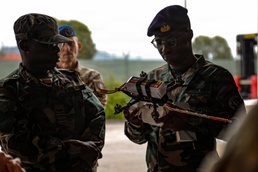
VICENZA, Italy – U.S. Army Southern European Task Force, Africa (SETAF-AF) hosted Ghana Armed Forces representatives for a showcase of U.S. unmanned aircraft systems innovation, technical management and production capabilities at Caserma Del Din in Vicenza, Italy, July 21-22.
The five-member delegation represented Ghana's army, navy and air force, and included leaders and planners ranging from the battalion to branch headquarters. It was the first time Ghanaians visited SETAF-AF to discuss UAS, and the first time Ghanaian officers toured the 173rd Airborne Brigade's Bayonet Innovation Team lab.
“The GAF are exceptionally professional and capable partners,” said U.S. Army Maj. Stephen Scuderi, the Ghana desk officer with the Security Cooperation Directorate, SETAF-AF. “While we are assisting the GAF in standing up their own drone production, this effort paves the way for future joint co-production opportunities and access to their training ranges to test and mature our own UAS and counter-UAS technology in different environments.”
Scuderi explained that Ghanaian leadership is focused on independence, self-reliance and locally developed solutions. They want to design and manufacture UAS capabilities tailored precisely for their specific regional environment, with a long-term goal of exporting those systems to West African regional partners.
This engagement builds upon a bilateral UAS partnership first discussed in 2025 between the U.S. Army Europe and Africa commander and the Ghanaian chief of army staff.
“Our primary goal was to demystify in-house drone manufacturing and show the Ghanaians exactly how the U.S. Army executes this at the tactical level,” Scuderi said.
The delegation spent its first day at the 173rd Airborne Brigade BIT’s lab, reviewing in-house manufacturing capabilities and observing a live UAS flight demonstration. The day ended with a question-and-answer session on manufacturing techniques, UAS training and rapid maintenance cycles.
On the second day, SETAF-AF experts briefed the delegation on electromagnetic spectrum control and electronic warfare in active UAS environments, airspace integration and management protocols, counter-UAS defense frameworks, and UAS intelligence exploitation.
While the U.S. Army and the GAF differ in size and budget, the localized production model utilized by the 173rd Airborne Brigade BIT is highly scalable and replicable for GAF forces. The intent was to provide the GAF delegation with a realistic, proven blueprint to help them lay the foundation for their own drone manufacturing capability.
U.S. Army Capt. Vincent Gasparri, director of the 173rd Airborne Brigade BIT, said the technical exchange ran in both directions.
“The BIT’s primary goal was to explain the lessons we have learned pursuing UAS in the 173rd Airborne Brigade to the GAF to support their similar efforts,” Gasparri said. “We also wanted to learn what advancements and work the GAF have made with respect to UAS that can inform our efforts internally.”
Gasparri noted that Ghana has faced technical challenges the 173rd has not, like extreme heat impacting battery life, which prompted internal consideration and planning for advancements in that area as well.
“Our team's experience with the GAF has been informative because it provides insight into alternative environments, and military challenges and progress within UAS,” Gasparri said.
Ghana's weather, supply chains and operating environment differ from Europe's, and accounting for those differences ensures U.S. systems and designs hold up across a wider range of conditions.
“It also serves to further shape the capacity and value that can come from a drone center of excellence and training area in Ghana for both the GAF and U.S. forces," Gasparri said.
To move discussions toward fielded capability, SETAF-AF is brokering partnerships between Ghanaian research institutions and U.S. universities and research centers, as well as securing collaboration with U.S. private industry partners.
Scuderi pointed out that these partnerships run parallel to and complement the line of effort to establish the Africa Multidomain Training and Experimentation Center in Morocco. Together, the two efforts contribute to a wider goal of fostering standardized partner-nation UAS proficiency and shared multidomain understanding across Africa.
“This engagement serves as a model,” Scuderi said. “SETAF-AF stands ready and willing to collaborate with African nations to drive innovation, whether in UAS or other emerging technological sectors.”