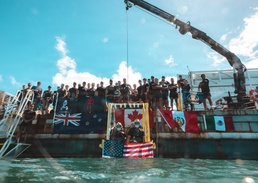
JOINT BASE PEARL HARBOR-HICKAM, Hawaii – U.S. Navy Explosive Ordnance (EOD) Disposal Technicians assigned to EOD Mobile Unit (EODMU) 11 completed combined training during Rim of the Pacific (RIMPAC) 2026, July 28, 2026.
Joining EODMU-11 were multinational Sailors from the Royal Canadian Navy, Japan Maritime Self-Defense Force, Mexican Navy, Royal New Zealand Navy, Peruvian Navy and Philippine Coast Guard forming the Navy Expeditionary Combat combined task force of 120 personnel.
Additional EODMU-11 personnel integrated with the RIMPAC mine warfare combined task force alongside the Royal Australian Navy, Royal Danish Navy, German Navy, Royal New Zealand Navy and Republic of Singapore Navy to conduct mine countermeasures training.
“RIMPAC is where we turn partnerships into operational capability,” said Cmdr. Eric Bokhoven, task force commander and commanding officer, EODMU-11. “Training alongside our allies and partners allows us to build common procedures, strengthen trust, and demonstrate that we can operate together in complex environments. Those relationships and shared experiences are what ensure we’re ready to respond together when it matters most."
Training opened with mutual familiarization of technical tools, equipment and procedures, leveling the capabilities across all EOD technicians and divers so the team could rapidly integrate, communicate and execute its mission.
“RIMPAC continues to provide an outstanding opportunity to train alongside partner nations,” said Lieutenant Ben Robertson, Royal New Zealand Navy maritime EOD officer in charge, HMNZS Matataua. “From the start, our efforts delivered significant capability growth for our team and reinforced our collective readiness to conduct future multinational maritime operations.”
Crews moved on to conduct ordnance exploitation and battle damage assessment drills, along with helicopter rope suspension techniques from both a rappel tower and MH-60S Seahawk aircraft with Helicopter Sea Combat Squadron 23.
“RIMPAC gave us a great opportunity to train with international EOD teams in all environments,” said Lt. j.g. Gomer Novero, Philippine Coast Guard EOD officer in charge. “We train to always think safety first while making sound decisions under pressure, and most importantly, this experience strengthened our relationships with our partners.”
Having completed training on land and in the air, EOD forces proceeded to conduct antiterrorism and force protection dives in Pearl Harbor, running scenarios to neutralize limpet mines placed on the hull of decommissioned tugboat USNS Navajo (T-ATF-169) at the Naval Inactive Ship Maintenance Facility. Simultaneously, teams practiced rigging and ordnance extraction onboard the vessel.
Rounding out the exercise with land-based improvised explosive device (IED) drills at Marine Corps Training Area Bellows, teams responded to quickly find, classify and dispose of explosive threats.
“The greatest value of RIMPAC lies in the relationships built among partner forces,” said Lt. Alejandro Angeles, Mexican Navy EOD team leader. “Trust, teamwork and interoperability cannot be developed overnight; they are earned through shared EOD training and mutual respect.”
Along with both land- and sea-based EOD training, the multinational task force leveraged their mobile diving and salvage (MDS) elements, logging over 4000 diving hours over the course of RIMPAC.
Similar to their EOD counterparts, the multinational divers ensured all participants were well-trained and qualified to use U.S. Navy dive gear for safety purposes prior to advancing to further training.
“Exchanging diving tactics and techniques builds both technical capabilities and trust,” said Petty Officer 1st Class David Denman, Canadian Armed Forces Dive Team officer in charge, Fleet Diving Unit Pacific. “Despite differences in language and procedures, our shared commitment to safety and mission success demonstrated how our nations can come together as one professional team.”
After several familiarization dives, the divers began more specialized underwater salvage techniques on an underwater training aid. This included wreck patching and ‘hot tap,’ the process of safely de-fueling a vessel underwater to eliminate any environmental risk to personnel and surrounding areas.
“Success in diving is built on trust, communication and teamwork from the start,” said Lt. j.g. Sebastian Chilet Guerrero, officer in charge for Peruvian Navy divers. “RIMPAC allowed us to strengthen skills, exchange knowledge and maintain our readiness for future operations.”
Advancing from a mock ship hull to the decommissioned salvor ship USNS Safeguard (T-ARS-50), divers conducted hull inspections, cutting and welding on a full-size vessel.
For the MDS element, the exercise culminated in a helicopter salvage project, drawing on weeks of teamwork to flex the unique and specialized skillset to refloat a sunken aircraft and recover it back to land.
“When you’re conducting sub-surface operations across different training and equipment standards, interoperability is mission critical,” said Lieutenant Dom Wells, Royal New Zealand Navy dive survey, search, and recovery officer in charge, HMNZS Matataua. “This kind of direct knowledge-sharing strengthens all of us and builds team trust when we need it the most.”
From ordnance disposal to underwater salvage, the task force demonstrated a full spectrum of expeditionary abilities to locate, neutralize or recover threats, hazards and obstructions. Integrated training in realistic environments empowers fleets worldwide to operate safely, efficiently and effectively in complex maritime environments.
Thirty nations, 30 ships, five submarines, 15 national land forces, more than 190 aircraft and more than 30,000 personnel are participating in RIMPAC in and around the Hawaiian Islands, June 24 to July 31. The world's largest international maritime exercise, RIMPAC provides a unique training opportunity while fostering and sustaining cooperative relationships among participants critical to ensuring the safety of sea lanes and security on the world's oceans. RIMPAC 2026 is the 30th exercise in the series that began in 1971.