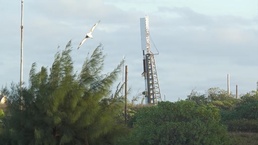
Naval Surface Warfare Center, Port Hueneme Division (NSWC PHD)’s White Sands Detachment (WSD) recently hit a high mark in its suborbital vehicles capabilities, launching its biggest sounding rocket for an experiment to bolster national security.
The Space Measurement of A Rocket-released Turbulence (SMART) mission, which blasted off from Wake Island in the Pacific Ocean on Feb. 12, marked WSD’s first flight of a four-stage sounding rocket and a rare expeditionary launch — requiring the team to bring all the equipment and infrastructure except for the launch rail.
Eight personnel from WSD, which is based at White Sands Missile Range in New Mexico, spent about seven weeks on Wake Island, from early January to late February, setting up the launch facilities, planning and executing the mission.
A total of 42 people traveled to the remote atoll for the effort. Along with the White Sands team, the group included scientists from the Naval Research Laboratory (NRL), which managed the SMART program, and personnel from NSWC Indian Head Division, NASA’s Goddard Space Flight Center, two universities and several supporting contractors.
The Oriole IV vehicle — composed of Talos, Terrier, Oriole and Nihka rocket motors carrying two payloads — flew to an altitude well into the realm of low Earth orbit where satellites reside. It then detonated a directional explosive known as a shape charge to vaporize several pounds of barium, creating a plasma field. Another payload deployed scientific instruments to measure the electromagnetic effects of that field.
The SMART mission sought to validate laboratory-tested plasma physics theories in low Earth orbit, explained Jay Breuer, senior test director in WSD’s suborbital vehicles division. This research can inform developments that will ultimately benefit the Navy fleet, according to Breuer.
“At the end of the day, we are proving theories that will lead to delivering capabilities for our warfighters,” he said.
Christopher Netwall, Dynamics and Control Systems branch head at NRL’s Naval Center for Space Technology, described the aim of the mission more technically as “to confirm the conversion of electrostatic lower hybrid waves to electromagnetic whistler waves from a high-speed metal vapor release in the ionosphere.”
The results of that experiment, he said, “represent a significant first step in validating key physics that will ultimately lead to important national security efforts.”
Netwall, who held the roles of program manager and experiment lead for SMART, started working with WSD personnel on plans for the undertaking a few years ago, and he said their level of commitment stood out.
“They knew it was a tough mission, but they really supported the idea, and they supported me,” Netwall said.
It had been about 15 years since WSD last executed a launch on the distant and isolated Wake Island, which wasn’t the originally planned location.
Why Wake?
The SMART mission was initially slated to take place at Wallops Flight Facility on Wallops Island in Virginia, with NASA launching the rocket. But after the agency’s safety analysis showed that the planned high-altitude detonation would scatter debris over a large area, NASA determined that Wallops wasn’t the right site and referred the project to the Navy, according to Breuer.
The Navy relocated the SMART mission to Wake Island, which the U.S. Air Force manages. The wishbone-shaped atoll lies about 2,300 miles west of Honolulu and 1,500 miles northeast of Guam. The closest inhabited island to Wake is nearly 600 miles away.
“It’s in the middle of nowhere,” Breuer said.
That isolation, along with the ability to close enough airspace and clear a large swath of the ocean, made Wake a prime place to execute the SMART mission safely, Breuer said.
While Wake was ideal in terms of geography, it was lacking in another key factor: infrastructure. That’s where the White Sands team’s expeditionary capabilities came into play.
Setting up shop
Launching research-oriented sounding rockets is the longest-running mission for WSD. The suborbital team builds and blasts off these high-flying vehicles at home on White Sands Missile Range and at sites around the world — such as the Hebrides Range in Scotland and Pacific Missile Range Facility Barking Sands in Kauai.
“This is basically our bread and butter, being able to plan and execute a test of this complexity,” Breuer said.
Even so, the SMART mission posed a unique challenge in that there was no working launch facility or instrumentation on Wake Island.
“Usually, we deploy to a range with telemetry dishes and launch control,” Breuer said.
The team members essentially had to start from scratch, bringing and setting up all of their own equipment except for the launch rail.
Small groups had traveled to the atoll last spring to survey the site and in September to take some equipment and start setting up. These advance efforts and information gathering — including talking to personnel stationed on Wake and others who had executed missions there — were critical to the success of SMART, according to Netwall.
“We knew what type of situation we were going into, and we understood that other programs have failed because of a lack of bringing what they needed,” Netwall said. “That motivated us to do everything we could do … to ensure that we didn’t fail when we got there.”
The team members operated out of an abandoned garage with a leaking roof, mold on the walls and a dirt floor. In this “post-apocalyptic” facility, as Breuer described it, they established a launch control center to house all of the ground support equipment and personnel for the mission.
Outside, they set up meteorological equipment, including wind readers and forecasters, which they used for the first time.
For connectivity, they brought Starlink devices that provide internet via satellite. Away from those units, they had no access to Wi-Fi or cellular service. The launch facility lacked running water and air conditioning, so they brought in coolers stocked with bottled water each day.
The situation was stressful at times, Netwall said, but everyone understood their roles and pulled together in a big group effort.
“The team chemistry was excellent,” he said.
After more than a month on Wake and multiple delays that were necessary to avoid collisions with satellites, the team was ready for launch on Feb. 12.
All systems go
The rocket took off from a Missile Defense Agency (MDA)-owned 50K launcher — meaning it can support a maximum design load of 50,000 pounds. WSD extended the rail to accommodate the 68-foot-tall vehicle.
WSD has decades of experience obtaining and repurposing demilitarized rocket motors, which reduces the cost of its launches. In this case, reaching an altitude of 335 miles required a stack of four of these motors that are relatively small in diameter. One bigger single-stage motor that could fly as high would have cost tens of millions of dollars more, according to Breuer.
“The cheaper we can make our vehicles, rockets and targets, the more programs get to test,” he said. “The more you get to test, the more you get to field.”
The Oriole IV vehicle was equipped with three telemetry systems that transmit flight data, such as how fast and high it goes. Because there was no infrastructure to receive this data on Wake, like range control at established launch sites, the White Sands team brought a new safari ground station to collect the telemetry streams from the rocket.
In another first for WSD, the Oriole IV was also equipped with two attitude control systems, which adjust the rocket’s orientation, instead of one.
The vehicle’s performance was “nominal,” meaning as predicted, Breuer said, and the payloads met all of NRL’s scientific objectives.
“We had a good flight, and we collected good science,” he said.
After the launch, MDA transferred ownership of the Wake launch rail to WSD, adding to its robust arsenal.
“We now own four of the five 50K launchers in existence,” Breuer said.
Proving the expeditionary launch ability and the equipment it required at Wake sets the stage for WSD to take on other far-flung missions, Breuer said, which will be critical in meeting the growing demands for testing hypersonic vehicles and for developing the Golden Dome for America missile defense system.
“We do plan on using this safari capability to conduct more remote launches wherever needed,” Breuer said.
Getting around Wake was something of a safari, with the team riding in diesel-powered carts known as mules on bumpy, mostly unpaved roads. Along the way, they saw legions of exotic birds, such as blue-footed boobies, albatross and sooty terns.
Getting to the island in the first place was even more of an adventure.
Far from home
Three C-17 cargo planes flew the team members, their equipment and the ordnance from Holloman Air Force Base — adjacent to White Sands Missile Range — some 5,800 miles to Wake Island, with required stops along the way for the aircrafts’ crew to rest and refuel.
Breuer rode aboard the C-17 that carried the explosives and the four stages of the rocket — “I was sitting right across from it,” he said.
That plane stopped first at Travis Air Force Base in Northern California for two nights, then at Joint Base Pearl Harbor-Hickam in Honolulu to refuel. After crossing the International Date Line and jumping ahead a day, the C-17 landed on the airfield at Wake about four days after it took off from Holloman.
Being 19 hours ahead of New Mexico was disorienting, Breuer said.
“When it’s Monday on Wake, it’s Sunday back home,” he said.
The weather was distinctly tropical: temperatures in the 80s, high humidity, regular rain spells. Even with the daily precipitation, the island is “very dusty,” Breuer said. He showered up to three times a day and washed his pillowcase several times a week.
“I’ve never been so dirty in my life,” he said. “You can’t get clean, and you can’t get dry.”
Wake is a ring of three thin islands and coral reef that rim a lagoon, which is the crater of an extinct underwater volcano. The beaches are composed of white coral sand — appropriate for the crew from White Sands Missile Range, whose name comes from its dunes of snow-like gypsum crystals.
The team stayed in a barrack that MDA owns. The dorm-style building has about 40 rooms sharing five showers and five toilets, which felt like “going back to college,” as Breuer put it.
Outside of work, there wasn’t much to do. Water activities were heavily restricted because of several incidents — including a shark attack — over the past year, Breuer said. But the teammates could occasionally float in the shallow turquoise waters of the lagoon or snorkel in the deep blue ocean outside of the atoll, where they spotted exotic fish, clams and grey reef sharks around the coral.
“The life under the sea was beyond anything I’ve ever seen,” Breuer said.
The atoll and its waters are also dotted with remnants of World War II battles, from old bunkers and a rusted 8-inch gun emplacement to shipwrecks and sunken planes. Breuer noted that the Japanese attacked Wake Island just hours after Pearl Harbor in 1941, but the date was Dec. 8 on Wake and Dec. 7 on Oahu because they’re on opposite sides of the International Date Line.
The area of Wake Island known as downtown offers amenities such as a dining facility, general store, gym and barbershop. There is also a bar, called Drifters Reef, but it was only open three times while the team was there, according to Breuer.
The most popular pastime came at the end of each day, when White Sands team members and other personnel working on the mission — including scientists who know a thing or two about space — gathered outside the barrack. They sat on lawn chairs and talked while gazing up at the brilliant night sky.
“Being surrounded by so many astrophysicist types in such a beautiful, clear place with no light pollution where you can really see the stars — that was really special,” Breuer said.
Leaving home for nearly two months to live and work on an isolated island with limited communications was a lot to ask of the team members, Breuer said, but they rose to the occasion.
“The team made a lot of personal sacrifice,” he said. “We really have a motivated, dedicated workforce that believes in our mission and believes in what we do. That makes all the difference in the world.”
Despite the austere conditions — or perhaps because of them — Breuer said he would welcome a chance to return to the remote atoll in the middle of the Pacific.
“I would love to go back to Wake,” he said.