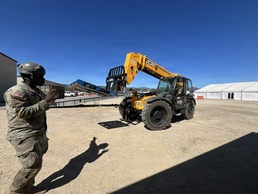
FORT HUNTER LIGGETT, Calif. – 310th Expeditionary Sustainment Command units attended Operation Bold Eagle (OBE) 14-23 July. The event, which consisted of a combat support training exercise (CSTX) and Global Medic, an international joint medical training exercise, provided mission command on Fort Hunter Liggett, California for 74 units and more than 3,300 Army Reserve soldiers from across the United States. OBE challenged units with realistic training in an austere environment that increased their preparation for large-scale combat operations (LSCO).
The exercise contributed to unit readiness by providing a platform for Soldiers to rally together to successfully complete their commander’s training objectives, accomplish real-world missions, and utilize modernized equipment.
Engineer, movement control, and quartermaster units including the 310th ESC’s 1015th Quartermaster Company, 373rd Quartermaster Battalion, Petroleum, and the 523rd and 199th Movement Control Teams were evaluated by observer coach/trainers (OC/Ts) from the 91st Training Division, 84th Training Division, and First Army. The OC/Ts evaluated units, which had Mission Essential Tasks (METs), on commanders training objectives. The evaluations were used to determine if units could meet the readiness requirements of being prepared to fight in a LSCO environment. These evaluations occurred while units experienced various injects and simulated attacks.
Although units were expected to complete all assigned Mission Essential Tasks (METs), two tasks served as the primary benchmarks for the training.
“One of the particular METs may be Conduct Sustainment Operations, while another would be to deploy or prepare to deploy into an expeditionary environment,” said Brig. Gen. James F. Porter, Commanding General, 451st Expeditionary Sustainment Command.
Porter, who is also the CSTX’s senior trainer, added, “Those are the two that really stand out to me is: being prepared to-or preparing to-deploy your unit into an expeditionary environment to perform your sustainment mission. They are a big part of what I am focused on.”
Units explained their missions.
“As a petroleum services battalion, we provided command and control over petroleum assets in theater, in large scale combat operations,” said Capt. Joshua D. Melson, Headquarters and Headquarters Detachment Commander, 373rd Quartermaster Battalion, Petroleum Services. “We manage how we get fuel, where it moves and how it’s utilized in support of our supported units in theater. Our mission at CSTX has been split between the South Torbian scenario for managing the fuel within that area of operations for the division that’s doing the push for the scenario as well as managing real-life fuel here at the exercise for all the tenant units within the training area.”
The 373rd QM BN wasn’t the only unit that had to juggle its scenario responsibilities with its real-world mission.
“The 1015 QM CO is a quartermaster supply company,” said Capt. Geoffrey Germaine, Commander, 1015th Quartermaster Company. “Our primary focus is to set up Service Support Areas to receive bulk shipments of equipment, break those down, and re-build those into palletized loads for the individual units out on the forward line of troops. Once we do that, we load it onto flat racks, and then transportation companies, typically using the Palletized Load Systems, will come pick those up and take those out to wherever they need to go.”
“Our mission at CSTX is to provide the real-world, Class One, or food support to the units,” said Germaine. “We receive the orders based off the head counts at each location of the field feeding teams. Then we take the bulk shipments of Meals Ready-to-Eat, Heat and Serves, and other forms of food, break those down to make sure that we are meeting that head count, repackaging them, and getting those set up. It consists mainly of non-perishable box items like the MRE and some perishable items like fresh fruits and vegetables and milk and ice. For this exercise, we are assisting approximately 3400 soldiers, which is somewhere between 71 and 75 units. Our unit’s mission contributes to readiness because if the soldiers don’t eat, the soldiers can’t perform. We’re here to make sure the soldiers have everything they need pre-packaged and ready to be delivered to them to ensure they can continue on.”
“The 523rd MCT’s mission at Bold Eagle is overseeing movement control,” said Staff Sgt. Christopher Foster, Transportation Management Coordinator, 523rd Movement Control Team. “Anyone who is trying to convoy somewhere, they send a trip ticket or clearance to us, we verify it and send it up to the movement control battalion. We’ll also go to the different sights and verify that what the units put on their document is true.”
The 199th MCT’s mission at Bold Eagle was to process Transportation Movement and Convoy Clearance Requests.
“Transportation Movement Requests are completed by units the 199th MCT supports,” said 1st Lt. Hakeem Mutebi, Executive Officer, 199th Movement Control Team. “We help synchronize and coordinate the movement of units’ personnel and cargo that they cannot organically move. CCRs are used to request approval to move military convoys on designated routes. This is primarily done to prevent congestion and conflicts between convoys, increase safety, and prioritize movements and accountability. Lastly, they ensure that units know that we are moving from this Tactical Assembly Area to this TAA so that everyone is tracking the personnel and cargo that’s being moved.”
A modernized Army communication system was one of the exercise’s highlights.
“A little over a year ago, the Command Post of the Future (CPOF) was used as a communication system,” said Porter. “It was the training tool we used to help commanders visualize the battlefield, synchronize operations, and develop our common operating picture. Since then, we have moved to the Joint Battle Command-Platform (JBC-P)--our step into the modern Army to ensure better communication and synchronization.”
The system was highly praised.
“My unit uses the JBC-P to maintain communications between mobile units as well as maintain in-transit visibility between all units,” said 2nd Lt. Noah Padilla, Movement Control Officer, 523rd Movement Control Team. “You’re able to see the movement of any vehicle with the system while they’re enroute to any destination, get live reports and chat in real time. Units can also respond quickly if any route planning is needed. A key moment for my unit with the system was that there was a problem at one of the fueling stations when our soldiers were conducting a convoy. So, we had to quicky re-route them to a different re-fueling station. One of my sergeants next made a route plan from our end and sent it to them on site. From there, they were then able to re-route to the new destination without any strong phone connections or something like Google Maps, just a pure military system.”
Melson also liked how the exercise was modernized.
“One of the things I enjoyed as one of the cornerstones of CSTX was the inclusion of the Cyber and Electromagnetic Activities and Unmanned Aerial Systems training as well as issuance of training aids out to our training areas and focusing on the modern era on how drones are used and how to counter drones,” said Melson. “Drones are the future of battle, but seeing that as an emphasis and one of the primary CSTX injects gives me confidence as a commander that my soldiers are able to utilize those tools, practice correct operating procedures and stay safe on the battlefield.”
The CSTX improved the units’ readiness by helping soldiers lead and work together as teams.
“With as small of a unit as we have that includes soldiers added from different units, we learned that we have to work as a team to complete tasks regardless of the rank, age, Military Occupational Specialty, or gender,” said Foster.
“The training has been really good and demanding,” said Sgt. Deylan Phelps, Technical Engineer, 373rd Quartermaster Battalion. “I’ve had a lot more responsibilities thrown on me that I’ve never really had before. It has increased my leadership abilities as a sergeant and helped me gain the confidence to lead. Growing as a soldier is the best training that we can have. Being in a new environment with new people and bonding, that’s good training.”
“The training has made me very uncomfortable to be comfortable,” said Staff Sgt. Shemeki Chandler, Class One Warehouse Noncommissioned Officer in Charge, 1015th Quartermaster Company. “I have been in a position that I’ve never had before. So, this was a learning lesson…to become better as a NCO and in personal life.”
“The training is amazing to learn,” said Pfc. Joi Elliott, Unit Supply Specialist, 373rd Quartermaster Battalion. We don’t do this training all the time, but it has helped me get into a war mindset and know what to do, when to do it, and how to do it.”
Finally, Melson praised the realistic training.
“I’m truly impressed by the rigor of this exercise in being able to simulate an austere environment to its maximal effect,” said Melson. “It was both stressful for the soldiers and high impact. If there’s any training environment or exercise that would be as close to 100% readiness for a mobilization or deployment, this is it.”