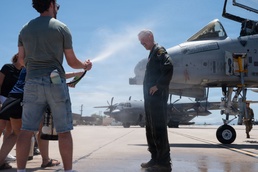
DAVIS-MONTHAN AIR FORCE BASE, Ariz. – The familiar growl of the A-10C Thunderbolt II echoed across Southern Arizona one final time July 29, 2026, as Airmen and local civic leaders gathered at Davis-Monthan Air Force Base to witness the aircraft's final flight, marking the end of nearly five decades of A-10 operations at the installation.
"It's not a place. It's not people. It's a mindset," said U.S. Air Force Chief Master Sgt. Dave Anderson Jr., 355th Operations Group senior enlisted leader. "Hopefully that attack mindset will continue to live on, and it will make every single airman it touches, every single airframe it touches, every single organization it touches better."
The flight served as both a celebration and a farewell, honoring an aircraft that became synonymous with the 355th Wing and its close air support mission. As the aircraft passed overhead, the sound that had long defined Tucson's skies became a reminder of the generations of Airmen who flew, maintained and supported the A-10 throughout its legendary service at Davis-Monthan.
“The reason the A-10 flies, and the reason why our enemies are afraid of that, is because of the level of support every single airman in all career fields gives to make sure that platform departs and comes back safely," Anderson said.
For nearly five decades, the A-10 represented more than a weapons system; it reflected the discipline, professionalism and commitment of the Airmen who ensured the aircraft remained ready to answer the nation's call. Every sortie, every training mission contributed to a legacy built on supporting forces on the ground in some of the most austere operational environments in the world.
"We've always had A-10s on the ramp; for the last 50 years they've been on the ramp," said U.S. Air Force Lt. Col. Rodney Dwyer, 355th Operations Group commander. "To see the sunshades get torn down, to see the jets divest, fewer and fewer A-10s out there ... it's definitely bittersweet."
As the aircraft landed following its final flight, the significance of the moment settled across the flight line. The Warthog's mission at Davis-Monthan had come to a close, but the legacy created by the Airmen who flew, maintained and supported the aircraft will remain woven into the history of the base and the Tucson community for generations to come.
"I got out of the aircraft and went over to him (Dwyer) and told him, 'I don't want to do this, man. I don't want to,'" U.S. Air Force Lt. Col. Ryan Rutter, 357th Fighter Squadron commander, said. "It's tough, and I think a lot of it is you've just spent years being part of this team and flying this aircraft all over the world and building friends and relationships in the community. So when you shut down the jet for the last time, it's that realization that some of that will change, some of that will go away."
The A-10’s final flight marked the closing chapter of a mission that shaped the identity of the installation and forged lasting connections between the base and the surrounding community. Residents grew accustomed to the unmistakable sound of the twin-engine aircraft overhead, recognizing it as a symbol of the military presence that has remained an enduring part of Tucson.
“Thanks for trusting us,”said Rutter, “Thanks for letting us train and improve our skills and develop the culture."