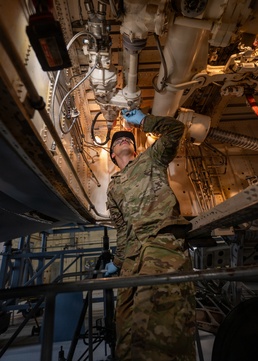
WESTOVER AIR RESERVE BASE, Mass. – Inside the Regionalized Isochronal Inspection (RISO) facility, towering maintenance platforms surround the C-5M Super Galaxy aircraft as reserve, civilian and active-duty maintainers operating around the clock, rising lifts, reviewing technical data and coordinating tasks to meet their 22-day inspection timeline.
The RISO program brings C-5M aircraft from across the Air Force together for scheduled isochronal inspections that identify discrepancies, complete required repairs and prepare the aircraft to return to operational service in support of global mission readiness.
"If you think about it like your car inspection, every year your car is due for an inspection," said Senior Master Sgt. Eric Jancaitis, 439th Maintenance Squadron flight chief. "For the C-5, every 18 months a minor ISO inspection is due."
Unlike routine flight line maintenance, ISO inspections allow maintainers to access areas of the aircraft that are not fully accessible during daily operations.
"We like to call it the aircraft's spa day," Jancaitis said. "They are flying these planes hard and when they come here, we have the time to open the panels, get into the flight controls and landing gear, inspect the components and fix what needs to be fixed."
The RISO program placed experienced maintainers, specialized equipment and standardized processes together at one location to support aircraft from across the Air Force.
"You're consolidating experience, equipment and processes," Jancaitis said. "Everything here is set up to do exactly what we do, which makes us safer and more efficient."
Each aircraft is scheduled to complete the RISO inspection process within 22 days before returning the aircraft to its home station. To maximize aircraft availability, maintainers rotate between 9-hour shifts allowing the mission to operate 24-hours a day.
Jancaitis said the team's work extends beyond supporting aircraft assigned to Westover.
"We are affecting the entire C-5 community with what we do here," Jancaitis said. "We get these planes ready to return to their units and go on a mission."
As maintainers move between work stands and open access panels, Master Sgt. Dominic DiNobile, 439th Maintenance Squadron aircraft maintenance supervisor, discusses that the mission depends on experienced Airmen who continue developing the next generation while meeting Air Force maintenance standards.
DiNobile said experience remains one of the organization's greatest strengths.
"Experience is invaluable," DiNobile said. "You cannot replace someone with 10 years of experience with someone who has two years of experience. It just does not translate."
Despite those challenges, experienced maintainers continue training newer Airmen while accomplishing the mission.
"We want more people, more parts and more training because it is necessary," DiNobile said. "This is a large operation and even when manpower is limited, the mission does not get smaller."
By developing younger maintainers alongside experienced technicians, the RISO program helps preserve technical expertise while maximizing the Air Force's investment in its people and aircraft.
For Senior Airman Theodore Davis, 439th Maintenance Squadron crew chief, each inspection provides another opportunity to build the technical experience needed to support the mission.
"The biggest thing is hands-on experience," said Davis. "The first time I was here, everything took forever. As I've gotten more time, I've gotten faster and more confident in what I'm looking at."
According to Davis, every maintenance task contributes to mission readiness.
"These inspections keep our aircraft mission ready," Davis said. "We make sure what's broken is fixed so the aircraft can go back out and accomplish whatever mission the Air Force calls for."
As Westover prepares to open its new RISO hangar, the mission continues to rely on the technical skills, teamwork and dedication of its reserve, civilian and active-duty maintainers to keep C-5M aircraft ready to support operations around the world.