U.S. Navy Lt. Raymond Stoetzer was completing his master’s degree at the Massachusetts Institute of Technology on April 10, 1963, when he learned that the USS Thresher, a nuclear submarine, had sunk about 220 miles east of Cape Cod, with all 129 men on board. It was the worst submarine disaster in U.S. Navy history. Two weeks later, Stoetzer was sent to the fleet tug USS Allegheny as part of the Navy’s crew searching for the submarine’s wreckage.
At sea, Stoetzer helped drop 1,441 numbered markers in a prearranged grid on the ocean floor to help the deep-sea submersible Trieste II find the Thresher. More than two months after the sinking, Trieste II discovered the Thresher’s debris field. The submarine had imploded after the engine room flooded from a piping system failure. After assisting with the search, Stoetzer’s connection to the submarine continued. He took the DSV Alvin, a newly developed deep-sea submersible, to the bottom of the ocean to examine the Thresher’s wreckage. “All he saw was some strange sea life and some debris,” explained Stoetzer’s wife Barbara, “but he couldn't really tell exactly what it was.”
Decades later, in September 2019, hundreds gathered at Arlington National Cemetery’s Memorial Amphitheater to dedicate a monument honoring the USS Thresher and its crew. The ceremony commemorated the ultimate sacrifice of the sailors and civilian technicians onboard.
Stoetzer was laid to rest at Arlington National Cemetery on July 9, 2026. He first met his wife Barbara in 1961 when he was assigned to the diesel-powered submarine USS Segundo in San Diego, California, and she was a schoolteacher. “He thought sub life was exciting,” Barbara said. “He never thought he would be walking around torpedoes or eating at the officers’ table.”
After earning his master’s degree in Naval Architecture and Marine Engineering, Stoetzer worked for the Navy’s Board of Inspection and Survey in Washington, D.C., where he and Barbara raised their three children. Stoetzer traveled to various countries to inspect submarines obtained from the United States. Retiring from the Navy in 1976 as a commander, he worked for a military contract company, and later the Washington Metropolitan Area Transit Authority. Barbara, meanwhile, spent 21 years volunteering as an Arlington Lady at Arlington National Cemetery, attending funerals to ensure that no sailor was buried alone.
After Stoetzer retired, he often told Barbara he did not know how he lived in a submarine’s cramped quarters. “He became more claustrophobic,” she said, “and I thought it was interesting to hear him say that it was an experience he did not think he could replicate.” In his later years, he wanted Arlington National Cemetery to be his final resting place. He and Barbara had lived in the area for 56 years, and Barbara’s parents were also buried at the cemetery.
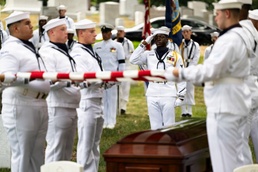
At Stoetzer’s funeral service in Section 31, a Navy firing party fired three volleys, a bugler sounded Taps, a Navy band played, and Chief Petty Officer Josua Waqa presented Barbara with the flag that had been draped over her husband’s casket. “I've seen it done many times before,” Barbara later said, reflecting on her time as an Arlington Lady. “I never thought it would be me.”
Cmdr. Raymond Stoetzer, who probed the depths of the ocean for his country, now rests safely beneath the sacred soil of the cemetery where he wanted to be, not far from the USS Thresher National Commemorative Monument.